MERCY CORPS INTERNATIONAL
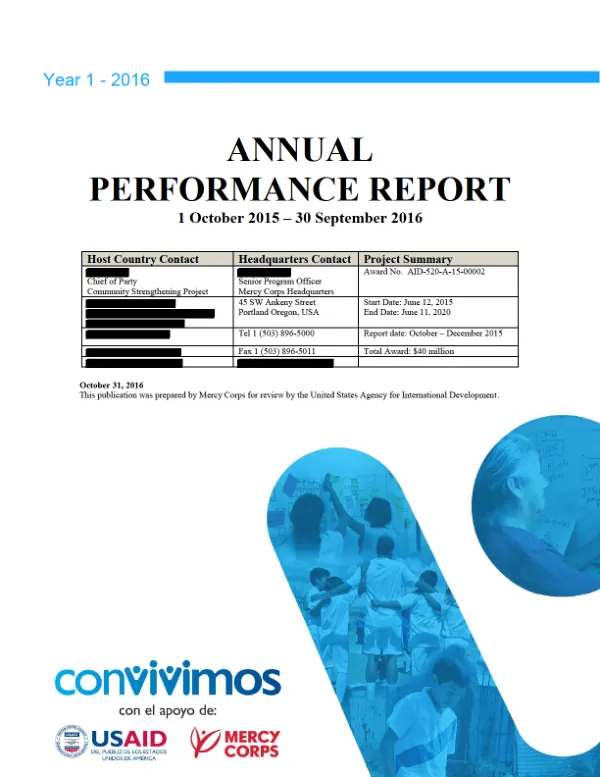
Final Report: Community Strengthening Project (Convivimos) in Guatemala
Crime and violence remain major concerns in Guatemala, with an annual homicide rate of 29.5 per 100,000 inhabitants, exceeding the global rate by almost five times.
2016 · 57 pages
Sign in to readA free account is required to download.
Abstract
The high and persistent insecurity is rooted in structural problems such as social exclusion and institutional weakness, and aggravated by organized crime, gangs, and corruption. Most of this violence concentrates in urban centers, affecting young people. The U.S. Agency for International Development (USAID) awarded funding to Mercy Corps to implement the Community Strengthening Project, also known as "Convivimos," which aims to contribute to Guatemala's goal of decreasing violence and promoting social and economic stability and prosperity. The project works in six municipalities with the highest crime rates nationwide, covering more than 80 urban neighborhoods and benefiting over half a million people. Convivimos has four complementary and mutually reinforcing objectives: supporting community commissions to institutionalize proven, integrated violence prevention projects; strengthening and mobilizing municipal and national stakeholders; supporting secondary prevention projects; and promoting and integrating evidence-based policy making among prevention actors. The project is based on the theory of change that improving individual, family, community, and government capacities will increase communities' resilience and make them safer and more secure. Mercy Corps implements Convivimos with the support of four national civil society organizations: FUNDAESPRO, Fé y Alegría, IEPADES, and FLACSO. The project contributes to USAID's first Development Objective for Guatemala, which aims to achieve greater security and justice for citizens and reduced levels of violence in target communities. It also supports the USAID Basic Education Earmark and the Central American Regional Security Initiative (CARSI) objectives. During the first year of the project (FY 2015-2016), the program developed activities in 48 communities, organized into 36 Community Violence Prevention Commissions (CVPCs), with the support of municipal governments, the national government, and civil society organizations. The creation of the CVPCs has been based on a participatory democratic process, promoting communication between neighbors, creating a sense of belonging, and strengthening social cohesion. The CVPCs became legitimate bodies to promote violence prevention in involved municipalities. Four municipalities already have a deep understanding of and commitment toward violence prevention, and are able to mobilize stakeholders to implement a range of programs and projects with regard to violence prevention in their territories. Community Violence Prevention Commissions are connected and working with local and municipal authorities to prevent violence, promoting positive and closer relationships between communities, local municipal authorities, municipal government teams, local public institutions, and civil society organizations. The project promotes the joint design and implementation of community projects and events, and has developed and implemented 31 Community Violence Prevention Plans, based on a participatory process in which CVPCs were trained and supported to elaborate these plans. The plans aim to address the root causes and consequences of violence through holistic prevention approaches, and are designed to be implemented by the CVPCs in collaboration with local and municipal authorities.
Related documents