WORLD VISION
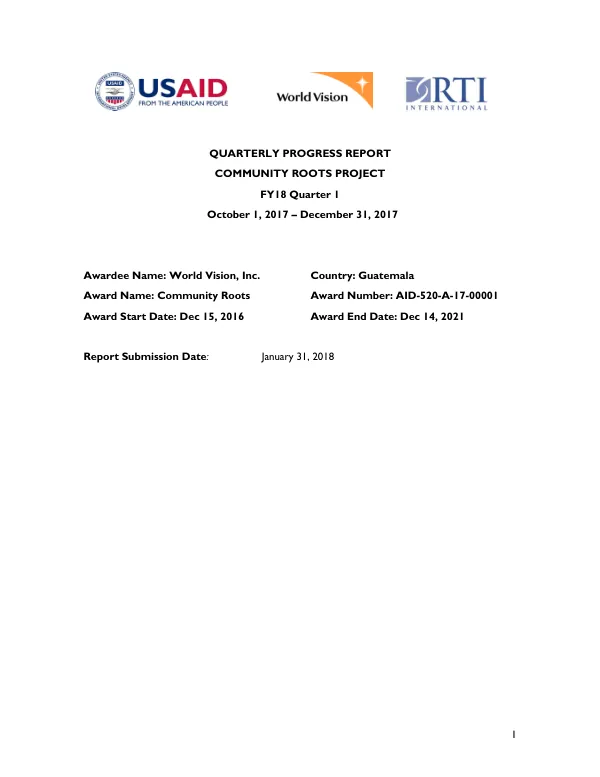
QUARTERLY PROGRESS REPORT COMMUNITY ROOTS PROJECT FY18 Quarter 1
The Community Roots Project is a USAID-funded initiative implemented by World Vision, Inc.
2018 · 41 pages
Sign in to readA free account is required to download.
Abstract
in Guatemala. The project aims to prevent violence and migration in target municipalities and communities. The project's main objectives are to strengthen and mobilize municipal and national stakeholders, promote private sector involvement, support secondary violence prevention projects, and develop municipal-level violence and migration prevention plans. Community certification and confirmation processes were a key focus during the first quarter of Fiscal Year 2018. Community Assemblies were held in proposed project intervention sites to present the project to community members and obtain local approval. These assemblies were attended by 22,827 individuals, and a total of 38 assemblies were held in Chiquimula, San Marcos, Quetzaltenango, and Huehuetenango. The project secured $47,221 in leverage through cash and in-kind donations from community and municipal participants. The project's implementation is guided by a Monitoring, Evaluation, and Learning (MEL) plan, which ensures that progress is tracked and lessons are learned. The MEL plan also facilitates coordination and collaboration among project stakeholders. The project has established partnerships with various organizations, including the Guatemalan Chamber of Agriculture, the Guatemalan Chamber of Industry, and the National Association of Municipalities. The project's activities are focused on developing municipal-level violence and migration prevention plans, promoting private sector involvement, and supporting secondary violence prevention projects. The project has made significant progress in these areas, with a total of 38 Community Assemblies held during the first quarter of Fiscal Year 2018. The project's efforts have also resulted in the mobilization of municipal and national stakeholders, as well as the development of partnerships with various organizations. The project's geographic focus is on the departments of Chiquimula, San Marcos, Quetzaltenango, and Huehuetenango. The project's timeframes are guided by the USAID funding cycle, with the current funding cycle running from December 15, 2016, to December 14, 2021. The project's recommendations for future implementation include continued community engagement and mobilization, as well as the development of partnerships with local organizations. The project's implementation is also guided by a gender considerations framework, which ensures that the project's activities are inclusive and responsive to the needs of women and girls. The project has established a coordination and collaboration mechanism to ensure that all stakeholders are engaged and informed throughout the implementation process. The project's monitoring and evaluation activities are designed to track progress and identify areas for improvement, ensuring that the project's objectives are met and its impact is maximized.
Related documents