USAID DEC
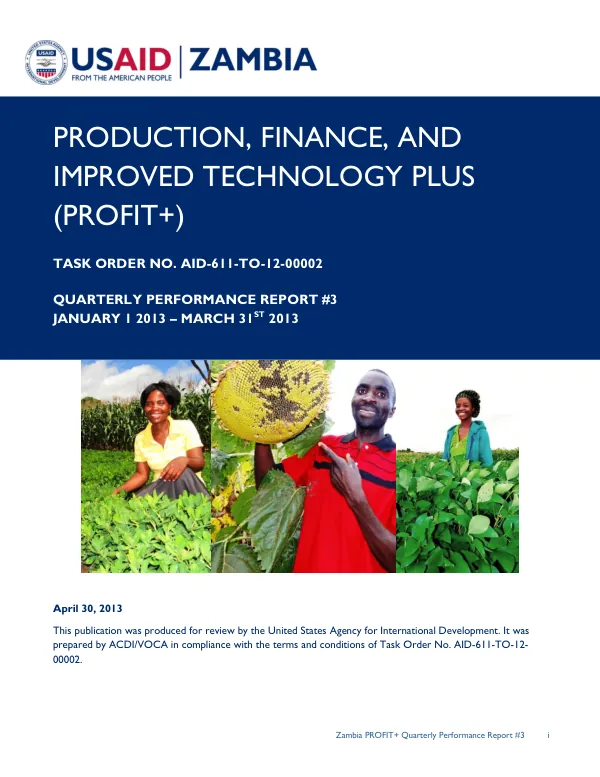
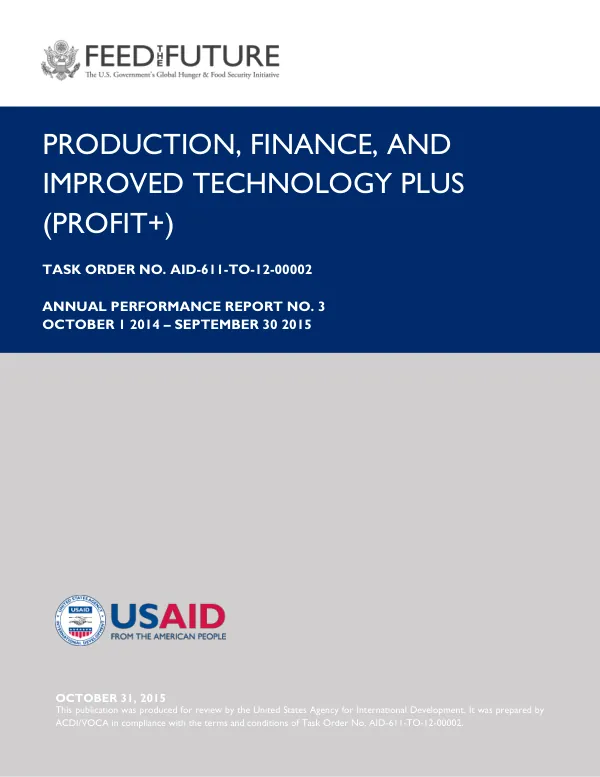
Annual Performance Report No.3: Production, Finance, and Improved Technology Plus (PROFIT+) Project in Zambia
Sign inACDI/VOCA
Annual Performance Report No.3: Production, Finance, and Improved Technology Plus (PROFIT+) Project in Zambia
The Production, Finance, and Improved Technology Plus (PROFIT+) project in Zambia aimed to improve productivity, expand trade, and increase investments by developing market systems in rural areas.
2015 · 46 pages
Sign in to readA free account is required to download.
Abstract
The project's objective was to facilitate stronger linkages to private sector service providers through public-private partnerships (PPPs), allowing for the permanent transfer of knowledge, services, and resources to farming communities. The project targeted six value chains: maize, groundnut, soybean, sunflower, onion, and tomato, and operated in Eastern Province and peri-urban Lusaka. The project's life of project (LOP) targets included increasing productivity and income of smallholders by 30 percent, reaching 180,000 smallholder farmers, achieving agricultural sales of $147 million, and generating between $10 and $30 million in private sector investment. In 2015, the project continued to take a facilitative approach, partnering with local and private sector entities to enable value chain actors to sustainably pursue market opportunities. The project enhanced the capacity of both established and emerging local partners, providing targeted technical assistance and investments to improve the quality of services. The project's behavior change and communication (BCC) strategy was utilized to gain an in-depth understanding of factors that contribute to technology adoption and practices, as well as the effects of technology on participants' livelihoods. Cross-cutting interventions ensured that gender equality efforts and environmental stewardship contributed to the project's intermediate results (IRs). The project's Year 3 achievements included increased productivity and income of smallholders, expanded markets and trade, and increased private sector investment in agriculture-related activities. The project also made significant progress in reaching its target of 180,000 smallholder farmers, with over 150,000 farmers reached in 2015. The project's monitoring and evaluation system tracked impact-enabling indicators such as investments, leverage, loans, trade, jobs, gender equality efforts, and environmental stewardship. Preliminary results from the 2015 Annual Outcome Survey (OS) showed positive outcomes in community capacity building and behavior change. The project's partnerships with local and private sector entities were critical to its success, with the Support for Food Security Activities (SFSA) Indefinite Quantity Contract (IQC) leading overall implementation of the project. The International Fertilizer Development Center (IFDC) provided support to selected IR 1.0 activities, while Catholic Relief Services (CRS) and Danya International contracts received a stop work order mid-way through Year 3. The project's operational areas in Eastern Province and peri-urban Lusaka were selected due to high poverty levels and proximity to markets, transportation, infrastructure, and complementary programs. The project's facilitative market-driven value chain approach enabled value chain actors to sustainably pursue market opportunities, while partnerships were the key element in the project's sustainability. The project's achievements in 2015 were significant, with increased productivity and income of smallholders, expanded markets and trade, and increased private sector investment in agriculture-related activities. The project's partnerships with local and private sector entities were critical to its success, and the project's facilitative market-driven value chain approach enabled value chain actors to sustainably pursue market opportunities.
Related documents