ACDI/VOCA
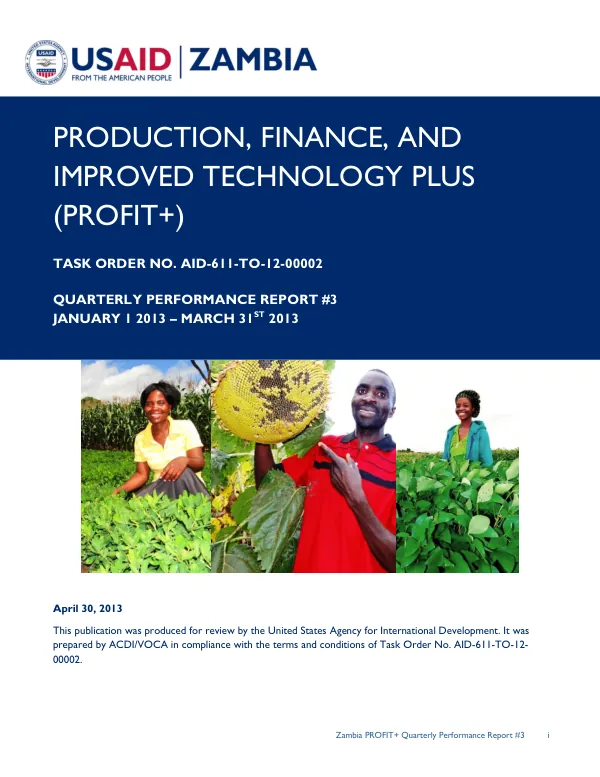
Zambia PROFIT+ Quarterly Performance Report #3
The Production, Finance, and Improved Technology Plus (PROFIT+) project in Zambia aims to improve smallholder productivity, expand markets and trade, and increase private sector investment in agriculture-related activities.
2013 · 40 pages
Sign in to readA free account is required to download.
Abstract
The project is funded by the United States Agency for International Development (USAID) and is implemented by ACDI/VOCA. The project's first quarter report covers the period from January 1, 2013, to March 31, 2013. During this period, significant progress was made on key activities. In the area of improved smallholder productivity, 8 field days were conducted with 1,120 smallholder farmers attending by March 2013. A horticulture demo plot strategy was developed, and the identification of farmer business agents commenced in March 2013. Additionally, the identification of 1,300 demo host farmers for the 2013/14 season began in March 2013. In the area of expanded markets and trade, a post-harvest aggregation assessment strategy was developed. An assessment of 56 cooperatives in Eastern Province was conducted, and 32 cooperatives were selected for collaborative activities. Training of trainers (TOTs) workshops were conducted for 133 trainers, and subsequent roll-out trainings were facilitated for 15,046 participants from the four target districts in the Eastern province. Market linkages were established with several private sector entities, including Nutri-Feed, Jungle Beat, and CARGILL, for groundnuts, soybeans, and sunflower value chains. The project also made progress in increasing private sector investment. Memoranda of understanding (MOUs) were developed or are in process with 11 private sector entities, 19 cooperatives, 20 agrodealers, 4 District Farmer Associations (DFA), and 3 District Women's Associations (DWAs). The Innovation, Investment & Partnership Fund (IIP) grants program was launched in March 2013, and the Annual Program Statement was developed. The initial call for concept notes was announced, and 19 concept notes were received and reviewed. In the area of access to finance, a blueprint and strategy were developed for implementing interventions to enhance and facilitate access to finance for smallholder farmers. Partnerships were established with major private sector stakeholders, including Jungle Beat, Cargill, and Dunavant, for input cost sharing initiatives. MOUs were developed to support the groundnuts and soybeans value chains. Partnerships were also established with major banks and microfinance establishments, including innovations and interventions to be funded under the USAID Development Credit Authority (DCA). The project also made progress in gender mainstreaming. A strategy was developed to ensure inclusion of women at all demo field days, Farmer Field Schools, Farmer Study Circles, and marketing activities. Over 9,000 women were reached through aflatoxin trainings, farmer field days, and trainings on gender equity at household level. A strategy document was developed to monitor gender mainstreaming at all levels of the project activities using the Women's Empowerment in Agriculture Index (WEAI) tool. In the area of environmental compliance, the Profit+ Environmental Review and Report (ERR) was approved. The project attended a USAID Climate Smart Agriculture workshop, and a PERSUAP assessment and draft report were completed. The project also made progress in monitoring and evaluation. Project beneficiaries were identified, and the Zone of Influence, which highlights areas for PROFIT+ interventions, was mapped in February. Initial PMP Indicators are under revision and to be submitted to USAID in April. Data entry templates, M&E field manuals, and questionnaires were developed and are awaiting field testing. Baseline Survey sample frames, roadmaps, and Statements of Work (SOW) for 600 households were completed. RALs dates were reviewed and incorporated into baseline survey. The project officially launched successfully in Eastern Province in March 2013, and 34 staff were employed in Chipata and Lusaka by March 2013. The project's dashboard shows progress against targets and indicators, with significant achievements in the areas of improved smallholder productivity, expanded markets and trade, and increased private sector investment.