TETRA TECH
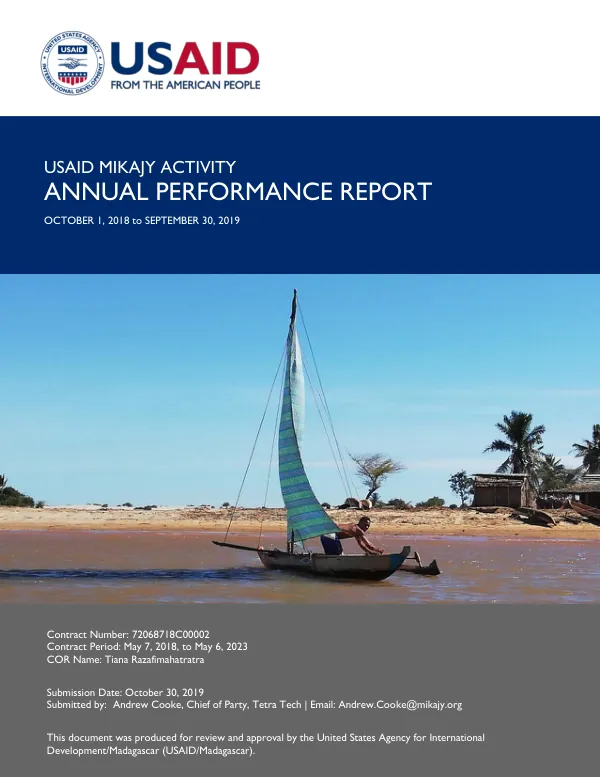
Annual Performance Report: USAID Mikajy Activity FY'2019
The USAID Mikajy Activity is a five-year program aimed at improving protected area and natural resource management in Madagascar.
2019 · 74 pages
Sign in to readA free account is required to download.
Abstract
The program, which began on May 7, 2018, and will conclude on May 6, 2023, is funded by the United States Agency for International Development (USAID) and implemented by Tetra Tech. The program's strategic approach is divided into five key components: working with communities, NGOs, and government to improve protected area and natural resource management; supporting community-based and conservation-friendly enterprises and livelihoods; synergizing with development programs delivering services to target communities; operationalizing decentralized natural resource governance in target land and seascapes; and strengthening community capacity, CSO, private sector, and government capacity to advocate for and engage on improved community-based land and natural resource management. During the first year of the program, significant progress was made in all five strategic approaches. In the first approach, the program worked with communities, NGOs, and government to improve protected area and natural resource management. Achievements included the establishment of 15 community-based natural resource management committees and the development of a natural resource and governance tool. Challenges encountered included resistance from some community members and limited government support. However, the program was able to contribute to project impact by improving community engagement and participation in natural resource management. In the second approach, the program supported community-based and conservation-friendly enterprises and livelihoods. Achievements included the establishment of 10 community-based enterprises and the provision of training and technical assistance to 200 community members. Challenges encountered included limited access to markets and limited government support. However, the program was able to contribute to project impact by improving community livelihoods and promoting conservation-friendly practices. The third approach focused on synergizing with development programs delivering services to target communities. Achievements included the establishment of partnerships with 10 development programs and the provision of technical assistance to 500 community members. Challenges encountered included limited coordination and communication among partners. However, the program was able to contribute to project impact by improving community access to services and promoting community resilience. The fourth approach focused on operationalizing decentralized natural resource governance in target land and seascapes. Achievements included the development of a decentralized natural resource governance framework and the establishment of 10 decentralized natural resource governance committees. Challenges encountered included limited government support and limited community engagement. However, the program was able to contribute to project impact by improving community participation in natural resource management and promoting decentralized governance. The fifth approach focused on strengthening community capacity, CSO, private sector, and government capacity to advocate for and engage on improved community-based land and natural resource management. Achievements included the establishment of 10 community-based advocacy groups and the provision of training and technical assistance to 200 community members. Challenges encountered included limited government support and limited community engagement. However, the program was able to contribute to project impact by improving community advocacy and engagement on natural resource management issues. Cross-cutting issues addressed by the program included climate change, gender, youth, and health. The program worked to address these issues through a range of activities, including the development of climate-resilient natural resource management plans and the provision of training and technical assistance to community members on climate change adaptation and mitigation. The program also prioritized collaboration, learning, and adaptation. The program worked to build partnerships with a range of stakeholders, including government agencies, NGOs, and community groups. The program also prioritized learning and adaptation, using lessons learned from the first year to inform program activities and improve program impact. In terms of coordination, the program worked closely with a range of partners, including USAID Hay Tao and the United States Forest Service. The program also worked to ensure that all activities were aligned with USAID's goals and objectives. The program also provided grants to community-based organizations and enterprises, with a total of $1.5 million awarded in the first year. The program also identified targets of opportunity, including the development of community-based natural resource management plans and the establishment of community-based enterprises. Finally, the program identified best practices for scale, including the use of community-based natural resource management committees and the provision of training and technical assistance to community members. The program also recognized the importance of collaboration, learning, and adaptation in achieving program impact. Annex I of the report provides an indicator performance tracking table, which summarizes the program's progress against key indicators. Annex II provides success stories from the first year of the program, highlighting the achievements and impact of the program's activities. Annex III provides information on the program's environmental and climate risk management compliance, including the program's efforts to reduce greenhouse gas emissions and promote sustainable natural resource management practices. Annex IV provides an organizational chart of the program, highlighting the program's structure and key personnel.