JOHN SNOW INTERNATIONAL
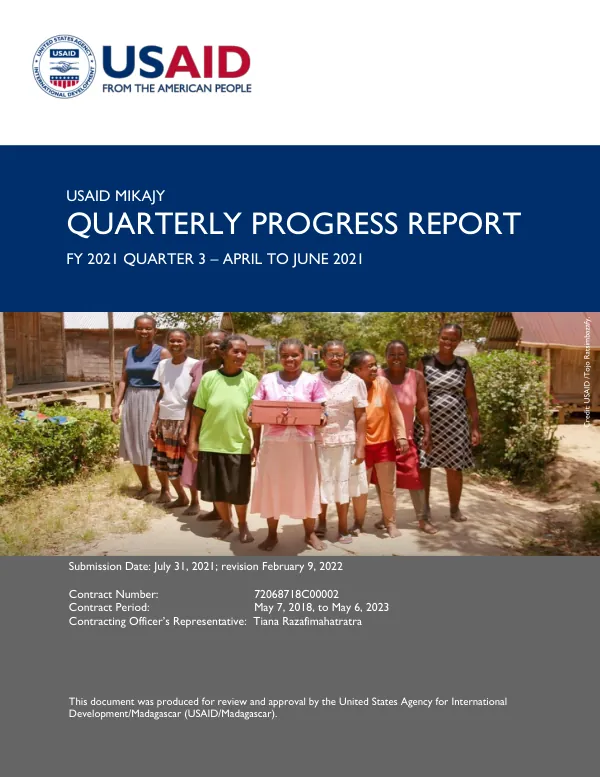
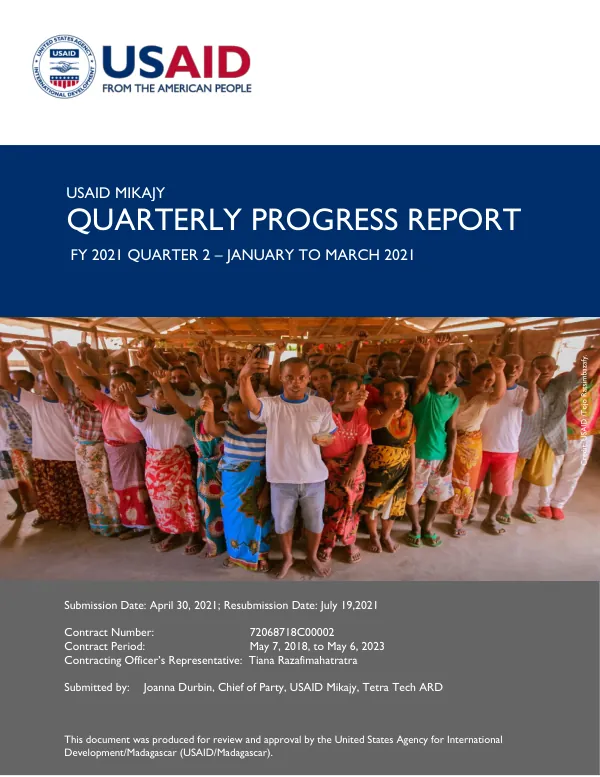
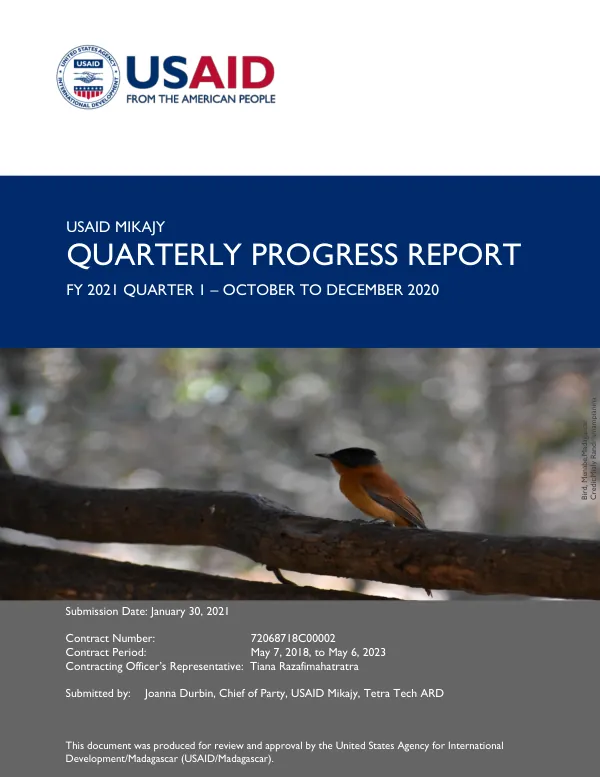
USAID Mikajy FY19 Q3 Progress Report
The USAID Mikajy Activity is a five-year project implemented by Tetra Tech, with a contract period from May 7, 2018, to May 6, 2023.
2019 · 72 pages
Sign in to readA free account is required to download.
Abstract
The project is funded by the United States Agency for International Development (USAID) and aims to improve the livelihoods of rural communities in Madagascar through sustainable natural resource management and economic development. The project focuses on five strategic approaches: Nature, Wealth, Resilient Communities, Action, and Power. The project's geographic focus is on the Menabe and Makira-Masoala-Bay of Antongil (MaMaBay) regions, where it works with local communities, government agencies, and other stakeholders to promote sustainable forest management, conservation, and economic development. The project's implementation is guided by a comprehensive scope of work (SOW) that outlines the specific objectives, activities, and indicators for each strategic approach. The project's progress is monitored and evaluated through a robust monitoring, evaluation, and learning (MEL) system, which tracks key performance indicators (KPIs) and provides regular updates to stakeholders. The project's quarterly progress reports, such as this one, provide a detailed account of the project's achievements, challenges, and lessons learned. In the Menabe region, the project has made significant progress in promoting sustainable forest management and conservation. The project has established a network of community-based natural resource management (CBNRM) groups, which are responsible for managing and protecting the region's natural resources. The project has also supported the development of a climate risk management plan (CRMP) for the region, which aims to reduce the impacts of climate change on local communities. In the MaMaBay region, the project has focused on promoting sustainable agriculture and economic development. The project has established a network of farmer organizations, which provide training and support to local farmers on sustainable agriculture practices. The project has also supported the development of a value chain for sustainable forest products, which aims to promote the production and trade of sustainable forest products. The project has also made significant progress in promoting gender equality and youth empowerment. The project has established a gender working group, which aims to promote gender equality and women's empowerment in the project's implementation. The project has also supported the development of a youth empowerment program, which aims to promote the skills and capacities of young people in the project's target areas. Overall, the USAID Mikajy Activity has made significant progress in promoting sustainable natural resource management and economic development in Madagascar. The project's achievements and lessons learned will inform future development initiatives in the region and contribute to the achievement of the Sustainable Development Goals (SDGs). The project's implementation is guided by a comprehensive scope of work (SOW) that outlines the specific objectives, activities, and indicators for each strategic approach. The project's quarterly progress reports, such as this one, provide a detailed account of the project's achievements, challenges, and lessons learned. In the next quarter, the project plans to continue its implementation of the strategic approaches, with a focus on promoting sustainable forest management and conservation in the Menabe region. The project will also continue to support the development of a climate risk management plan (CRMP) for the region, which aims to reduce the impacts of climate change on local communities. The project's achievements and lessons learned will inform future development initiatives in the region and contribute to the achievement of the Sustainable Development Goals (SDGs).