DAI GLOBAL, LLC
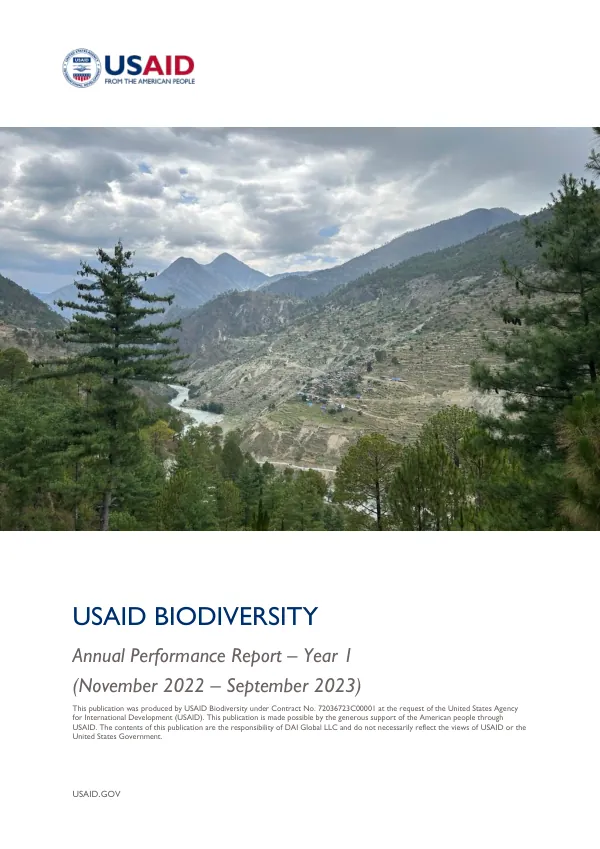
Annual Performance Report – Year 1 (November 2022 – September 2023)
USAID Biodiversity (Jal Jangal) is a program aimed at supporting local communities and conservation practitioners while strengthening the capacity of provincial and municipal governments in Nepal.
2023 · 47 pages
Sign in to readA free account is required to download.
Abstract
The program focuses on biodiversity conservation, natural resource management, and climate change adaptation. A collaborative approach is adopted, working closely with community stakeholders, conservation partners, government entities, academic institutions, the private sector, civil society, and media outlets. The program's foundational activities in the first year of implementation centered on developing critical partnerships, gathering baseline information, and laying the groundwork for collaboration with the Ministry of Forests and Environment (MOFE). To ensure full engagement with the Government of Nepal (GoN), USAID Biodiversity formed a Project Steering Committee (PSC) and a Project Working Group (PWG). The team convened three PWG meetings and held four provincial-level co-design workshops in Dhangadhi, Pokhara, Surkhet, and Kathmandu. Multistakeholder dialogues were held in 12 critical Local Governments (LGs) across four landscapes to promote gender, equity, and social inclusion (GESI) within natural resource management issues. The team also held consultations with national parks and forest management authorities, provincial forest and environment ministries, LGs, federations, community organizations, and river-dependent communities to verify needs and priorities related to forests, freshwater, and biodiversity conservation. Critical foundational documents were developed and approved by USAID, including the Year 1 Work Plan, Monitoring, Evaluation and Learning (MEL) Plan, Grants Under Contract Manual, Branding Implementation and Marking Plan, and the GESI Analysis Report and Action Plan. The GESI Analysis Report and Action Plan provides a roadmap for mainstreaming GESI while implementing USAID Biodiversity activities. Operationally, the team established and staffed a main office in Kathmandu and a provincial office in Dhangadhi, with a team of 15 staff members, including a Country Director, a Deputy Country Director, a Program Manager, and several program officers. The team also established a robust communication and outreach strategy, including a website, social media platforms, and a quarterly newsletter. The program's geographic focus is on four landscapes in Nepal: the Terai Arc Landscape, the Chitwan Annapurna Conservation Landscape, the Karnali Conservation Landscape, and the Kailash Sacred Landscape. The program's timeframes are from November 2022 to September 2023, with a total budget of $10 million. The program's implementation details include the establishment of a Project Steering Committee (PSC) and a Project Working Group (PWG), the development of critical foundational documents, and the establishment of a robust communication and outreach strategy. The program's key findings and methodologies include the development of critical partnerships with government entities, conservation partners, and community stakeholders, the gathering of baseline information, and the establishment of a robust communication and outreach strategy. The program's conclusions and recommendations include the need for continued collaboration and partnership-building, the importance of mainstreaming GESI, and the need for a robust communication and outreach strategy. The program's implementation details for projects and programs include the establishment of a main office in Kathmandu and a provincial office in Dhangadhi, the development of critical foundational documents, and the establishment of a robust communication and outreach strategy. The program's geographic focus is on four landscapes in Nepal, and the program's timeframes are from November 2022 to September 2023.
Related documents