DAI GLOBAL, LLC
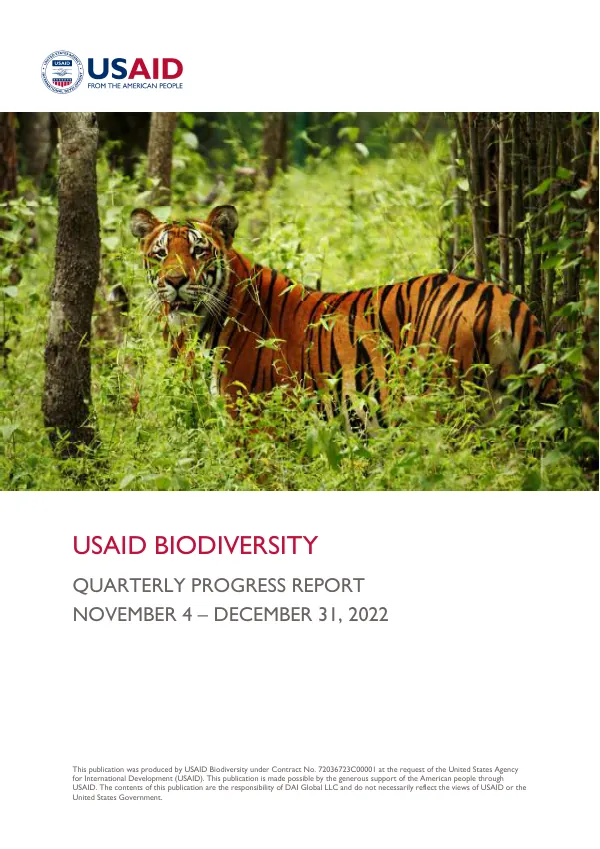
USAID Biodiversity Quarterly Progress Report November 4 – December 31, 2022
USAID Biodiversity's focus during the first quarter of 2023 was on critical start-up operations and start-up technical deliverables.
2023 · 15 pages
Sign in to readA free account is required to download.
Abstract
Recruitment efforts were prioritized, with the successful onboarding of three key personnel: the Chief of Party, Deputy Chief of Party, and Gender Equity and Social Inclusion (GESI) Director. Additionally, short-term assistance was mobilized to facilitate start-up activities, including a Start-up Manager, Start-up Procurement Specialist, and Start-up Recruitment Specialist. Office space was a critical procurement, with USAID Biodiversity identifying temporary office space in Kathmandu and signing a two-month short-term lease by mid-December. Vehicles were assessed from the USAID PAANI Program and the USAID Hariyo Ban Program for disposition to USAID Biodiversity, as advised by USAID. Four institutional subcontractors were identified: Asia Network for Sustainable Agriculture and Bioresources (ANSAB) Nepal, Center for Molecular Dynamics Nepal (CMDN), Rupantaran Nepal, and TRAFFIC International. Senior management conducted initial consultation meetings with key partners, informing draft subcontracts for the four institutional subcontractors. By the end of the quarter, USAID granted consent to subcontract for ANSAB, CMDN, and Rupantaran Nepal, with DAI preparing a revised consent to subcontract request for TRAFFIC International. Technical activities during the quarter included landscape prioritization and site selection. Discussions with USAID/Nepal and stakeholders will continue into the second quarter and will be finalized after the Year 1 multi-stakeholder co-design joint work planning workshops. Planning for the Co-design Workshop in Q2 will inform several technical deliverables, including the Year 1 Annual Work Plan, Monitoring, Evaluation and Learning (MEL) Plan, Literature review and Terms of Reference for the Political Economy Analysis (PEA) report, Gender Equality and Social Inclusion (GESI) Analysis, and GESI Action Plan. The primary purpose of USAID Biodiversity is to reduce multiple threats to ecosystem and wildlife species to conserve nature, enhance human well-being, and safeguard the future. The Activity will achieve measurable conservation targets within the biodiversity-rich, terrestrial, and freshwater ecosystems, while increasing resilience to climate change and contributing to the inclusive and sustainable development of the Nepali people. To accomplish this, USAID Biodiversity will implement activities aligned with three mutually interrelated and reinforcing objectives: improve the health of ecosystems (Objective 1), strengthen environmental crime control and natural resource safeguards (Objective 2), and enhance the climate resilience of natural and human ecosystems (Objective 3). The Activity will be implemented in the Government of Nepal's (GON) four existing or proposed conservation landscapes: Kailash Sacred Landscape, proposed Karnali Conservation Landscape, Chitwan Annapurna Landscape, and the Terai Arc Landscape. The main office will be located in Kathmandu, with three proposed field offices in Dhangadhi, Surkhet, and Pokhara, and satellite offices in the high mountain areas (TBD). Key technical activities in Q1 included convening the Project Steering Committee, landscape and site selection, and delineating landscapes by March 31. Discussions with USAID agreed on broader criteria for landscape prioritization and site selection, including biodiversity hotspots, Ramsar sites, priority aquatic species habitats, and human-wildlife conflict hotspots. Finalization of the delineation of landscapes is expected by the end of Q2, with the selection of target sites within the landscapes to be finalized by June 30.
Related documents