CARE
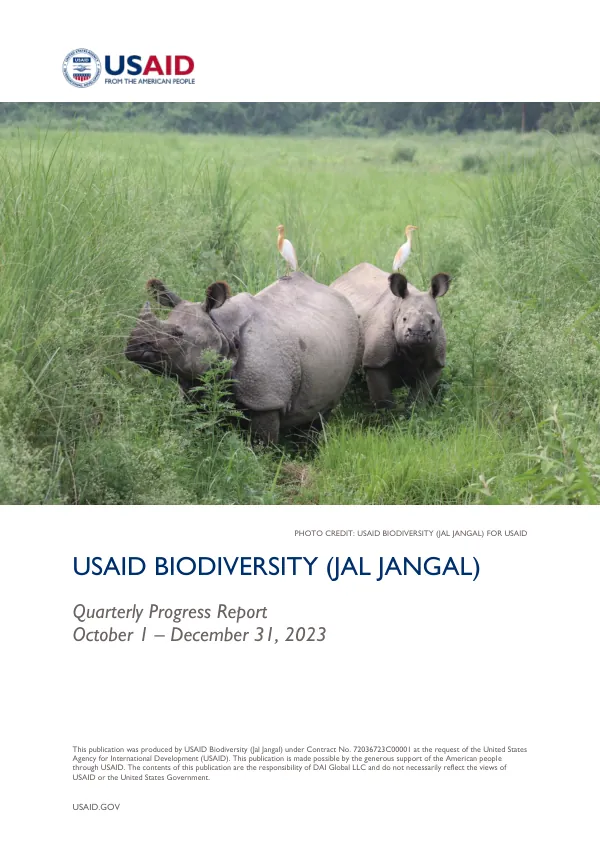
Quarterly Progress Report: October 1 – December 31, 2023
The USAID Biodiversity (Jal Jangal) program is a flagship initiative of USAID/Nepal aimed at promoting biodiversity conservation and sustainable natural resource management in Nepal.
2024 · 41 pages
Sign in to readA free account is required to download.
Abstract
The program is implemented by DAI Global, LLC under Contract No. 72036723C00001. The program's primary objective is to improve health and ecosystems in targeted landscapes, strengthen environmental crime control and natural resource safeguards, and enhance climate resilience of natural and human systems. During the first quarter of Year Two (Y2 Q1), the program achieved several key milestones. The activity finalized various foundational deliverables, including the baseline survey, the Gender, Equity, and Social Inclusion (GESI) Strategy and Action Plan, and the Political Economy Analysis (PEA) strategy. The program also reviewed 212 concept notes received in response to the first Annual Program Statement (APS) and shortlisted 34 concepts for full proposals. The team is in the process of finalizing grant awards. The program supported three local governments in developing Aquatic Animal and Biodiversity Conservations (AABC) Bills and Environment Protection Bills. Additionally, the activity is supporting the preparation of the Second Five-Year Plan and Forest Regulation of Gandaki Province, the formulation of the Rangeland Management Strategy and Action Plan, and the revision of the Climate Change Strategy and Action Plan of Karnali Province. Capacity development was a key focus area during the quarter, with the program organizing capacity development programs for government staff, community, and environmental journalists. Center for Molecular Dynamics Nepal (CMDN) organized three training events for national park staff, lab technicians, and members of judiciary covering field sample collection, lab analysis, presenting evidence in the court, and maintaining chain of custody. The program also led a training on climate change adaptation and biodiversity conservation for four local governments of Sudurpashchim Province. Private sector engagement was another key area of focus, with the program conducting a business roundtable on bridging business and biodiversity for a climate-resilient future. The activity also supported two indigenous women entrepreneurs to participate in the Nepal International Trade Fair, where they successfully sold local non-timber forest products-based handicraft products worth NPR.165,000 (USD 1,241). The program organized seven multistakeholder dialogue events in Gandaki, Sudurpashchim, and Karnali Provinces to better understand natural resource management (NRM) issues as they relate to GESI and to find collective solutions to address these challenges. Monitoring, evaluation, and learning (MEL) was also a key focus area, with the program developing critical foundational documents, including its baseline survey and data analysis report, which was approved by USAID. The team also developed, reviewed, and finalized indicator-based data collection tools through a MEL workshop and digitalized the tools in DAI Collect, an open-source data collection software. The program's efforts have been recognized by local communities, with Shrijana Khadka, a female representative of a local community forest, stating that the program has enlightened her about the importance of protecting natural resources and the need for local governments to prioritize creating laws and policies that regulate the proper usage of natural resources by communities. Ram Bahadur Kathi, Deputy Chairperson of Thalara Rural Municipality, Bajhang, also committed to reducing wildlife crime in his municipality and implementing policies related to this issue, with the support of USAID Biodiversity (Jal Jangal) expertise.