USAID DEC
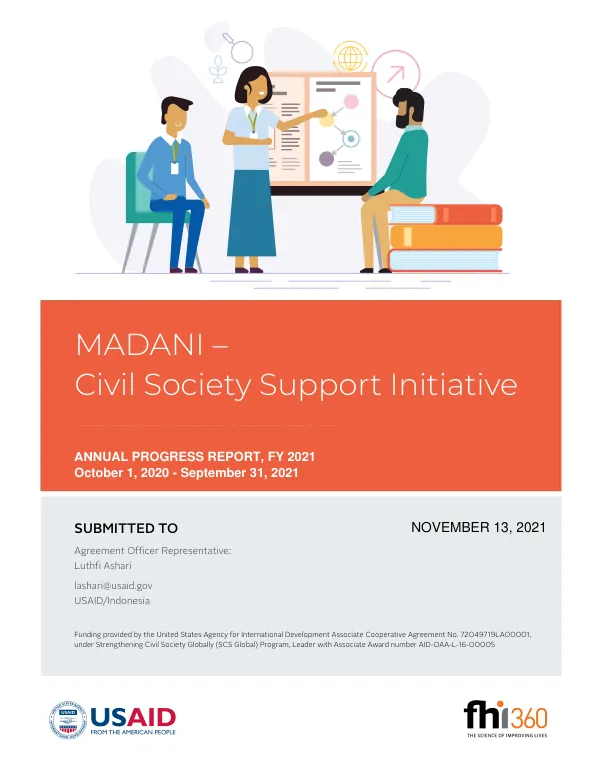
Annual Progress Report, FY 2021: MADANI – Indonesia Civil Society Support Initiative
Sign inFHI 360
Annual Progress Report, FY 2021: MADANI – Indonesia Civil Society Support Initiative
The USAID/Indonesia MADANI Civil Society Support Initiative (MADANI) aims to strengthen the capacity of local civil society organizations (CSOs) to advocate for government accountability and tolerance in their communities.
2021 · 58 pages
Sign in to readA free account is required to download.
Abstract
The initiative operates in 32 districts across six provinces in Indonesia, including Banten, East Java, South Sulawesi, West Kalimantan, West Java, and Central Java. MADANI's program objective is to enable local CSOs to become leaders in their districts, building partnerships with local government and the private sector to address key development challenges. MADANI collaborates with 32 Lead Partner (LP) organizations, providing them with technical assistance, financial support, and opportunities to participate in Learning Forums. These multi-stakeholder forums bring together CSOs, local government officials, the private sector, and community leaders to strengthen CSOs' advocacy on government accountability and communal tolerance. During FY21, MADANI implemented its program as scheduled, despite the challenges posed by the ongoing COVID-19 pandemic. MADANI's investments in CSOs' capacity, legitimacy, and sustainability have begun to yield real progress on its objectives. One key outcome is that MADANI's partners have operationalized elements of organizational accountability to a promising degree. MADANI provided advanced technical assistance on organizational development topics and coached Lead Partners to develop and operationalize relevant policies and procedures. As a result, 22 out of 32 local partners have improved leadership, management, and results, while 31 out of 32 have improved their organizational performance. These activities have contributed to the project's overarching goal of strengthening government accountability and communal tolerance at the local level. MADANI's emphasis on collaborative governance has proved effective in sparking a new openness and willingness among local government counterparts to build new partnerships. The initiative has also led to increased organization capacity among MADANI partners, enabling them to become more effective advocates for government accountability and communal tolerance. MADANI's approach has been successful in building partnerships among CSOs, local government, media, and the private sector. The Learning Forums have provided a platform for locally-identified issues to be addressed, and resources and relationships have been mobilized to demonstrate a commitment by various stakeholders. The initiative's focus on collaborative governance has helped to create a more inclusive development model, where local voices are valued. In terms of overall proof of concept of the theory of change, expected results are being met, demonstrating the relevance of the project and the effectiveness of its approach. MADANI's investments in CSOs' capacity, legitimacy, and sustainability have begun to yield real progress on its objectives, with several key outcomes to report. The initiative's emphasis on collaborative governance has proved effective in sparking a new openness and willingness among local government counterparts to build new partnerships. MADANI's program has been successful in improving the organizational capacity of its partners, enabling them to become more effective advocates for government accountability and communal tolerance. The initiative's focus on collaborative governance has helped to create a more inclusive development model, where local voices are valued. The Learning Forums have provided a platform for locally-identified issues to be addressed, and resources and relationships have been mobilized to demonstrate a commitment by various stakeholders.