USAID DEC
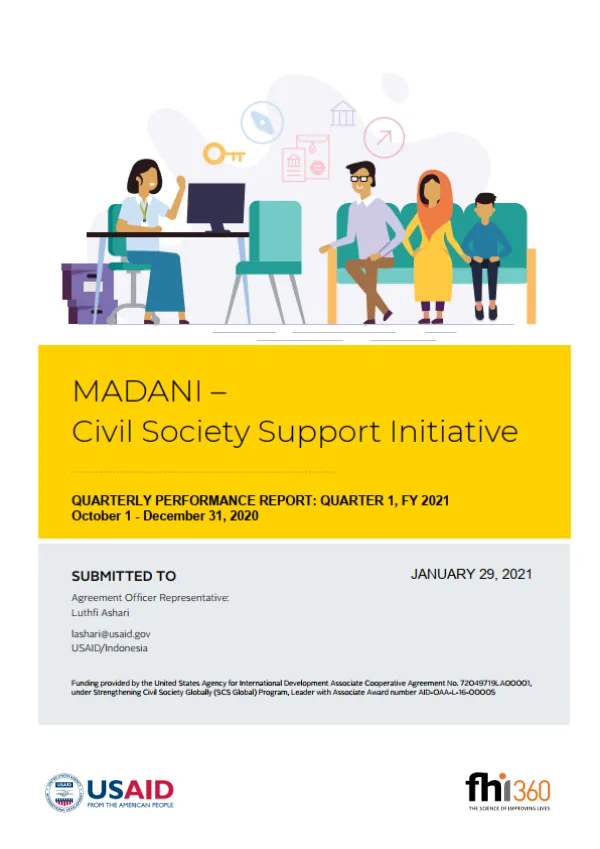
MADANI – Indonesia Civil Society Support Initiative Quarterly Performance Report, Q1 FY 2021
Sign inFHI 360
MADANI – Indonesia Civil Society Support Initiative Quarterly Performance Report, Q1 FY 2021
The MADANI Civil Society Support Initiative, funded by the U.S.
2021 · 45 pages
Sign in to readA free account is required to download.
Abstract
Agency for Development (USAID) for the five-year period of 2019 to 2024, and implemented by FHI 360 in Indonesia, worked toward the project's goal of improving the ability of civil society organizations (CSOs) to advocate for government accountability and communal tolerance. During the October–December 2020 quarter, MADANI continued to build the effectiveness and efficiency of its partner CSOs through training and technical assistance (TA) to improve local CSOs' legitimacy and increase CSO sustainability. MADANI's Primary Accomplishments in Q1 FY 2021 included launching its full pathway toward achieving its results framework and development outcomes. The project is now starting to see results in the form of improved capacity and changes in behavior and outcomes, forming a proof of concept that its modalities are effective. The increasing capacity and legitimacy of MADANI's Lead Partners is leading them to produce improvements and social change throughout their home districts. Improved Organizational Capacities were achieved through advanced organizational development trainings provided by a consortium led by PT. Remdecotama Swaprakarsa (ReMDeC) to an initial 24 Lead Partners. Support for each organization included introducing customized standard operating procedures (SOPs) in financial management, procurement, and human resource management. This training helped Lead Partners improve their literacy about organizational procedures and develop a more mature organizational structure. Improved Collaboration with Stakeholders was achieved through the establishment of new forums for collaboration and the exploration of opportunities for collaborative governance in target districts. MADANI's Lead Partners are now better equipped to engage with stakeholders and build stronger relationships with local communities. Improved Ability to Advocate for Government Accountability and Community Tolerance was achieved through the provision of training and technical assistance to Lead Partners on how to effectively advocate for government accountability and community tolerance. This training helped Lead Partners develop the skills and knowledge necessary to effectively advocate for their communities and promote social change. MADANI's progress in fostering CSO capacity development at the national level was also significant. The project's Lead Partners are now more effective in addressing core issues and improving their organizational capacities. This progress is a result of the project's focus on building the capacity of Lead Partners and providing them with the necessary tools and resources to achieve their goals. In terms of monitoring and evaluation, communications, outreach, and engagement, MADANI made significant progress in Q1 FY 2021. The project's Monitoring, Evaluation, and Learning (MEL) system was strengthened, and the project's communications and outreach efforts were expanded to reach a wider audience. The project's engagement with stakeholders was also improved, with a focus on building stronger relationships with local communities and promoting social change. Overall, MADANI's progress in Q1 FY 2021 was significant, with improvements in organizational capacities, collaboration with stakeholders, and the ability to advocate for government accountability and community tolerance. The project's focus on building the capacity of Lead Partners and providing them with the necessary tools and resources to achieve their goals has paid off, and the project is now starting to see results in the form of improved capacity and changes in behavior and outcomes.