USAID DEC
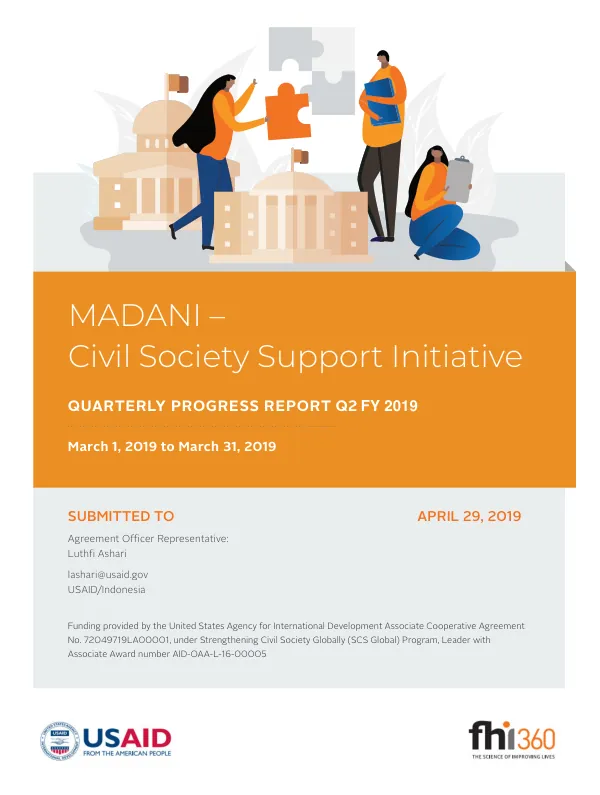
MADANI – Indonesia Civil Society Support Initiative Quarterly Report: March 1 – March 31, 2019
Sign inFHI 360
MADANI – Indonesia Civil Society Support Initiative Quarterly Report: March 1 – March 31, 2019
The MADANI Civil Society Support Initiative is a five-year, $19.8 million, USAID-funded initiative implemented by FHI 360 to strengthen local government accountability and promote communal tolerance in Indonesia.
2019 · 16 pages
Sign in to readA free account is required to download.
Abstract
The initiative aims to improve and sustain local civil society's capacity, legitimacy, and sustainability in 32 districts in eight provinces. By the end of the initiative, these "proof of concept" models will be replicated in an additional 32 districts. MADANI works toward its vision by providing grants and technical assistance directly to targeted subnational civil society organizations (CSOs) in the identified districts. The initiative prioritizes district-level activities because the national and community levels have received strong support and attention through previous donor programs. MADANI's vision is to leave Indonesia a better functioning, more tolerant, and more resilient democracy, demonstrated by strengthened local democratic practices, improved local government performance and responsiveness, better accountability of frontline service delivery, and more effective and inclusive mechanisms for district-level participation, oversight, and transparency. During the first month of operation, March 2019, the main outputs and achievements included the recruitment of 12 national office staff, who will start in April and May. The Chief of Party (COP) and Deputy Chief of Party (DCOP) were inducted, and negotiations for a new office space at Setiabudi Atrium were finalized, with a planned relocation in September 2019. A call for Expressions of Interest was drafted for the design of the Innovation and Knowledge Hub (iHub) and the Directory of Capacity Building. Terms of reference were drafted for two consultants to conduct a desk review of government and civil society data and indexes to develop the MADANI district shortlist. MADANI's Tax ID number was obtained, and a request for an expat COP work permit was prepared to be submitted to the Ministry of Law and Human Rights. The FY 2019 Implementation Plan was drafted for submission on April 15, and the first draft of the Activity Monitoring, Evaluation, and Learning (AMEL) Plan was completed, to be submitted on May 20. These outputs and achievements are part of the start-up and mobilization activities carried out during the first month of operation, and they lay the foundation for the implementation of the initiative's activities in the coming months. The development hypothesis is that if the organizational and technical capacity of civil society groups at the local level increases, it will lead to improved local government accountability and communal tolerance in Indonesia. By the end of the initiative, these "proofs of concept" models will be replicated in an additional 32 districts, demonstrating the effectiveness of the initiative's approach.