AFRICAN BIODIVERSITY COLLABORATIVE GROUP
Workshop Report: ABCG Mining & Biodiversity in DRC
The Democratic Republic of Congo (DRC) is known for its wealth and diversity of minerals, including diamonds, gold, copper, and cobalt.
2013 · 21 pages
Sign in to readA free account is required to download.
Abstract
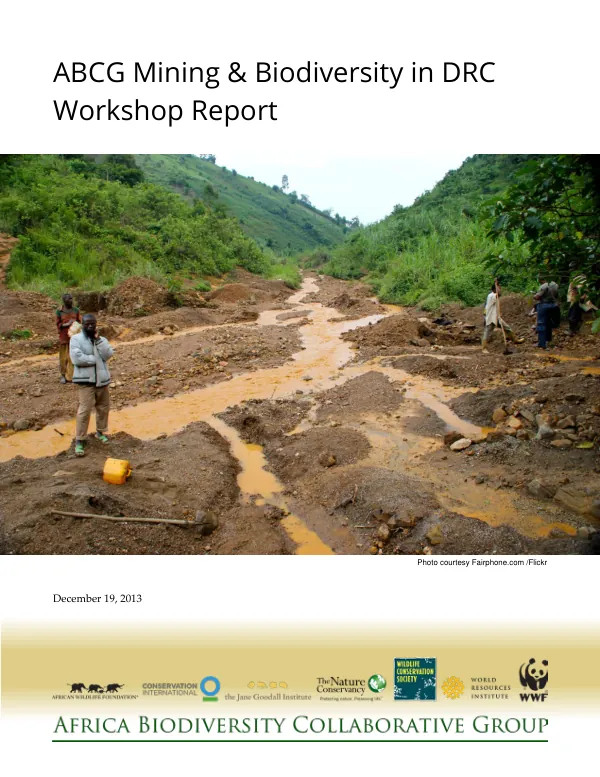
The mining sector is considered a principal development path capable of moving the DRC out of economic stagnancy. A 2008 sector-based study conducted by the World Bank estimated that the mining sector could contribute $5 billion to the gross national product (GNP) in DRC, representing more than 50% of the current GNP and potential fiscal revenues of $730 million within the period 2013-2017. However, a century of intensive mining activities throughout much of DRC has produced many negative impacts on its environment, most directly through the degradation and destruction of some of the world's most diverse and irreplaceable natural habitats. Mining activities have also provoked the loss of biodiversity through associated over-hunting and poaching. The opening of prospecting activities in previously inaccessible regions attracts human populations, and local water, protein, or staple crops often cannot support these new residents. Extraction methods similarly degrade ecosystem services, including pollution of watercourses from suspended silt and groundwater from heavy metals. The clearest example in DRC's recent history of mining's deleterious impacts on biodiversity may be from the coltan boom era from 2000-2002. The spike in coltan value was caused by a perceived global shortage of this precious metal, which was highly sought after for its function in electrical capacitors. Some figures declared that 75% of the world's coltan reserves were located within Kahuzi-Biega National Park. This figure is similar to the proportion of the KBNP's eastern lowland gorilla population. During this war period, artisanal miners flooded into the park, scooping up coltan by the bucket full and eating all of the local wildlife, including this threatened subspecies of gorilla. The final impact was measured in a 75% reduction in eastern gorilla populations while elephants were all but wiped out. The Wildlife Conservation Society (WCS) working in collaboration with other partners from the Africa Biodiversity Collaborative Group (ABCG) held a strategic and technical workshop designed to review and build responses to these and other threats to biodiversity and ecosystem services from poorly regulated mining and mineral extractions in DRC. The workshop entitled "Mitigating the Impacts from Mining in the DRC: Workshop on Strategy and Practice" was carried out in DRC's capital, Kinshasa on June 13-14, 2013. The workshop was organized by ABCG's Mining and Biodiversity in DRC working group, which is comprised of the following ABCG partners: Wildlife Conservation Society (WCS), World Wildlife Fund (WWF), Conservation International (CI), and World Resources Institute (WRI). The overall objective of the workshop was to identify and promote the adoption of best practices in DRC's mining sector in order to mitigate negative impacts on biodiversity and ecosystem service values. The overall results and deliverables from the workshop include increased awareness of international standards for best practices in mining and biodiversity, a review of case studies of results from the application of the mitigation hierarchy in the mining sector, and identification of opportunities to strengthen the mitigation of biodiversity impacts through social and environmental assessments mechanisms. The workshop featured 18 technical presentations, followed by facilitated discussion to formulate specific recommendations. The main themes of this workshop were technical in nature, and included the following key dialogues: the mining sector in DRC, threat to World Heritage Sites, and the Africa Biodiversity Conservation Group (ABCG). The Ministry of Mines introduced the justification for this workshop and its objectives, highlighting the need to balance economic development with environmental conservation. A UNESCO representative evaluated the risks to DRC's World Heritage Sites due to armed conflict, poaching, and mining activities, emphasizing the need for strong governance measures to prevent negative impacts within protected areas and World Heritage Sites. The ABCG initiative was presented to provide participants with an understanding of its overall themes and the specific focus on "Mining and Biodiversity in DRC" activities.
Related documents