USAID
Report on Engaging Indigenous Peoples for CARPE
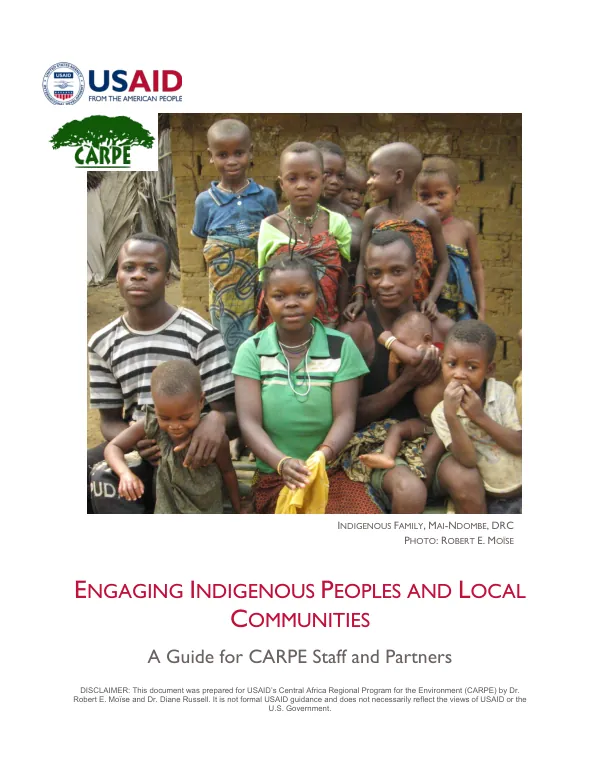
The Central Africa Regional Program for the Environment (CARPE) initiatives aim to engage Indigenous Peoples (IPs) in conservation efforts.
57 pages
Sign in to readA free account is required to download.
Abstract
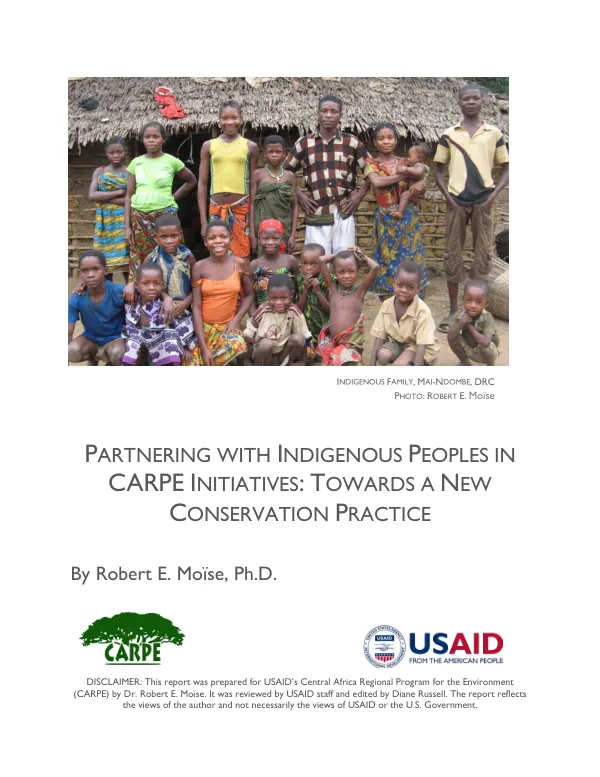
Research was conducted in the Republic of Congo (ROC) and Democratic Republic of the Congo (DRC) to assess the current state of engagement of IPs in CARPE initiatives. The study focused on the experiences of IPs in the Okapi Wildlife Reserve in DRC and the Nouabalé-Ndoki National Park in ROC. The term "Indigenous Peoples" refers to the minority population of the Congo Basin, often referred to as "Pygmy" or Pygmée in French. However, the term "Indigenous" or "autochthone" in French is preferred due to its more neutral connotation. Local communities discussed in this report typically comprise both Indigenous and Bantu peoples. Protected Areas (PAs) are created to conserve wildlife and biodiversity, as well as ecosystem services such as sequestering carbon in trees and soils. In the Congo Basin, there are several types of PAs with different levels of protection and allowable human habitation. The Okapi Wildlife Reserve incorporates Indigenous and local populations within its borders, while the Nouabalé-Ndoki National Park does not. Community Forestry Concessions (CFCs) were established in 2014, enabling the implementation and formal recognition of community forest concessions in DRC. CFCs are a community's right with a size up to 50,000 ha, and the concession duration is determined as perpetual. There are now dozens of CFCs set up and planned in DRC. The study found that the engagement of IPs in CARPE initiatives is limited, and there are several challenges to overcome. Macro-level challenges include the lack of recognition of IPs' rights and interests, while local challenges include the lack of trust and communication between IPs and conservation authorities. The study also highlights the importance of involving IPs in the decision-making process and providing them with benefits and incentives for their participation. Alternative models for protected areas, such as the Itombwe Nature Reserve, were also explored in the study. This reserve is a community-managed protected area that incorporates Indigenous and local populations within its borders. The study found that community-managed protected areas can be effective in conserving biodiversity and promoting sustainable livelihoods for IPs. The study recommends several short-term, medium-term, and long-term actions to improve the engagement of IPs in CARPE initiatives. Short-term actions include providing training and capacity-building for IPs and conservation authorities, while medium-term actions include establishing community-managed protected areas and providing benefits and incentives for IPs' participation. Long-term actions include advocating for the recognition of IPs' rights and interests at higher levels of government and promoting the adoption of a Rights-Based Approach (RBA) to conservation. The study concludes that the engagement of IPs in CARPE initiatives is crucial for the success of conservation efforts in the Congo Basin. By involving IPs in the decision-making process and providing them with benefits and incentives for their participation, CARPE can promote sustainable livelihoods and conserve biodiversity in the region.