KNCV TUBERCULOSIS FOUNDATION
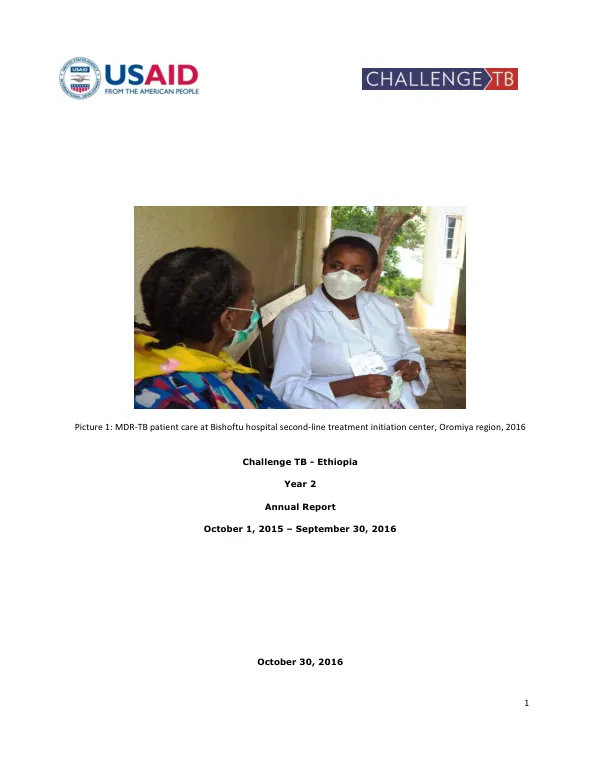
Annual Report: Challenge TB - Ethiopia Year 2
The Challenge TB project in Ethiopia aimed to improve access to patient-centered care, prevent transmission and disease progression, and strengthen TB platforms or health systems.
2016 · 52 pages
Sign in to readA free account is required to download.
Abstract
The project's intervention areas focused on ensuring the delivery of basic TB programming, especially at zonal, woreda, and community levels. Challenge TB emphasized assisting the National TB Control Program (NTP) and Regional Health Bureaus (RHBs) to ensure continuum of care addressing gaps in providing drug-sensitive, drug-resistant TB, and TB/HIV collaborative activities. The project's three main objectives were to improve access to patient-centered care, prevent transmission and disease progression, and strengthen TB platforms or HSS. Guided by these objectives, Challenge TB contributed significantly to the NTP's achievements in key areas. The project was instrumental in quality service expansion to improve case finding of drug-resistant TB cases in the country. New technologies like the GenXpert were availed, ensuring quality in diagnostic services, scaling up treatment initiation centers, and building local capacity in terms of human resources, medical commodities, and equipment. As a result, the overall national case finding and enrollment into second-line treatment of MDR-TB cases increased significantly, with a 22% increase observed in 2015/16, which is much higher than the increase a year earlier (7%) and 13% higher than initially planned (650). The project also gained momentum in improving childhood TB care in Ethiopia, from developing a national childhood TB prevention and care roadmap, training materials, and job aids to the recently initiated pilot implementation of an integrated TB care service at child health clinics (IMNCI). Early results showed that the practice of healthcare staff in sample collection from young children in the attempt to diagnose TB started to take off, with a significant increase in the number of children under 5 years of age who were contacts of TB cases being identified as risk groups to develop TB. Challenge TB built the capacity of TB officers to screen close contacts and diagnose or rule out TB in children. In year 2, from a total of 1038 children below 5 years of age who were household contacts identified, 941 were screened negative, and 425 (45%) of them were put on IPT. Of the total children evaluated, children with presumptive TB were 43 (4%), and 13 (30%) children were diagnosed with TB and put on treatment. To address the increasing number of MDR-TB cases on treatment and decentralization of MDR-TB service in the country, Challenge TB supported the importation of 8 cold chain vehicles and developed e-health (specimen referral) software in consultation with the RHBs to facilitate better communication between referring and testing facilities. In the period from 20th August to 30th September 2016, a total of 550 specimens were collected from all treatment sites of Oromia, Amhara, and Addis Ababa regions. The use of cold chain vehicle sample transportation reduced the time of sample delivery significantly, with 75% of runs achieving same-day delivery of sputum samples to testing facilities. Challenge TB's intervention areas focused on ensuring the delivery of basic TB programming, especially at zonal, woreda, and community levels. The project emphasized assisting the NTP and RHBs to ensure continuum of care addressing gaps in providing drug-sensitive, drug-resistant TB, and TB/HIV collaborative activities. The project's three main objectives were to improve access to patient-centered care, prevent transmission and disease progression, and strengthen TB platforms or HSS. The project contributed significantly to the NTP's achievements in key areas, including quality service expansion to improve case finding of drug-resistant TB cases in the country. New technologies like the GenXpert were availed, ensuring quality in diagnostic services, scaling up treatment initiation centers, and building local capacity in terms of human resources, medical commodities, and equipment. The project also gained momentum in improving childhood TB care in Ethiopia, from developing a national childhood TB prevention and care roadmap, training materials, and job aids to the recently initiated pilot implementation of an integrated TB care service at child health clinics (IMNCI). Challenge TB built the capacity of TB officers to screen close contacts and diagnose or rule out TB in children. In year 2, from a total of 1038 children below 5 years of age who were household contacts identified, 941 were screened negative, and 425 (45%) of them were put on IPT. Of the total children evaluated, children with presumptive TB were 43 (4%), and 13 (30%) children were diagnosed with TB and put on treatment. The project also supported the importation of 8 cold chain vehicles and developed e-health (specimen referral) software in consultation with the RHBs to facilitate better communication between referring and testing facilities. The use of cold chain vehicle sample transportation reduced the time of sample delivery significantly, with 75% of runs achieving same-day delivery of sputum samples to testing facilities. The project's efforts contributed to the NTP's achievements in key areas
Related documents