FHI 360
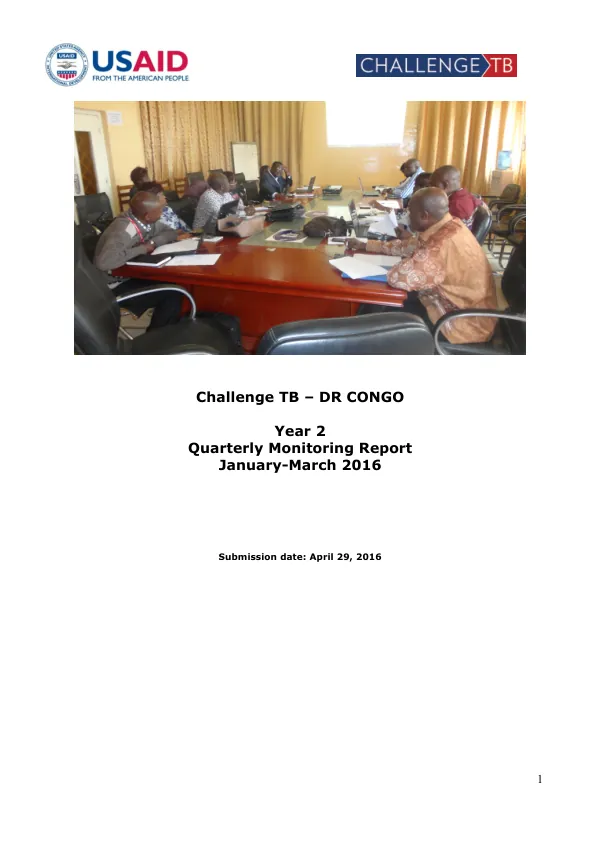
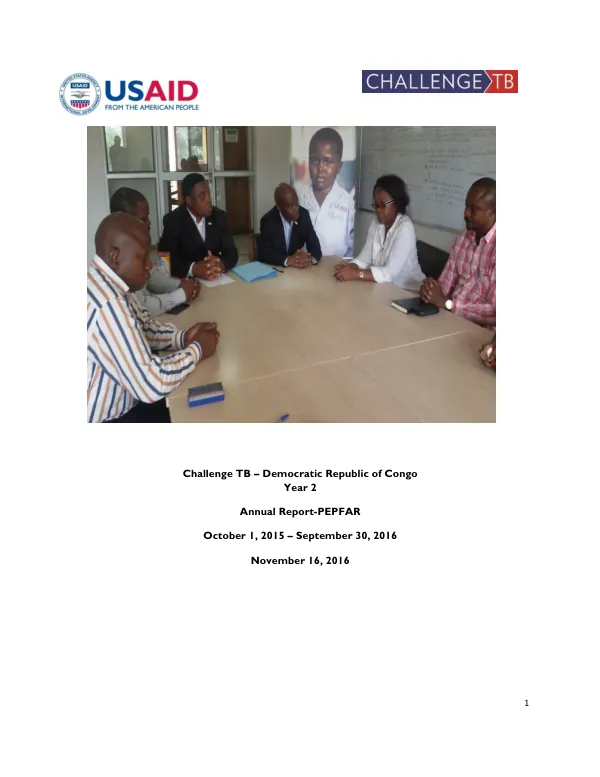
Annual Report: Challenge TB – Democratic Republic of Congo Year 2
Challenge TB is the flagship global mechanism for implementing the tuberculosis (TB) strategy of the United States Agency for International Development (USAID).
2016 · 48 pages
Sign in to readA free account is required to download.
Abstract
The project also contributes to TB/HIV activities under the US President's Emergency Plan for AIDS Relief (PEPFAR). CTB collaborates with national and international initiatives in providing global leadership and support for national TB control efforts. CTB, led by the KNCV Tuberculosis Foundation (KNCV), is a USAID-funded five-year global program to decrease TB mortality and morbidity in high-burden countries. The program is implemented by a consortium of nine partners led by KNCV: the American Thoracic Society (ATS), FHI 360, Interactive Research & Development (IRD), Japan Anti-Tuberculosis Foundation (JATA), and Management Sciences for Health (MSH), PATH, The International Union Against Tuberculosis and Lung Disease (The Union), and the World Health Organization (WHO). In the Democratic Republic of Congo (DRC), The Union acts as the technical lead for CTB, responsible for overseeing the successful implementation of the project, and coordinating with the partners at the national and international level. MSH is a collaborating partner in the implementation of TB/HIV activities in three provinces: Haut-Katanga (Lubumbashi), Lualaba (Kolwezi), and Kinshasa (KIN), all funded under PEPFAR. At the community level, the project works with three local nongovernmental organizations (NGOs) through subcontracts. These NGOs include Club des Amis de Damien (CAD), La Ligue Nationale Anti-Tuberculeuse et Anti-Lepreuse au Congo (LNAC), La Fondation Femmes Plus (FFPlus). All three NGOs work with communities in TB care. Five TB/HIV working groups have been created, including three in the Haut-Katanga and Lualaba provinces and two additional working groups in KIN (TB/HIV working group at the national level and that of USAID PEPFAR IPs). In the reporting year, CTB and the working groups listed above organized nine quarterly TB/HIV meetings. The purpose of these quarterly meetings was to develop joint TB/HIV plans, to assess the implementation plan, to discuss the implementation methods of collaborative TB/HIV activities and to analyze the results to reschedule activities to be carried out next quarter. A national TB/HIV roadmap was developed by PNLT and PNLS with technical inputs from CTB. Drawing from the national TB/HIV roadmap, three joint TB/HIV workplans were developed in the provinces of Upper Katanga, Kinshasa, and Lualaba. Nine maps were created documenting the quarterly progress of joint TB/HIV activities in KIN, Haut-Katanga, and Lualaba. Nine quarterly TB/HIV progress meetings were conducted in KIN, Haut-Katanga, and Lualaba. The project also implemented TB/HIV activities in three provinces, including Haut-Katanga, Lualaba, and Kinshasa. In these provinces, the project worked with local health facilities to provide TB/HIV services, including diagnosis, treatment, and prevention. The project also provided training and technical assistance to health workers to improve their skills in TB/HIV care. In addition, the project implemented community-based TB/HIV activities, including outreach and education programs, to raise awareness about TB/HIV and to encourage people to seek testing and treatment. The project also worked with local communities to establish TB/HIV support groups, which provided emotional and social support to people living with TB/HIV. The project's TB/HIV activities were implemented in collaboration with the DRC Ministry of Health and other national and international partners. The project's success was measured through regular monitoring and evaluation, which included tracking the number of people tested for TB/HIV, the number of people diagnosed with TB/HIV, and the number of people treated for TB/HIV. Overall, the Challenge TB project in the DRC made significant progress in implementing TB/HIV activities in the country. The project's efforts helped to improve access to TB/HIV services, increase awareness about TB/HIV, and reduce the burden of TB/HIV in the country.
Related documents