GLOBAL FUND
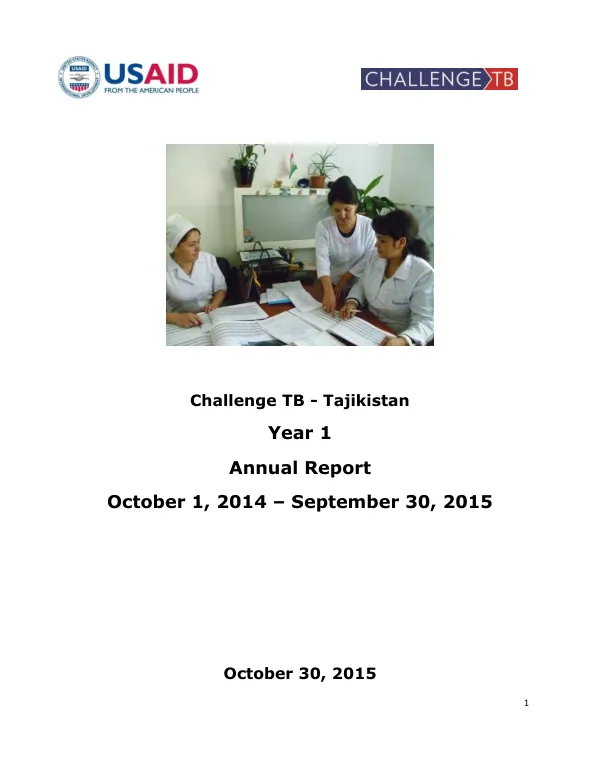
Annual Report: Challenge TB - Tajikistan Year 1
The Challenge TB project in Tajikistan aims to strengthen the National Tuberculosis Program (NTP) by improving capacity and quality of care for drug-resistant TB patients.
2015 · 22 pages
Sign in to readA free account is required to download.
Abstract
The project is led by KNCV Tuberculosis Foundation (KNCV) and is funded by the United States Agency for International Development (USAID). The project's overall strategy is to improve capacity and quality of care for drug-resistant TB patients with a focus on new tools and innovations. In year 1, Challenge TB focused on building NTP's capacity for management and implementation of shorter treatment regimens and new TB drugs. The project created databases of MDR-TB patients eligible for shortened regimens and new drugs, which will be used for drug calculation and procurement through the Global Fund's New Funding Mechanism (NFM). A plan for introduction of shortened regimens and new drugs was also drafted based on the results of the assessment of the M/XDR-TB situation and preparedness of the NTP for implementation. A pilot site was defined for the implementation of new regimens in year 2, and a framework was developed for the introduction of a Pharmacovigilance (PV) system in TB services. A Thematic Working Group (TWG) on PV was established, and a Scope of Work (SoW) and list of TWG members were developed. The main steps for reinforcing spontaneous reporting by healthcare institutions and providers involved in TB case management were discussed with key specialists. Tajikistan has a high burden of TB, with an estimated incidence of 100 per 100,000 population in 2013, which is the fifth highest level of TB burden among 53 countries of the WHO European Region. The estimated TB mortality rate (excluding TB/HIV cases) in 2013 was 6.9 per 100,000 population. The national Drug Resistance Survey (DRS) conducted in 2010-2011 reported 12.5% MDR-TB among new culture-positive TB cases and 53.6% among re-treatment cases. The DRS also revealed a prevalence of 10% of extensively-drug resistant (XDR)-TB among MDR-TB cases that were tested for resistance to Second Line Drugs (SLDs). The National Strategic Plan (NSP) aims to reach universal treatment coverage for MDR-TB (including XDR-TB) by the year 2020, with a coverage of at least 90-95% of the estimated total need. The approaches currently used for treatment of MDR-TB require a long-term period (20 months and more), are difficult to implement, and require great financial and human resources. High levels of treatment interruption and patients reported as lost to follow-up are adversely affecting the final treatment outcomes, and may lead to development and spread of extensively resistant TB. The Challenge TB project works in close collaboration with NTP, WHO Country Office, international partners, and projects, including USAID TB Control Program, Global Fund projects, and MSF. The project's work plan was approved by USAID in June 2015, and not all activities were implemented by September 2015. The project's overall budget for year 1 was USD 475,000, which was obligated to support Challenge TB in Tajikistan.