USAID DEC
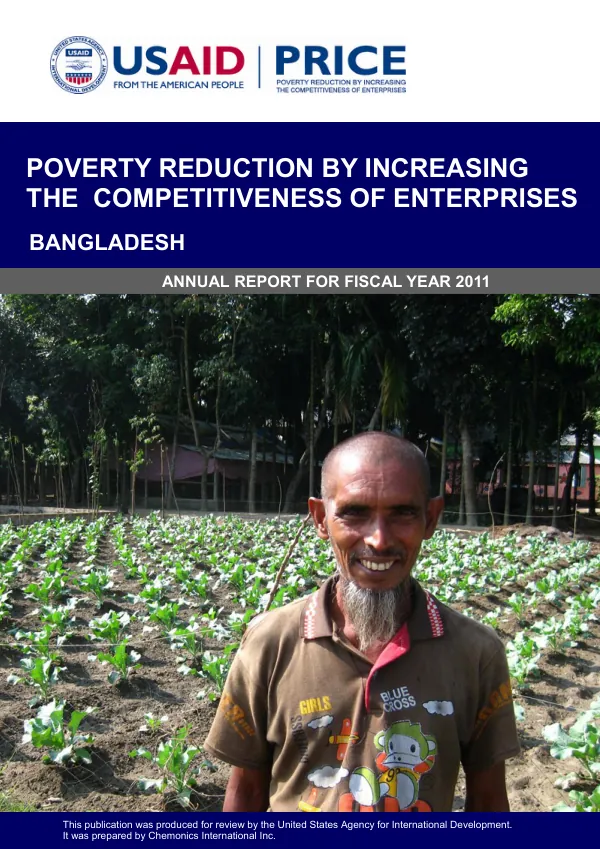
Annual Report for Fiscal Year 2011: Poverty Reduction by Increasing the Competitiveness of Enterprises (PRICE)
Sign inCHEMONICS
Annual Report for Fiscal Year 2011: Poverty Reduction by Increasing the Competitiveness of Enterprises (PRICE)
The USAID-funded PRICE project aims to alleviate constraints hindering the competitiveness of the aquaculture, horticulture, and leather products sectors in Bangladesh.
2011 · 88 pages
Sign in to readA free account is required to download.
Abstract
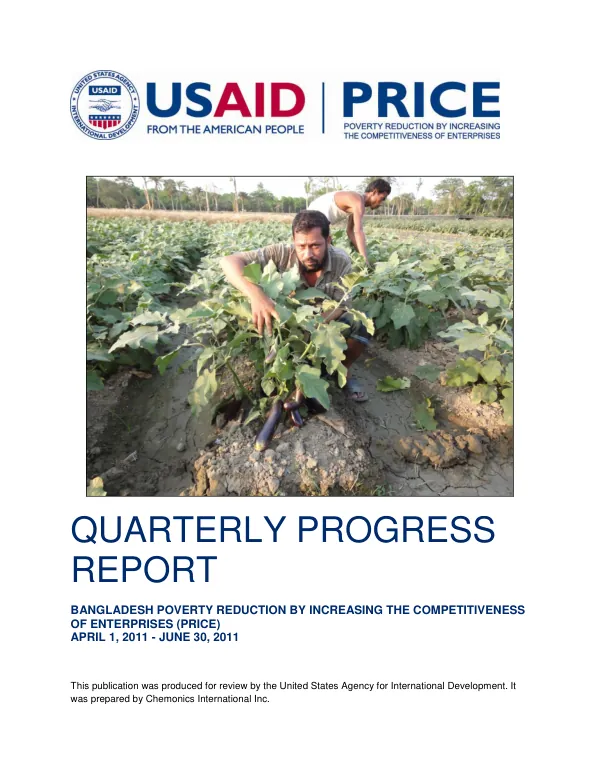
The project works with the Government of Bangladesh and private sector farmers and firms to improve competitiveness and promote broad-based economic development. The project's overall goal is to improve competitiveness while simultaneously engendering a higher than average rate of growth among low-income target groups. In the horticulture sector, economic growth, rising incomes, and urbanization have led to a growing domestic demand for fresh fruits, vegetables, and spices that vastly exceeds current supplies. As a result, Bangladesh is a net importer of horticultural products. During FY 2011, PRICE trained and assisted over 11,300 farmers in the northwest and southwest of the country to improve the domestic supply and export potential of potato, eggplant, and mango. The project provided technical support to local seed companies for the production of clean seed and provided technical assistance and training to over 1,000 seed potato contract farmers. As a result of PRICE's technical assistance and market linkages, one partner was able to produce the first ever export of Bangladeshi potato to the international retail giant TESCO. The project also trained 840 eggplant farmers on production technology, safe pest management, and post-harvest handling, and facilitated the introduction of improved varieties for sustained higher production. In mango, the project assisted five associations to train nearly 2,864 farmers in orchard management, pest control, harvesting, and post-harvest technology. As a result of these interventions, horticulture sales increased by almost $12.8 million, 3,453 jobs were created, and 2,700 farmers received help accessing finance. In the aquaculture sector, both fisheries and shrimp farms play a major role in meeting Bangladesh's food requirements, generating employment, and contributing to export sales. However, productivity is poor, and there are significant problems related to quality control, food safety, and post-harvest handling. During FY 2011, PRICE collaborated with over 50 fish farmers associations and other value chain actors throughout the country, with special emphasis in the Jessore, Mymensingh, Bogra, and Cox's Bazar regions. Almost 30,000 fish and shrimp farmers were trained on good aquaculture practices, management, and group marketing, and were linked to quality seed-producing hatcheries, nurseries, feed millers, and micro credit. The project promoted the development of the dry fish manufacturing industry by training 400 yard owners and more than 2,000 female workers on hygienic dry fish production, personal hygiene, and packaging. Shrimp processing firms received assistance to improve food safety and to open new markets in the Middle East. As a combined result of these efforts, $94.8 million in new sales were generated, of which $68.6 million were in fish and $26.2 million were in shrimp. The project's sector activities were expanded during FY 2011, making considerable progress towards achieving the project's overall goals and targets, including sales growth, job creation, and increased investment. The project's efforts in the horticulture and aquaculture sectors have improved the competitiveness of these sectors, leading to increased sales, job creation, and access to finance for farmers. The project's collaboration with the Government of Bangladesh and private sector farmers and firms has also promoted broad-based economic development throughout the value chain. The project's success in the horticulture sector can be attributed to its focus on improving the domestic supply and export potential of key crops such as potato, eggplant, and mango. The project's technical assistance and market linkages have enabled farmers to access new markets and improve their productivity. In the aquaculture sector, the project's focus on good aquaculture practices, management, and group marketing has improved the productivity and quality of fish and shrimp farms. The project's promotion of the dry fish manufacturing industry has also improved the quality and safety of dry fish products. Overall, the PRICE project has made significant progress towards achieving its overall goals and targets in the horticulture and aquaculture sectors. The project's efforts have improved the competitiveness of these sectors, leading to increased sales, job creation, and access to finance for farmers. The project's collaboration with the Government of Bangladesh and private sector farmers and firms has also promoted broad-based economic development throughout the value chain.
Related documents