USAID DEC
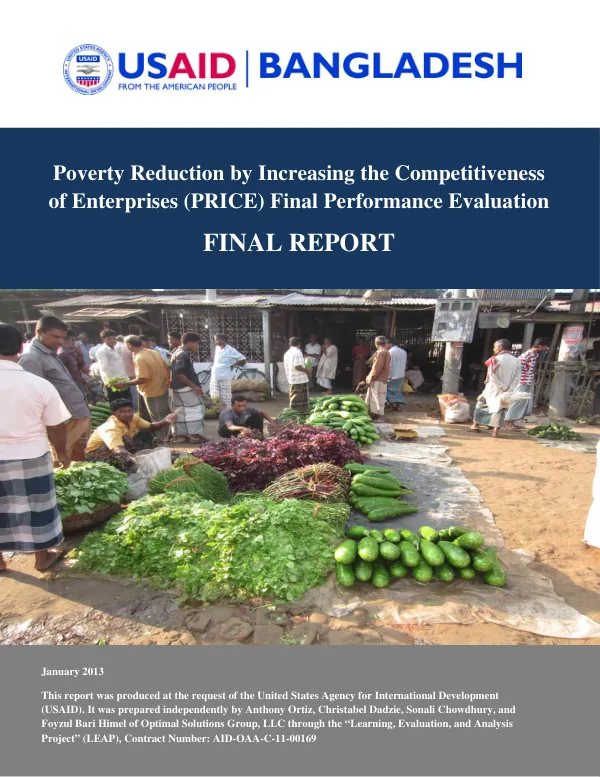
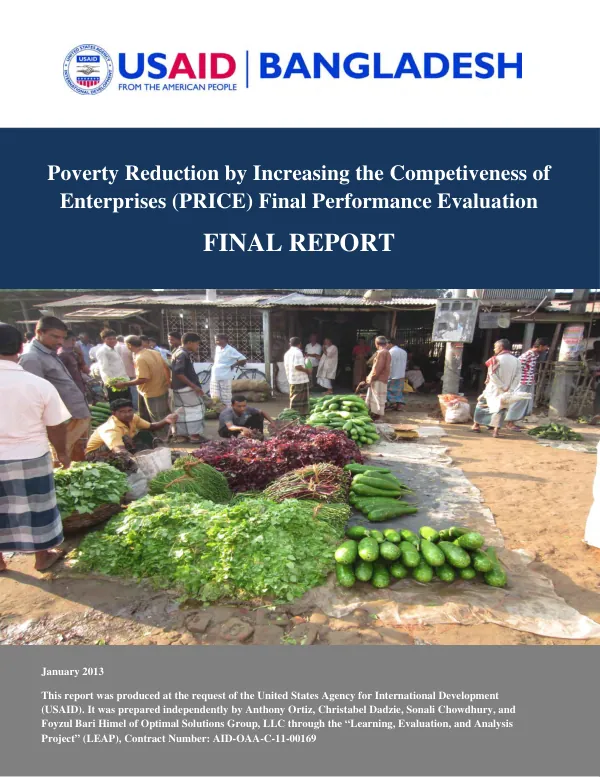
Poverty Reduction by Increasing the Competiveness of Enterprises (PRICE) Final Performance Evaluation
Sign inCHEMONICS
Poverty Reduction by Increasing the Competiveness of Enterprises (PRICE) Final Performance Evaluation
The Poverty Reduction by Increasing the Competitiveness of Enterprises (PRICE) project was implemented in Bangladesh between 2008 and 2013 with a total funding of $12.9 million from the United States Agency for International Development (USAID).
2014 · 97 pages
Sign in to readA free account is required to download.
Abstract
The project's main mission was to reduce poverty sustainably by increasing enterprise competitiveness across three main sectors: horticulture, aquaculture, and leather. Chemonics International was the implementing partner for the project. The PRICE project aimed to achieve several specific objectives across the three sectors, including improving pro-poor economic opportunities, workforce skills, social compliance practices, and governance practices related to economic growth. The project also sought to enhance the competitiveness of small and medium enterprises (SMEs) and improve market linkages for farmers and producers. The project's implementation was focused on several key areas, including the development of value chains, improvement of market access, and enhancement of enterprise competitiveness. The project team worked closely with stakeholders, including government agencies, private sector companies, and civil society organizations, to achieve the project's objectives. The evaluation of the PRICE project was conducted by Optimal Solutions Group, LLC, through the Learning, Evaluation, and Analysis Project (LEAP) contract. The evaluation aimed to assess the project's overall performance, its impact on sector competitiveness, and its effectiveness in achieving the desired outcomes. The evaluation also examined the project's contribution to women's empowerment and its impact on small and medium enterprises and workforce development. The evaluation findings indicate that the PRICE project made significant contributions to the development of the horticulture, aquaculture, and leather sectors in Bangladesh. The project helped to improve the competitiveness of SMEs, enhance market linkages for farmers and producers, and increase pro-poor economic opportunities. The evaluation also found that the project had a positive impact on women's empowerment, with women participating in the project showing higher levels of economic empowerment and social status. However, the evaluation also identified some challenges and limitations faced by the project, including the need for more effective monitoring and evaluation systems, the need for greater stakeholder engagement, and the need for more effective project management. The evaluation recommended several actions to address these challenges and improve the project's effectiveness, including the need for more effective project planning, the need for greater stakeholder engagement, and the need for more effective monitoring and evaluation systems. The evaluation also identified several lessons learned from the project, including the importance of effective stakeholder engagement, the need for more effective project planning, and the need for more effective monitoring and evaluation systems. The evaluation recommended that future projects should build on the lessons learned from the PRICE project and incorporate effective stakeholder engagement, effective project planning, and effective monitoring and evaluation systems into their design and implementation. Overall, the evaluation of the PRICE project found that the project made significant contributions to the development of the horticulture, aquaculture, and leather sectors in Bangladesh and had a positive impact on women's empowerment and small and medium enterprises. However, the evaluation also identified several challenges and limitations faced by the project and recommended several actions to address these challenges and improve the project's effectiveness.
Related documents