DAI GLOBAL, LLC
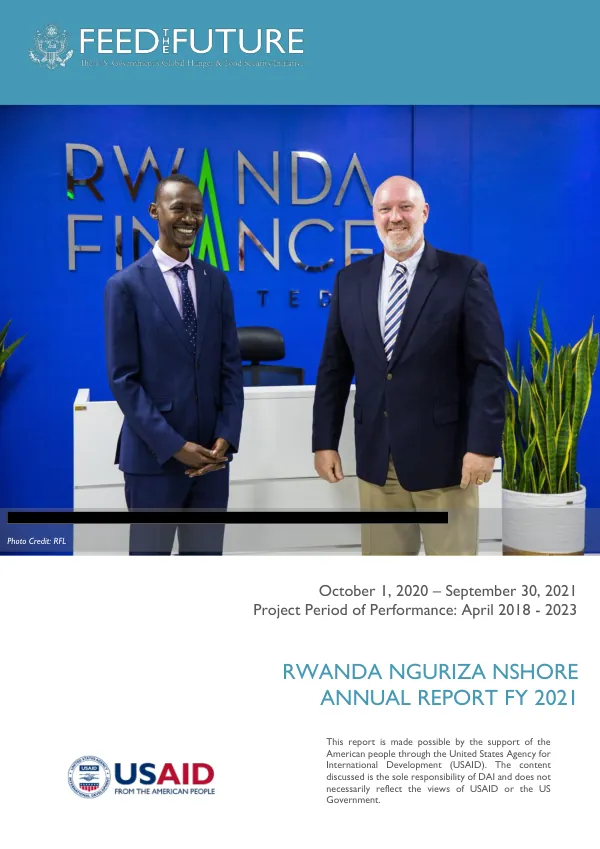
Annual Report FY 2021: Rwanda Nguriza Nshore
Rwanda Nguriza Nshore is a USAID-funded program aimed at promoting economic growth and development in Rwanda.
2021 · 111 pages
Sign in to readA free account is required to download.
Abstract
The program began in April 2018 and is set to conclude in 2023. The program's primary objective is to increase the capacity of financial institutions and non-bank financial institutions to finance small and medium-sized enterprises (SMEs) and agribusinesses. The program is divided into three main components. Component I focuses on expanding the capacity of financial institutions and non-bank financial institutions to finance SMEs and agribusinesses. In FY 2021, this component achieved several milestones, including the establishment of a business development fund and the provision of training to financial institutions on SME financing. The component also faced challenges, including the need for financial institutions to develop more robust risk management systems. Component 2 aims to increase private and commercial investment in SMEs and agribusinesses. In FY 2021, this component achieved several successes, including the mobilization of $10 million in private sector investment and the establishment of a business partners network. However, the component also faced challenges, including the need for more effective market linkage facilitation. Component 3 focuses on strengthening the policy environment for SMEs and agribusinesses to increase their performance and profitability. In FY 2021, this component achieved several milestones, including the development of a entrepreneurship development policy and the establishment of a business service provider. The component also faced challenges, including the need for more effective regulatory frameworks. The program also places a strong emphasis on cross-cutting themes, including gender, youth, and persons with disabilities. In FY 2021, the program achieved several successes in these areas, including the establishment of a women's entrepreneurship development program and the provision of training to youth on entrepreneurship skills. The program's monitoring, evaluation, and learning (MEL) framework is designed to track progress towards the program's objectives and identify areas for improvement. In FY 2021, the program achieved several successes in this area, including the development of a performance management plan and the establishment of a learning and adaptation framework. The program also places a strong emphasis on collaboration, learning, and adapting. In FY 2021, the program achieved several successes in this area, including the establishment of a consortium of partners and the development of a strategic partnership framework. The program's financial summary for FY 2021 shows a total expenditure of $10.5 million, with $5.5 million allocated to Component 1, $3.5 million allocated to Component 2, and $1.5 million allocated to Component 3. The program's performance indicators for FY 2021 show a 27% increase in SME financing and a 25% increase in private sector investment. Overall, the Rwanda Nguriza Nshore program has made significant progress towards its objectives in FY 2021, with several successes achieved in each of the program's three components. However, the program also faces several challenges, including the need for more effective market linkage facilitation and the need for more robust risk management systems in financial institutions.
Related documents