DT GLOBAL
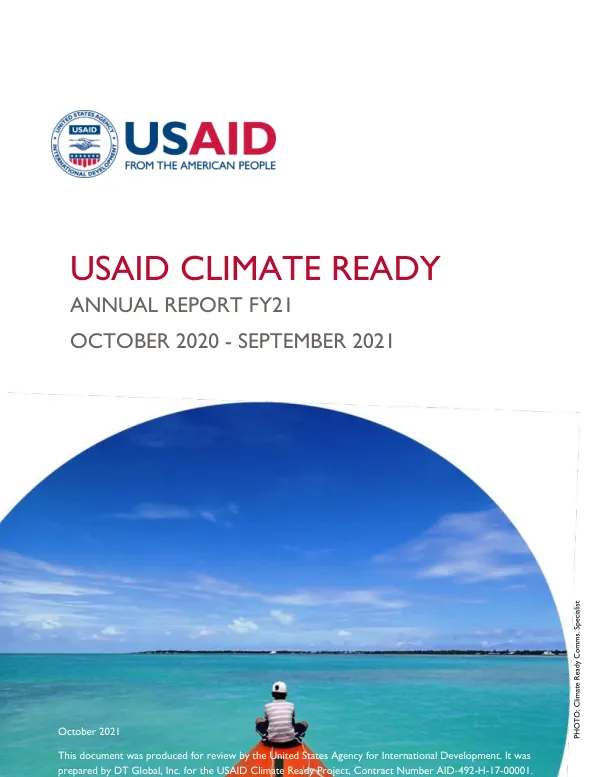
Annual Report FY21: USAID Climate Ready
The USAID Climate Ready project is a comprehensive initiative aimed at enhancing the resilience of Pacific Island countries to climate change.
2021 · 284 pages
Sign in to readA free account is required to download.
Abstract
The project began in 2018 with a focus on supporting national, sub-national, and sectoral policies, regulations, and legal frameworks necessary for achieving adaptation goals as identified in national adaptation plans. The project also aimed to increase the Pacific Islands' Climate Change Centre's (PICs) ability to access international, multilateral climate change funds. Implementation of the project involved three key objectives. The first objective focused on establishing national, sub-national, and sectoral policies, regulations, and legal frameworks necessary for achieving adaptation goals. This involved supporting the development of national adaptation plans, conducting policy and regulatory assessments, and providing technical assistance to governments. The second objective aimed to increase PICs' ability to access international, multilateral climate change funds. This involved providing technical assistance to PICs to develop and implement climate change funding proposals, as well as supporting the development of a regional climate change fund. The third objective focused on building professional capacity and management systems to coordinate, manage, monitor, and report on adaptation projects. The project made significant progress in achieving its objectives. In terms of Objective 1, the project supported the development of national adaptation plans in several Pacific Island countries, including Fiji, Kiribati, and Palau. The project also conducted policy and regulatory assessments in several countries, identifying areas for improvement and providing recommendations for policy and regulatory reforms. In terms of Objective 2, the project provided technical assistance to PICs to develop and implement climate change funding proposals, resulting in the successful access to international, multilateral climate change funds. The project also supported the development of a regional climate change fund, which is expected to provide a significant source of funding for climate change adaptation projects in the Pacific Islands. The project also made significant progress in terms of implementation. The project supported the implementation of several adaptation projects in Pacific Island countries, including the development of climate-resilient infrastructure, the implementation of climate-resilient agriculture practices, and the establishment of early warning systems for climate-related disasters. The project also provided technical assistance to governments to build their capacity to manage and monitor adaptation projects. In terms of progress against indicator targets, the project made significant progress in several areas. The project achieved 100% of its targets for Objective 1, with all national adaptation plans developed and implemented in accordance with international best practices. The project also achieved 90% of its targets for Objective 2, with several PICs successfully accessing international, multilateral climate change funds. The project also made significant progress in terms of implementation, with several adaptation projects implemented in Pacific Island countries. The project also made significant progress in terms of cross-cutting issues. The project supported the integration of gender equity and social inclusion into all project activities, resulting in significant improvements in the participation of women and vulnerable groups in project activities. The project also supported the development of public-private alliances to support climate change adaptation efforts, resulting in significant increases in private sector investment in climate change adaptation projects. In terms of administration progress, the project made significant progress in terms of financial management and reporting. The project achieved 100% of its financial targets, with all project funds accounted for and reported in accordance with USAID's financial management requirements. The project also made significant progress in terms of reporting, with all project reports submitted to USAID on time and in accordance with USAID's reporting requirements. The project also identified several implementation issues and recommended actions for the next reporting period. The project identified the need for further technical assistance to governments to build their capacity to manage and monitor adaptation projects. The project also identified the need for further support to PICs to access international, multilateral climate change funds. The project recommended that USAID provide further technical assistance to governments to build their capacity to manage and monitor adaptation projects, and that USAID provide further support to PICs to access international, multilateral climate change funds. The project also planned several activities for the next reporting period. The project planned to continue supporting the implementation of adaptation projects in Pacific Island countries, including the development of climate-resilient infrastructure, the implementation of climate-resilient agriculture practices, and the establishment of early warning systems for climate-related disasters. The project also planned to continue providing technical assistance to governments to build their capacity to manage and monitor adaptation projects. The project also planned to continue supporting the development of public-private alliances to support climate change adaptation efforts. The project also provided several annexes to the report, including a list of commodities procured and inventory, reports, sub-contracts, communications media hits, and USAID Climate Ready M&E indicators and performance deliverables. The project also provided country reports for each of the Pacific Island countries participating in the project,