USAID
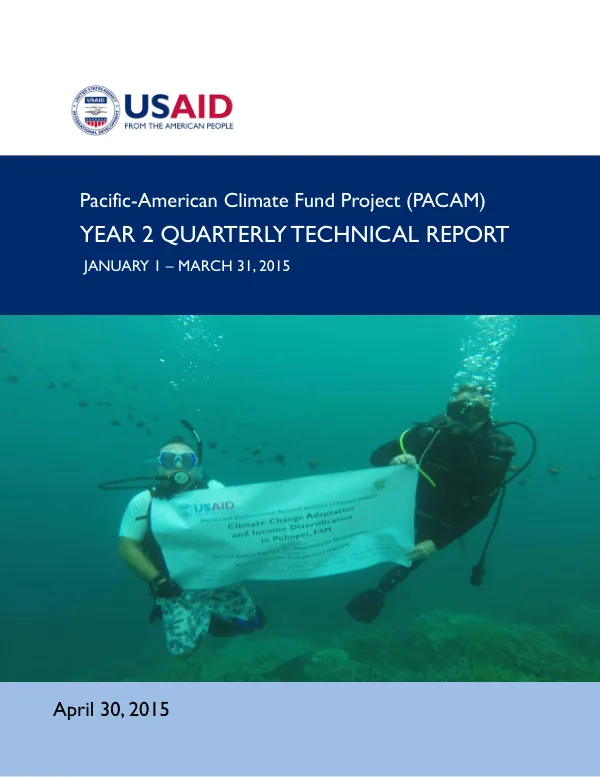
Pacific-American Climate Fund Project (PACAM) YEAR 2 QUARTERLY TECHNICAL REPORT
The Pacific-American Climate Fund (PACAM) team, comprised of Partners for Global Research and Development, LLC (PGRD) and URS, is pleased to present this Quarterly Technical Report covering the second quarter of Year 2 of project activity under U.S.
2015 · 26 pages
Sign in to readA free account is required to download.
Abstract
Agency for International Development (USAID) Contract No: AID-492-C-13-00017. The quarterly report presents program activity from January 1, through March 31, 2015. The objective of the PACAM activity is to establish, on behalf of USAID/Pacific Islands, a transparent grant-making facility to provide and monitor climate change adaptation grants to civil society organizations (CSOs), in order to support innovative projects that reduce long-term vulnerabilities associated with climate change and provide additional "co-benefits," such as livelihoods enhancement, food security, improved health, better governance, or sustainable natural resources management. This directly supports USAID/Pacific Islands' overall objective of strengthening the resilience of Pacific Island communities as well as Strategic Objective 2 of USAID's Global Climate Strategy, with an emphasis on increasing community resilience through strategic investments in climate change adaptation. Grants awarded under PACAM are targeted to non-sovereign CSOs in twelve Pacific nations: Fiji, Kiribati, Palau, Federated States of Micronesia, Marshall Islands, Nauru, Papua New Guinea, Samoa, Solomon Islands, Tonga, Tuvalu, and Vanuatu. The Fund's administrative office is based in Manila, Philippines, with regional fund management offices (RFMOs) in Majuro, Marshall Islands; Port Moresby, Papua New Guinea; and Suva, Fiji. The Year 2 PACAM Work Plan provides an outline of the activities to be undertaken to enhance and maintain the overall management and administrative infrastructure of the PACAM Program and ensure that expected results are achieved for the three areas of strategic engagement: Grants Management, Capacity-Building, and Communication and Outreach. The PACAM Results Framework creates the structure for program activities, which are targeted towards the achievement of four key objectives: Result 1, Result 2, Result 3, and Result 4. In Year 1 of implementation, PACAM focused on establishing operations in the Administrative Office and PACAM Regional Fund Management Offices (RFMOs) in the Pacific Islands; establishing the grant award and management framework; and initiating the selection process for the awarding of grants. In the first and second quarters, preparations were made for formal Solicitation launches to encourage grant applications in the twelve countries and raise public awareness of the grants program through launches in Papua New Guinea, Fiji, and the Republic of the Marshall Islands. PACAM Pre-bid workshops, designed to encourage CSOs to apply for a PACAM grant and submit concept papers as an initial step in the application process, were held in those three countries, as well as in Palau and Samoa. Other outreach activities included presentations on PACAM at Pacific regional and local conferences, as well as briefings for interested CSOs. Following the launches, activity focused on the processing of solicited concept papers submitted for the 1st Grant cycle, under the April 30 deadline. The PACAM Team screened 55 concept papers, of which 17 were invited to submit full grant application proposals. A total of 15 full applications were submitted, of which nine were recommended by the PACAM Grant Review Board for award. Successful Cycle 1 applications were announced on September 1, 2014, at a reception in Apia, Samoa. PACAM RFMO and consultant teams conducted in-depth Pre-Award Surveys during Quarter 4 of Year 1, the final award of a PACAM grant to each of the successful applicants being conditional on the completion of the survey in order to make a determination of financial responsibility. Year 2 was initiated with a focus on program recalibration and acceleration through a series of administrative and management reviews and enhancements, including a change in Chief of Party leadership, the addition of short-term technical assistance, and the expansion of operations capacity. Quarter 1 activities included the conduct of the annual Work Planning session; a review of management systems and resource needs; the drafting of the Year 2 Work Plan; the review and initiation of revisions and updates of key Program documents such as the Grants Manual and the Monitoring and Evaluation Plan; the finalization of Cycle 1 grants awards; and the timely advancement of the grant Cycle 2. Quarter 2 activities have been focused on robust implementation of the PACAM Year 2 Work Plan, including the conduct of a series of administrative and management reviews and enhancements, the expansion of operations capacity, and the initiation of the grant Cycle 2. The process of concurrently changing leadership; identifying and implementing necessary management course corrections needed; and ensuring timely implementation of program technical and operational priorities was not without its challenges but ultimately addressed successfully. The PACAM Team has made significant progress in implementing the Year 2 Work Plan, including the conduct of a series of administrative and management reviews and enhancements, the expansion of operations capacity,