USAID DEC
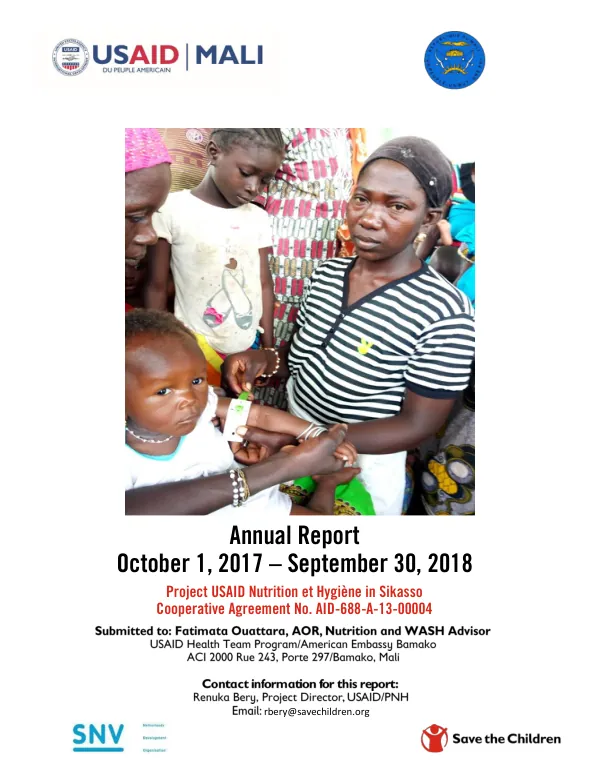
Annual Report October 1, 2017 – September 30, 2018 Project USAID Nutrition et Hygiène in Sikasso
Sign inSAVE THE CHILDREN FUND
Annual Report October 1, 2017 – September 30, 2018 Project USAID Nutrition et Hygiène in Sikasso
The USAID Nutrition and Hygiene project in Sikasso, Mali, is a five-year initiative that began in 2013.
2018 · 57 pages
Sign in to readA free account is required to download.
Abstract
The project's goal is to improve the nutritional status of pregnant and lactating women and children under two years of age in six health districts of the Sikasso Region. The project is led by Save the Children, in partnership with SNV, and is funded by the United States Agency for International Development (USAID). Implementation of the project's activities accelerated in August and September 2018, following the submission of a supplemental application for a 12-month extension. The project was officially extended at the end of September 2018. The project's objectives are aligned with the USAID's goals for improving nutrition and health outcomes in Mali. The project's strategic objectives are threefold: to increase the adoption of optimal behaviors to support nutrition, health, sanitation, and hygiene; to increase production and accessibility of nutrient-rich foods; and to improve the delivery of nutrition services to address acute malnutrition. The project's activities are implemented through a range of interventions, including community mobilization, producer group strengthening, improved farm management techniques, and enhanced access to agricultural inputs. The project has made significant progress in achieving its objectives. In the reporting period from July 1 to September 30, 2018, the project reached 3,155 village coordination committee members, 2,466 maman leaders, 1,063 mothers-in-law, 1,014 husband leaders, 446 relais communautaires, 67 community health workers, and 200 peer farmers. The project also conducted joint supervision activities with SNV staff, who continued to provide limited support until June 2018. The project's success stories include the adoption of optimal behaviors to support nutrition, health, sanitation, and hygiene by households and caregivers. The project faced several challenges, including technical, managerial, and financial difficulties. However, the project proposed solutions to address these challenges, including strengthening the management structure capacity to support community-based management of acute malnutrition and enhancing the capacity of health workers to manage acute malnutrition. The project's geographic focus is on the six health districts of the Sikasso Region, with a total of 142 health facilities and 236 villages. The project's timeframes are aligned with the USAID's goals for improving nutrition and health outcomes in Mali, with a focus on the period from 2013 to 2018. The project's recommendations for future activities include continued support for community-based management of acute malnutrition and enhanced capacity building for health workers.