GOVERNMENT OF THE REPUBLIC OF ZAMBIA
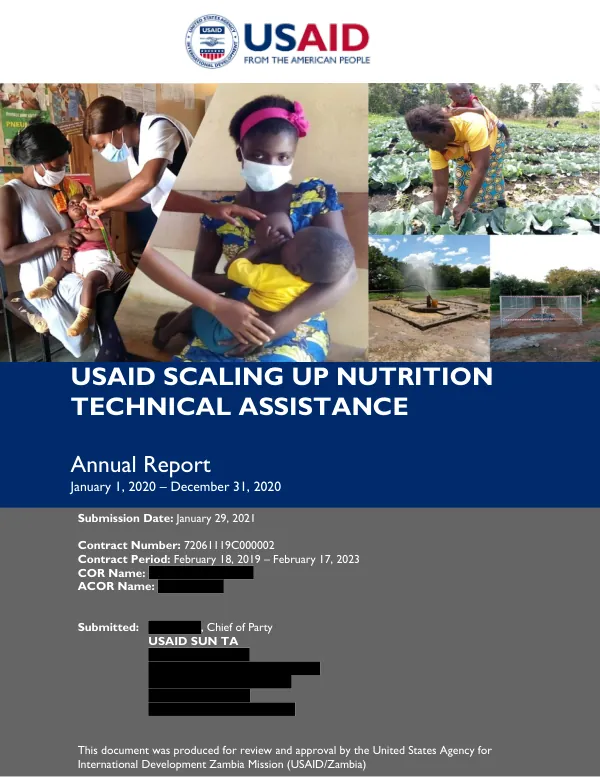
USAID SCALING UP NUTRITION TECHNICAL ASSISTANCE ANNUAL REPORT
The USAID Scaling Up Nutrition Technical Assistance (SUN TA) project in Zambia aimed to reduce stunting among children under two years of age through implementation of the Government of the Republic of Zambia's (GRZ) 1,000 Most Critical Days Program (MCDP II).
2021 · 34 pages
Sign in to readA free account is required to download.
Abstract
The project targeted women of reproductive age 15-49 with at least one child under two years of age, pregnant women, and the SUN Program's most vulnerable households. The SUN TA project began 2020 with ambitious plans to scale operations, outreach, and technical activities across all 13 target districts. However, the COVID-19 pandemic created an urgent need for the SUN TA team to pivot quickly and adapt both operations and scale-up of activities to ensure Zambians, especially the youngest and most vulnerable, received proper nutrition and mothers of young children received support to create new or expand existing income-generating opportunities. Despite the pandemic, the SUN TA project found ways to mitigate challenges and press forward with the important work at hand. The project continued to support its objectives using the SUN Minimum Package of High Impact Interventions, household targeting strategy, and public service delivery mechanisms (MCDP II Pyramid), all of which built on the strong foundation of integrated nutrition services through its service delivery structures. The project's collaboration with the National Food and Nutrition Commission (NFNC) and Government line ministries proved critical for outreach in communities and long-term buy-in and sustainability. For example, SUN TA worked closely with GRZ, NFNC, private seed companies, and SUN TA-trained farmers throughout 2020 on promoting and scaling up quick maturing vegetables to boost nutrition, immunity, and overall food security. The SUN TA's WASH component ramped up considerably in 2020, focusing on providing safe, clean drinking water and promoting proper sanitation and hygiene behaviors. The project leveraged COVID-19 messaging on hygiene and sanitation practices, such as proper handwashing guidance and hand sanitization, as part of WASH behavior change. The project's train-the-trainer workshops onboarded 886 health professionals, who in turn trained 3,960 community-based volunteers, resulting in 5,687 SUN Mother Support Groups formed. These groups provided a supportive platform for sharing information on health and nutrition, food preparation, and essential hygiene behaviors. Ultimately, the cascade of training reached 77,500 pregnant women and mothers of children aged 0-24 months from SUN households, improving adoption of key behaviors, such as regular antenatal care visits and growth monitoring. The project also showcased its work through virtual field visits, a first for USAID, which proved possible, meaningful, and reproducible, while cutting costs, reducing exposure, and allowing more people to join and facilitate. This approach has since become a model employed on many other USAID projects.