SAVE THE CHILDREN FUND
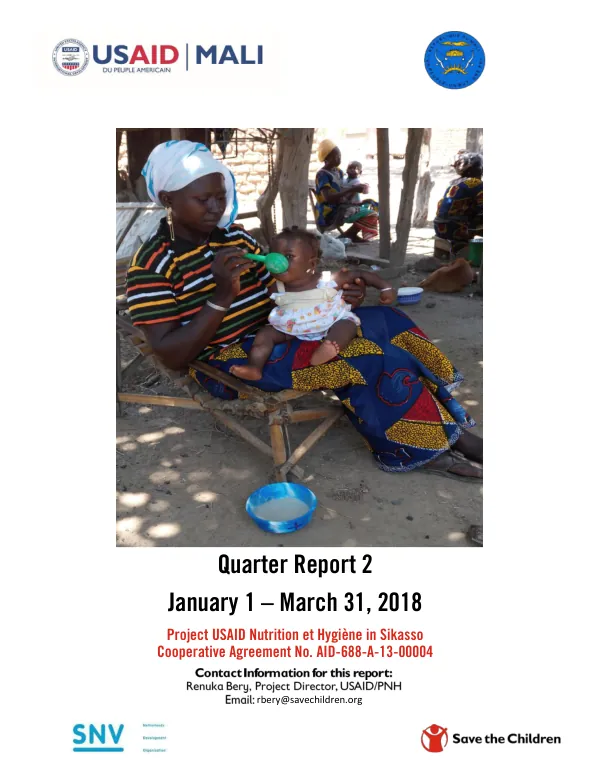
Quarter Report January 1 – March 31, 2018
The USAID Nutrition et Hygiène project in Sikasso, Mali, is in its fifth year of implementation, with the second quarter of 2018 marking the end of the eighteenth quarter.
2018 · 62 pages
Sign in to readA free account is required to download.
Abstract
The project aims to improve the nutritional status of pregnant and lactating women and children under two years of age in six health districts of the Sikasso Region. The project's goal is to reach at least 13,000 pregnant and lactating women and 53,000 children under two years of age in these six health districts with a full package of interventions. The project is led by Save the Children, partnering with SNV, and is active in 6 health districts, 142 health facilities, and 236 villages. The project reaches out to these communities through 3,155 village coordination committee members, 2,466 maman leaders, 1,063 mothers-in-law, 1,014 husband leaders, 446 relais communautaire, 67 community health workers, and 200 peer farmers with social and behavior change in nutrition, water, sanitation, and hygiene, and agriculture. The project has three strategic objectives: to increase the adoption of optimal behaviors to support nutrition, health, hygiene, and sanitation; to increase the production and accessibility of nutrient-rich foods; and to improve the delivery of nutrition services to address acute malnutrition. The project's approach is grounded in community mobilization and social and behavior change, working through community structures to facilitate change and promote specific behaviors. Implementation of planned activities for the second quarter of 2018 is ongoing. Technical assistance is being provided to community health workers and peer farmers to enhance their capacity in nutrition, WASH, and agriculture. Community mobilization and social and behavior change activities are being implemented through community-led total sanitation, care groups, women farmers' groups, farm field schools, and family farmer management systems. The project is also supporting the Malian Ministry of Health and community health associations in addressing acute malnutrition through improvements to community-based management of acute malnutrition and encouraging better interpersonal communication between health workers and caregivers to support and promote adoption of recommended behaviors. Core project activities related to each strategic objective are expected to lead to targeted outcomes that improve stunting and anemia in the six project-supported districts. The project uses a multi-sectoral approach to improve the nutritional status of women and children through integrating health/nutrition, WASH, agriculture, and SBC interventions to maximize the potential impact. The project's progress is being monitored and evaluated regularly to ensure that the project is on track to meet its objectives and to identify areas for improvement. The project has made significant progress in the second quarter of 2018, with a total of 3,155 village coordination committee members, 2,466 maman leaders, 1,063 mothers-in-law, 1,014 husband leaders, 446 relais communautaire, 67 community health workers, and 200 peer farmers being trained and supported in nutrition, WASH, and agriculture. The project has also established 142 health facilities and 236 villages, and has reached out to these communities through various community structures. The project's success stories include the establishment of community-led total sanitation, care groups, women farmers' groups, farm field schools, and family farmer management systems, which have led to improved hygiene and sanitation practices, increased access to nutrient-rich foods, and improved delivery of nutrition services to address acute malnutrition. The project's challenges and difficulties encountered during the second quarter of 2018 include technical, managerial, and financial constraints, which are being addressed through proposed solutions and lessons learned. The project's indicators report shows that the project has made significant progress in improving the nutritional status of women and children in the six project-supported districts. The project's indicators report includes data on the number of pregnant and lactating women and children under two years of age reached with a full package of interventions, the number of community health workers and peer farmers trained and supported, and the number of health facilities and villages established. The project's future events include travel, workshops, and meetings, which are being planned to ensure the project's continued progress and success. The project's conclusion highlights the importance of continued support and funding to ensure the project's sustainability and impact.