MANAGEMENT SCIENCES FOR HEALTH
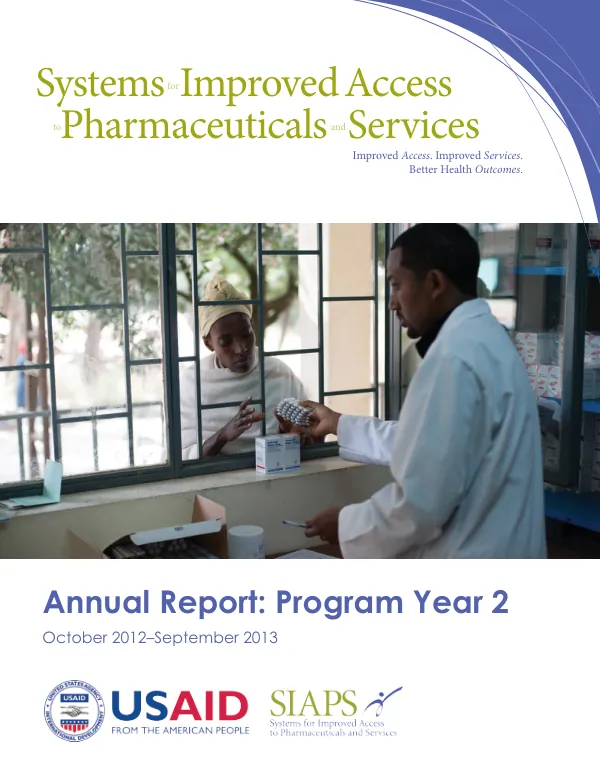
Annual Report: Program Year 2, October 2012–September 2013
The SIAPS Program aims to assure the availability of quality pharmaceutical products and effective pharmaceutical services to achieve desired health outcomes.
2013 · 68 pages
Sign in to readA free account is required to download.
Abstract
The program's goal is to promote and use a systems-strengthening methodology that will result in a positive and sustainable health impact. To achieve this goal, SIAPS focuses on improving governance, building capacity for pharmaceutical management and services, addressing information needed for decision-making in the pharmaceutical sector, strengthening financing strategies and mechanisms to improve access to medicines, and increasing quality pharmaceutical services. SIAPS has identified five result areas to achieve its goal. The first result area, Pharmaceutical Sector Governance Strengthened, focuses on improving governance in the pharmaceutical sector. This includes strengthening pharmaceutical registration, licensing, and medicine quality, as well as developing strategic plans and policies to ensure good governance and better service delivery. The program has made significant progress in this area, with notable achievements in Swaziland, where the pharmaceutical sector was regulated, and in South Sudan, where a public health system was built from the ground up. The second result area, Capacity for Pharmaceutical Management and Services Increased and Enhanced, focuses on building the capacity of healthcare workers to manage pharmaceuticals and provide services. This includes leadership and management training, preservice and in-service training, and grassroots leadership development. The program has made significant progress in this area, with notable achievements in Tambura County, South Sudan, where a public health system was built from the ground up, and in Quezon City, Philippines, where grassroots leadership improved the TB control program for the urban poor. The third result area, Information for Decision-Making Challenges Addressed in the Pharmaceutical Sector, focuses on addressing information challenges in the pharmaceutical sector. This includes data utilization, data quality and reporting, information system design and collaboration, and end-use verification. The program has made significant progress in this area, with notable achievements in South Africa, where evidence-based decisions resulted in financial savings, and in Burundi, where community case management of malaria saved lives of children under five. The fourth result area, Financing Strategies and Mechanisms Strengthened to Improve Access to Medicines, focuses on strengthening financing strategies and mechanisms to improve access to medicines. This includes efficient utilization, tracking pharmaceutical spending, and ensuring access to treatment through better quantification. The program has made significant progress in this area, with notable achievements in South Africa, where evidence-based decisions resulted in financial savings, and in South Sudan, where a public health system was built from the ground up. The fifth and final result area, Pharmaceutical Services Improved to Achieve Desired Health Outcomes, focuses on improving pharmaceutical services to achieve desired health outcomes. This includes supply planning, supply management, pharmacovigilance, community case management, and antimicrobial resistance. The program has made significant progress in this area, with notable achievements in South Sudan, where a public health system was built from the ground up, and in Burundi, where community case management of malaria saved lives of children under five. Overall, the SIAPS Program has made significant progress in strengthening the pharmaceutical sector in various countries, improving access to medicines, and achieving desired health outcomes. The program's holistic approach has looked beyond product availability to include other essential access components, such as governance, capacity building, information, and financing.