USAID DEC
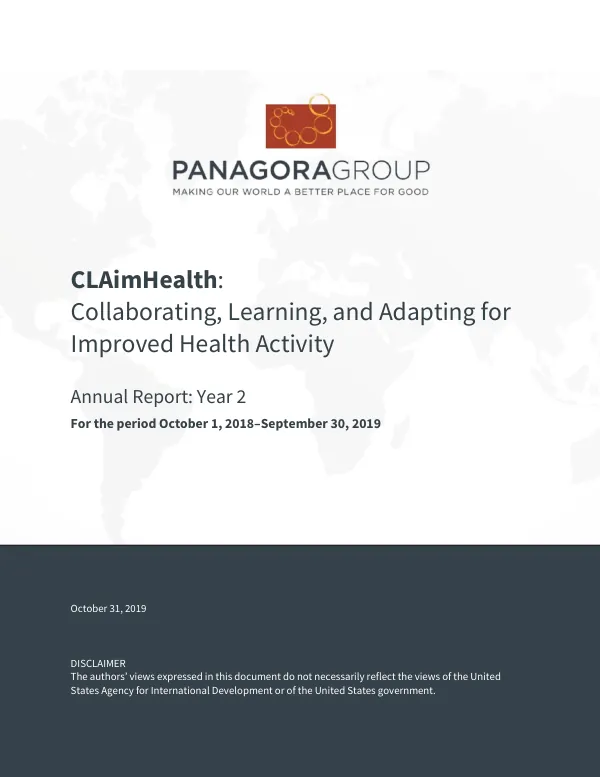
Annual Report: Year 2 for the Collaborating, Learning, and Adapting for Improved Health Activity
Sign inPANAGORA GROUP, INC.
Annual Report: Year 2 for the Collaborating, Learning, and Adapting for Improved Health Activity
The Collaborating, Learning, and Adapting for Improved Health (CLAimHealth) activity is a technical support mechanism of the Office of Health (OH) of U.S.
2019 · 47 pages
Sign in to readA free account is required to download.
Abstract
Agency for International Development (USAID)/Philippines. The activity provides technical assistance, advisory services, capacity building, and logistical support to strengthen strategic collaboration with partners, scale up good practices, and adapt programs based on data-driven recommendations. The specific objectives of CLAimHealth are to streamline and strengthen the Health Portfolio performance monitoring and evaluation (M&E) processes and tools, provide a strong technical evidence base for continuous learning and adaptive management, enhance the skills of OH staff and implementing partners (IPs) on the use of data for decision-making, and foster a culture that supports collaborating, learning, and adapting (CLA). In Year 2, CLAimHealth developed and enhanced key MEL tools for the Health Project (HP), including refinement of the HP Results Framework and HP performance indicators (HPPIs), Data Quality Assessment (DQA) Plan and tools, and development of the Activity MEL Plans (AMELPs) of existing and new activities. The activity also provided regular support for OH's key platforms for CLA technical working group (TWG) meetings, adaptive management sessions (AMS), and the OH Knowledge Library (KL). CLAimHealth documented and disseminated learnings from five HP good practices and promising interventions (GPPIs) in Year 2, including family planning (FP) in hospitals, program for young parents, FP days, service delivery networks (SDNs) for FP and maternal and child health in underserved populations, and the journal to self-reliance (J2SR) of the Integrated Midwives Association of the Philippines (IMAP). The activity also conducted secondary data analyses (SDA) of the 2016 National TB Prevalence Survey (NTPS) and the 2017 National Demographic and Health Survey (NDHS) with respect to FP issues. In recognition of its efforts, USAID named Panagora/CLAimHealth a finalist in the 2019 CLA Case Competition, which is held annually by the USAID Learning Lab. The case study describes USAID/Philippines OH's efforts to instill a CLA culture among the 11 HP activities mainly through a coordination framework that facilitates collaboration and a data-driven approach to decision-making. The geographic coverage of CLAimHealth includes USAID-assisted sites covered by tuberculosis, family planning/reproductive health, and health systems strengthening activities. The activity has a strong focus on data-driven decision-making, adaptive management, and collaboration with partners to improve health outcomes in the Philippines. In Year 2, CLAimHealth made significant progress in achieving its objectives, including the development and enhancement of key MEL tools, documentation and dissemination of learnings from GPPIs, and conduct of secondary data analyses. The activity's efforts to foster a culture of CLA and promote data-driven decision-making have been recognized by USAID, and the activity continues to play a critical role in supporting the Health Project's efforts to improve health outcomes in the Philippines.