USAID DEC
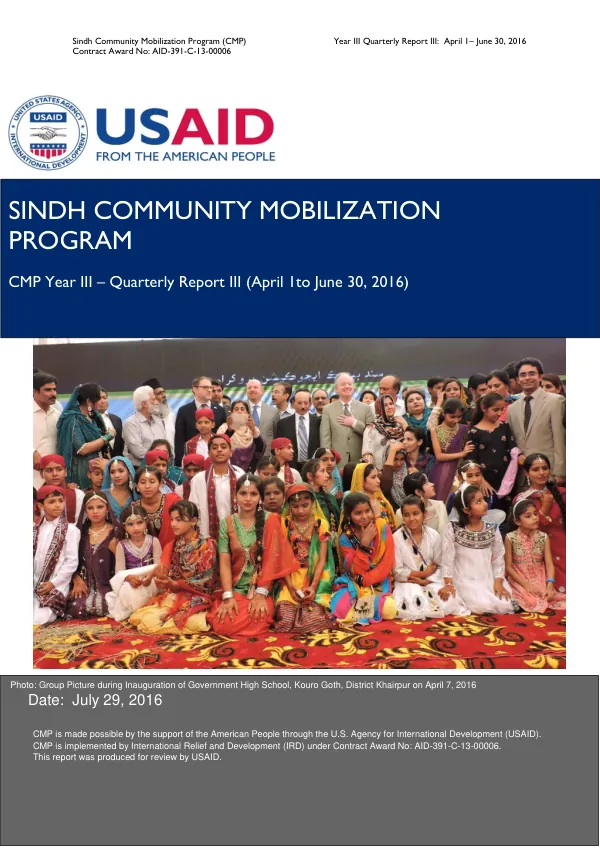
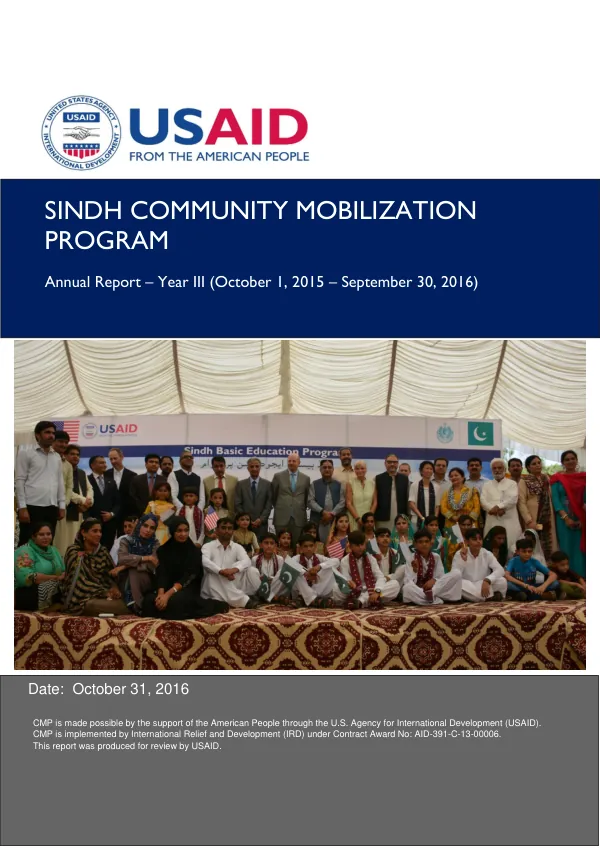
Annual Report – Year III (October 1, 2015 – September 30, 2016) of Sindh Community Mobilization Program (CMP)
Sign inGOVERNMENT OF SINDH
Annual Report – Year III (October 1, 2015 – September 30, 2016) of Sindh Community Mobilization Program (CMP)
The Sindh Community Mobilization Program (CMP) is a five-year USAID-funded initiative implemented by International Relief and Development (IRD) that commenced in August 2013.
2016 · 65 pages
Sign in to readA free account is required to download.
Abstract
The program forms a cornerstone of the Sindh Basic Education Program (SBEP), particularly component four of the program. CMP has four key components: 1) increasing communities' involvement in the Government of Sindh (GOS) reform of merging, consolidating, and upgrading schools; 2) improving community and district administrations' coordination for increased girls' enrollment; 3) improving child nutrition in selected communities and government schools through research that informs good practice; and 4) piloting the launch of Education Management Organizations (EMOs). The program has five cross-cutting themes that significantly add value to these objectives: 1) gender mainstreaming of program activities; 2) Water and Sanitation (WATSAN): improved facilities, knowledge, and practice; and 3) Disaster Risk Reduction (DRR): improved awareness, knowledge, preparation, and practice. Additionally, CMP provides small grants to neighboring schools to address needs that they identify and prioritize in school improvement plans (SIPs). The program tracks and supports the construction, merging, and upgrading of SBEP schools. CMP works with neighboring schools that fall within designated areas around new schools being built under SBEP, which accord with specific criteria. The program aims to increase and sustain student enrollment in primary, middle, and higher secondary schools in seven districts in northern Sindh. The seven districts are Dadu, Jacobabad, Khairpur, Shikarpur, Larkana, Qamber Shahdadkot, and Sukkur, as well as the five towns Bin Qasim, Gadap, Kemari, Lyari, and Orangi of Karachi City in Sindh Province. The program focuses on increasing and sustaining student enrollment in primary, middle, and higher secondary schools, with a particular emphasis on girls' enrollment. The program has seven components: 1) construction of schools in areas affected by the 2010 floods; 2) support to GOS policy reforms to merge, consolidate, and upgrade schools through construction of schools; 3) improvement in early grade reading in primary schools; 4) community mobilization, with a focus on increasing girls' enrollment and improving nutritional status of children; 5) technical assistance to the GOS's Education and Literacy Department (ELD); 6) architecture and engineering support for school construction; and 7) monitoring and evaluation. The program has made significant progress in increasing student enrollment, particularly in girls' enrollment, and improving child nutrition in selected communities and government schools. The program has also supported the construction, merging, and upgrading of schools in the designated areas.