USAID DEC
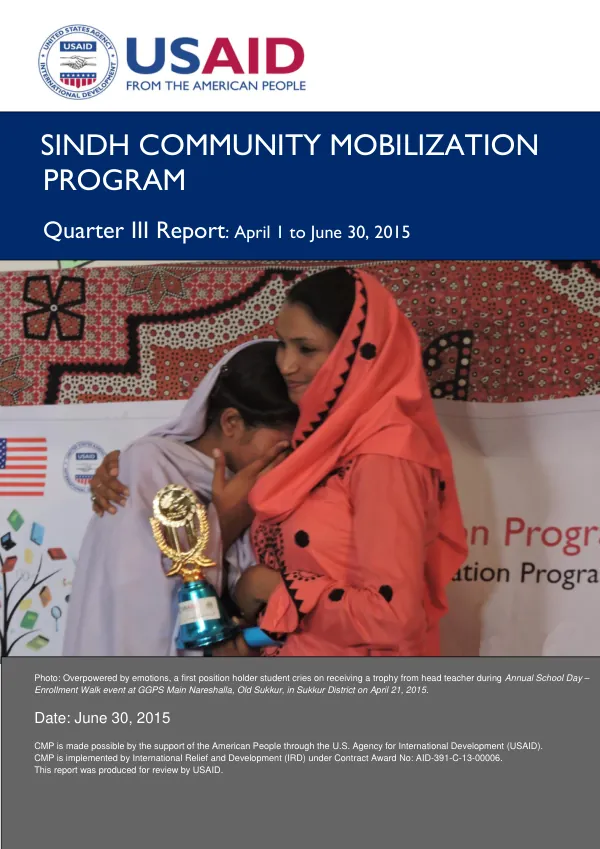
Sindh Community Mobilization Program (CMP) Third Quarterly Report: April 1 – June 30, 2015
Sign inGOVERNMENT OF SINDH
Sindh Community Mobilization Program (CMP) Third Quarterly Report: April 1 – June 30, 2015
The Sindh Community Mobilization Program (CMP) is a five-year initiative implemented by International Relief and Development (IRD) in collaboration with the Government of Sindh (GOS).
2015 · 70 pages
Sign in to readA free account is required to download.
Abstract
The program is a cornerstone of the Sindh Basic Education Program (SBEP), which aims to increase and sustain student enrollment in primary, middle, and higher secondary schools. SBEP focuses on seven provincial districts and five Karachi City towns. CMP has four key objectives, which are separated into four components. The first component aims to increase communities' involvement in the GOS reform of merging, consolidating, and upgrading schools. This involves supporting the GOS in its efforts to improve the education sector through policy reforms. The second component focuses on improving community and district administrations' coordination for increased girls' enrollment. This includes working with local stakeholders to identify and address barriers to girls' education. The third component of CMP aims to improve child nutrition in selected communities and government schools through research that informs innovation and good practice. This involves conducting research on effective nutrition interventions and working with local partners to implement these interventions. The fourth component is a pilot component that focuses on the launch of an Education Management Organization (EMO) system. This system aims to improve the management and administration of schools in the target areas. CMP is implemented in seven provincial districts and five Karachi City towns, with a focus on increasing girls' enrollment and improving the nutritional status of children. The program is supported by the United States Agency for International Development (USAID) and is implemented by IRD under Contract Award No: AID-391-C-13-00006. The third quarterly report for CMP covers the period from April 1 to June 30, 2015. During this period, the program made significant progress in achieving its objectives. The report highlights the achievements of the program, including the increase in communities' involvement in the GOS reform of merging, consolidating, and upgrading schools. The report also highlights the progress made in improving community and district administrations' coordination for increased girls' enrollment. The report also provides an overview of the activities implemented under each component of the program. For example, under Component 1, the program supported the GOS in its efforts to improve the education sector through policy reforms. This included working with local stakeholders to identify and address barriers to girls' education. Under Component 2, the program worked with local partners to improve child nutrition in selected communities and government schools. The report also highlights the successes achieved by the program during the reporting period. For example, the program reported a 27% increase in girls' enrollment in schools in the target areas. The report also highlights the challenges faced by the program, including the need to improve the capacity of local stakeholders to implement the program's objectives. The report concludes by highlighting the plans for the next reporting period. The program plans to continue its efforts to increase communities' involvement in the GOS reform of merging, consolidating, and upgrading schools. The program also plans to continue its efforts to improve community and district administrations' coordination for increased girls' enrollment. The report ends by highlighting the importance of continued support for the program to achieve its objectives. Overall, the third quarterly report for CMP provides a comprehensive overview of the program's achievements and challenges during the reporting period. The report highlights the progress made by the program in achieving its objectives and provides a roadmap for the next reporting period.