GOVERNMENT OF SINDH
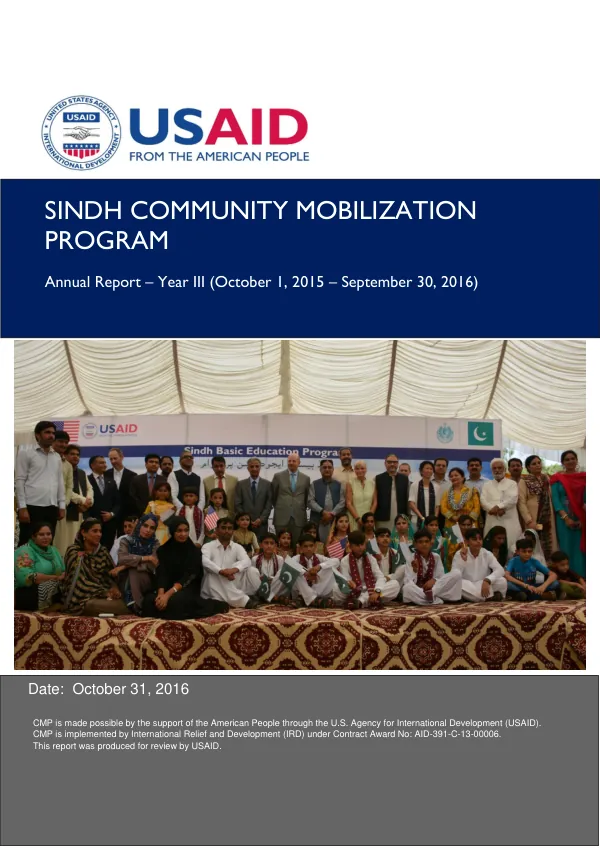
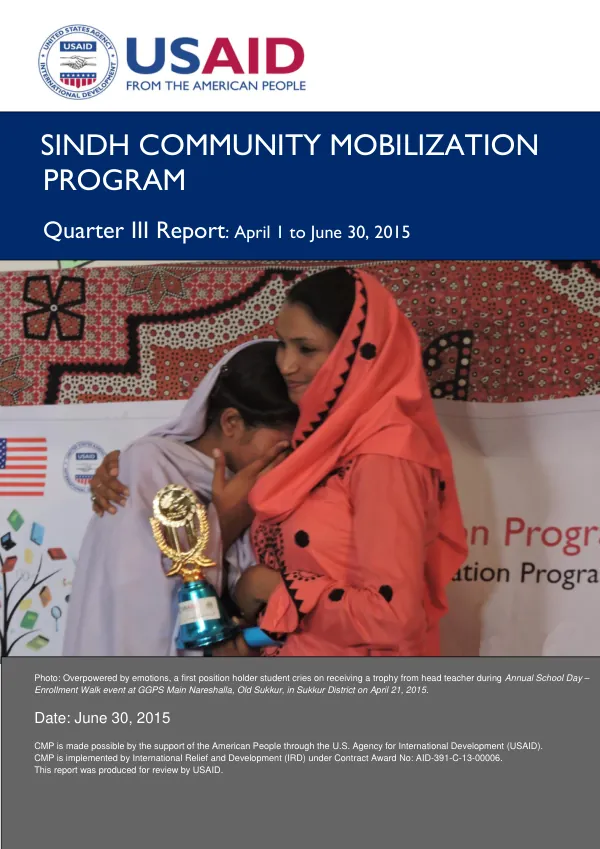
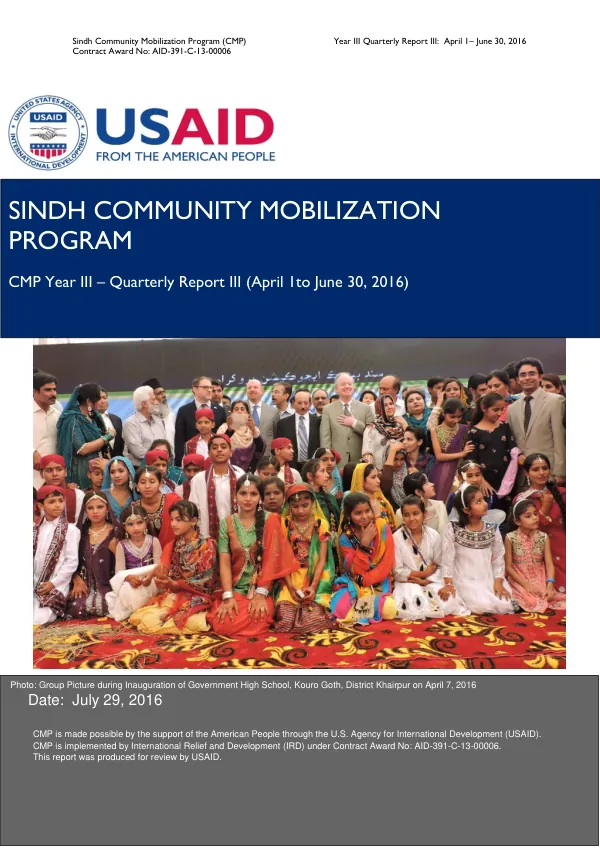
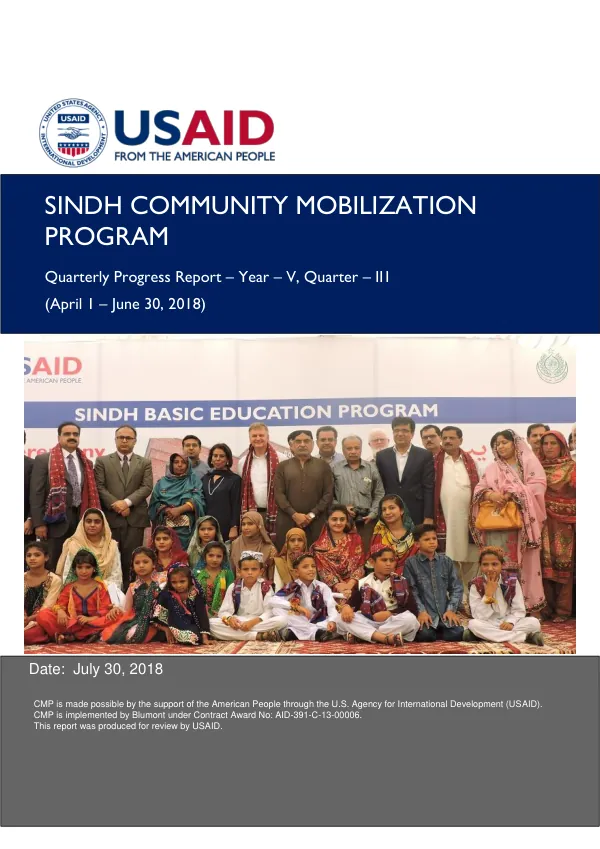
Sindh Community Mobilization Program, Year IV Work Plan
The Sindh Community Mobilization Program (CMP) is a five-year initiative implemented by International Relief and Development (IRD) in collaboration with the Government of Sindh (GOS) and the United States Agency for International Development (USAID).
2016 · 76 pages
Sign in to readA free account is required to download.
Abstract
The program aims to increase and sustain student enrollment in primary, middle, and higher secondary schools in seven districts of northern Sindh and five towns in Karachi City. The program is comprised of four key components: 1) Increase communities' involvement in the GOS reform of merging, consolidating, and upgrading schools; 2) Improve community and District administrations' coordination for increased girls' enrollment; 3) Improve child nutrition in selected communities and government schools through research that informs innovation and good practice; and, 4) Pilot component: Launch of the Education Management Organizations (EMOs). Additionally, CMP has three cross-cutting themes: 1) Gender: Mainstreaming of program activities; 2) Water and sanitation (WATSAN): Improved facilities, knowledge, and practice; and, 3) Disaster Risk Reduction (DRR): Improved awareness, knowledge, preparation, and practice. The program tracks and supports the construction, merging, consolidation, and upgrading of SBEP schools. CMP works with neighboring schools that fall within designated areas around new schools being built under SBEP and that accord with the specific criteria set by USAID for CMP activities. The program's inclusive community activities are designed to make these educational improvements sustainable by increasing community support for their local schools and advocacy for better educational provision generally. The program's methodology involves a continuous monitoring and assessment process (CMAP) to track progress and identify areas for improvement. The program also conducts formative action research (FAR) to inform innovation and good practice in education management. The program's activities are coordinated through a project advisory group (PAG) that includes representatives from the GOS, USAID, and other stakeholders. The program's target areas include seven districts in northern Sindh and five towns in Karachi City. The program's geographic focus is on the Sindh Province, with a specific emphasis on the districts of Dadu, Jacobabad, Khairpur, Kashmore, Larkana, Qamber Shahdadkot, Sukkur, and the five towns in Karachi City. The program's timeframes are from October 1, 2016, to September 30, 2017, with a project ending date of August 6, 2018. The program's budget is supported by USAID, with a contract number of AID-391-C-13-00006. The program's implementation is overseen by a chief of party (COP) and a deputy chief of party (DCOP), who are responsible for ensuring the program's effective implementation and coordination with stakeholders. The program's key performance indicators (KPIs) include increased community involvement in school reform, improved community and District administrations' coordination for girls' enrollment, improved child nutrition, and the launch of Education Management Organizations (EMOs). The program's monitoring and evaluation framework includes a results-based framework (RBF) that tracks progress against the program's KPIs. The program's cross-cutting themes include gender mainstreaming, water and sanitation (WATSAN), and disaster risk reduction (DRR). The program's documentation outreach and communications plan includes a strategy for disseminating information to stakeholders and the public. The program's training plan includes a comprehensive training program for program staff and stakeholders. The program's annexes include a year IV work plan, a five-year work plan, a result-based framework, a training plan, and a school hygiene and nutrition committee (SHNC) strategy paper. The program's overall goal is to improve education outcomes in Sindh Province through community mobilization and education management reform.