USAID DEC
Sindh Community Mobilization Program (CMP) Year III Quarterly Report III: April 1– June 30, 2016
Sign inGOVERNMENT OF SINDH
Sindh Community Mobilization Program (CMP) Year III Quarterly Report III: April 1– June 30, 2016
The Sindh Community Mobilization Program (CMP) is a five-year initiative implemented by International Relief and Development (IRD) in collaboration with the Government of Sindh (GOS).
2016 · 56 pages
Sign in to readA free account is required to download.
Abstract
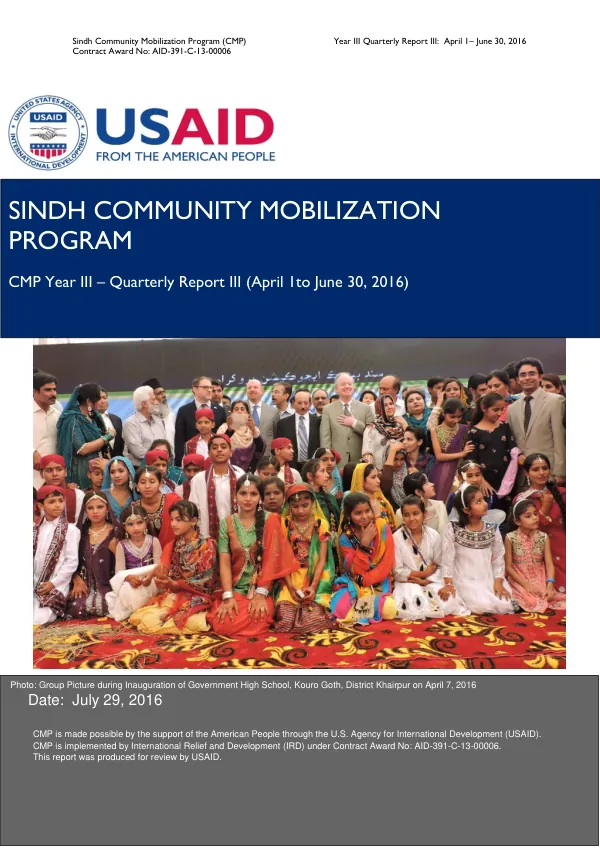
The program commenced in August 2013 and is focused on increasing and sustaining student enrollment in primary, middle, and higher secondary schools in seven districts of northern Sindh. The program is part of the Sindh Basic Education Program (SBEP), which aims to support the GOS's broader education reform agenda. The CMP has four key components: 1) Increase communities' involvement in the GOS reform of merging, consolidating, and upgrading schools; 2) Improve community and District administrations coordination for increased girls' enrollment; 3) Improve child nutrition in selected communities and government schools through research that informs innovation and good practice; and, 4) Pilot component: Launch of the Education Management Organizations (EMOs). Additionally, the program has three cross-cutting themes: 1) Gender: Mainstreaming of program activities; 2) Water and sanitation (WATSAN): Improved facilities, knowledge, and practice; and, 3) Disaster Risk Reduction (DRR): Improved awareness, knowledge, preparation, and practice. The program tracks and supports the construction, merging, consolidation, and upgrading of SBEP schools. CMP also works with neighboring schools that fall within designated areas around new schools being built under SBEP and that accord with the specific criteria set by USAID for CMP activities. The program's inclusive community activities are designed to make these educational improvements sustainable by increasing community support for their local schools and advocacy for better educational provision generally. In the third quarter of Year III (April 1 to June 30, 2016), the program achieved several milestones. Component 1 focused on increasing communities' involvement in the GOS reform of merging, consolidating, and upgrading schools. This involved the inauguration of a government high school in Kouro Goth, District Khairpur, on April 7, 2016. Component 2 improved community and District administrations coordination for increased girls' enrollment, with a focus on enhancing the capacity of District Education Officers (DEOs) and Assistant District Officers Education (ADOEs). Component 3 improved child nutrition in selected communities and government schools through research that informs innovation and good practice. This involved the establishment of School Hygiene and Nutrition Committees (SHNCs) in 15 schools, which aimed to improve the nutritional status of children. Component 4 launched the Education Management Organizations (EMOs) system, which aimed to improve the management and governance of schools. The program also made progress on its cross-cutting themes. The Gender Mainstreaming theme focused on increasing the participation of women in program activities, with a particular emphasis on increasing girls' enrollment in schools. The Water and Sanitation (WATSAN) theme aimed to improve the availability and quality of water and sanitation facilities in schools. The Disaster Risk Reduction (DRR) theme focused on improving the awareness, knowledge, preparation, and practice of communities to mitigate the impact of disasters. Overall, the Sindh Community Mobilization Program (CMP) has made significant progress in its third quarter of Year III. The program's activities have contributed to the improvement of education outcomes in the seven districts of northern Sindh, with a particular focus on increasing girls' enrollment and improving child nutrition. The program's cross-cutting themes have also contributed to the improvement of education outcomes, with a focus on gender mainstreaming, water and sanitation, and disaster risk reduction.