INTERNATIONAL YOUTH FOUNDATION
Annual Report: Youth:Work Jordan
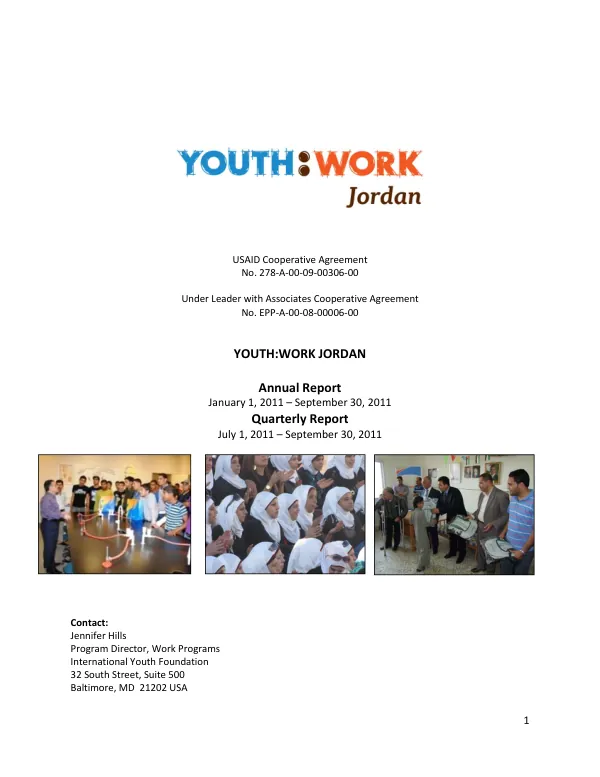
Youth:Work Jordan (YWJ) made significant strides in Year 3, with the program's three Coordination NGOs (CNGOs) entering their second and final year of managing community-based interventions in six communities.
2011 · 59 pages
Sign in to readA free account is required to download.
Abstract
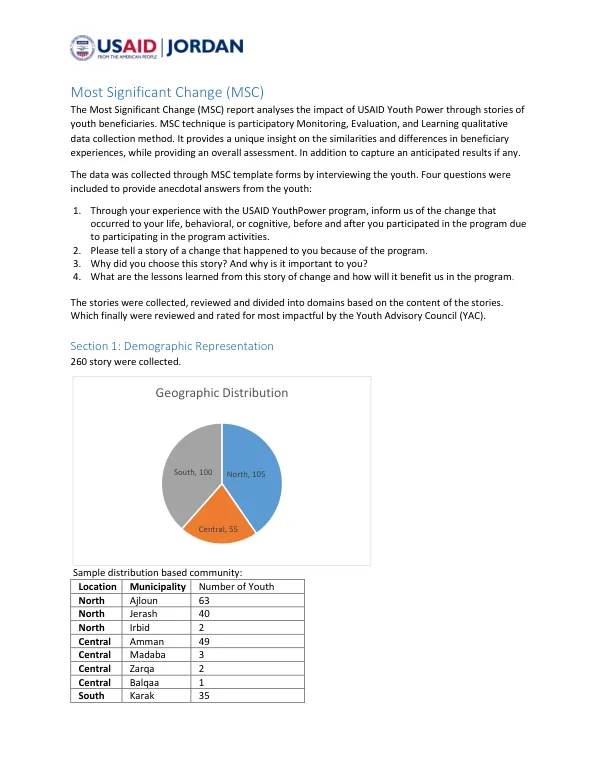
The program expanded to three new communities under the management of International Youth Foundation (IYF). YWJ focused on improving the quality of interventions supporting youth, scaling implementation activities, and empowering community-level actors to sustain the projects catalyzed by YWJ's community-based partners. By the end of Year 3, the CNGOs and their 22 Community-Based Organization (CBO) partners made significant progress in program implementation, reaching 3,083 youth beneficiaries, training 491 youth workers, and forging 69 strategic partnerships and community alliances. These activities resulted in a substantial increase in outreach activities, communications, and public events to highlight YWJ's achievements. The start-up of implementation in YWJ's expanded communities also got underway, with the award of 5 CBO grants to lead the implementation of YWJ's interventions and the initial recruitment and training of 382 youth in life skills and volunteerism. YWJ's midterm evaluation, carried out by World Education, Inc. for USAID, provided valuable lessons learned and recommendations that have helped inform programmatic and Monitoring and Evaluation (M&E) adjustments to YWJ's model and guide IYF's overall strategy and focus areas for the remaining two and a half years of the program. Notwithstanding these achievements and the tremendous efforts of YWJ's partners, the program faced challenges in meeting targets in a few key program areas, particularly in the areas of employability training and job placement. Institutional Capacity Building Activities were a key focus area for YWJ in Year 3. CNGOs made good progress in building the capacity of CBOs to improve their youth case management systems, track and coach youth prior to the job placement phase, and integrate the YWJ Career Guidance toolkit and other case management tools into the youth training activities. To date, 71% of youth have participated in career guidance activities. However, in the communities of Irbid, Zarqa, Russeifeh, and Ma'an, these achievements were adversely affected by poor internship and job placement rates for the youth. Literacy and psycho-social support services were also integrated into YWJ's activities in Year 3, with CNGOs working with their CBO partners to address the challenge of illiteracy amongst YWJ's target group and to better address the psychological needs of YWJ's at-risk youth. The CNGOs demonstrated considerable progress in building the capacity of CBOs to engage youth in effective volunteer and civic engagement activities, with 2,999 youth participating in youth civic engagement activities, representing 78% of YWJ's overall target. YWJ's employability capacity building and youth interventions were more tempered, with four out of six communities falling short of expected targets for job placement and internships. However, in East Amman, CBOs exceeded their job placement targets by 15% as a result of JCEF's capacity building efforts and technical support. Similarly, in the Jordan Valley, 73% of targeted youth have been placed in jobs, and there is a strong likelihood that JRF will meet close to 100% of their employment outcomes in Jordan Valley. Based on the midterm evaluation and the experience of the CNGOs and IYF's direct implementation activities, USAID and IYF collectively reflected on YWJ's achievements and challenges to date and strategized how best to position the YWJ program for maximum success after the CNGO grants end in December. A decision was made not to renew the CNGO grants in 2012 and instead shift YWJ's program approach and management structure so that IYF is directly supporting CBOs in all communities. This CBO-centered approach, coupled with more streamlined management structures, is expected to position YWJ well to more effectively ensure the quality of youth activities in the field and help make up shortfalls in targets to date.
Related documents