HELLEN KELLER INTERNATIONAL
Annual Result Report FY 2016: Harande
The Harande project operates in the Mopti region of Mali, specifically in the four districts of Youwarou, Tenenkou, Bandiagara, and Douentza.
2016 · 20 pages
Sign in to readA free account is required to download.
Abstract
The project focuses on improving sustainable food, nutrition, and income security for vulnerable household members in 290 communities. The project goal is to achieve this by 2020, with a total of 310,855 targeted participants. The project is divided into five main purposes: Human Capital, Livelihoods, Climate Change Resilience, Conflicts Limiting Food, Nutrition, and Income Security, and Social Accountability and Governance. Each purpose has several sub-purposes, which outline specific objectives and targets. Human Capital is the first purpose, with the goal of ensuring food, nutrition, and livelihood security among 143,285 vulnerable participants. This includes improving the health and nutrition status of pregnant and lactating women, as well as enhancing functional literacy and numeracy among participants. The second purpose is Livelihoods, which aims to diversify and improve market-based agricultural livelihoods among 64,000 targeted participants, including 60% women and 20% youth. Non-farm livelihoods among 4,500 youth are also targeted for improvement, as well as access to suitable financial services for 33,460 participants. Climate Change Resilience is the third purpose, with the goal of improving climate change resilience among 310,855 targeted farmers in targeted communities. This includes providing accurate climate information to 18,750 targeted farmers and increasing climate change resilience through adaptation plans. The fourth purpose is Conflicts Limiting Food, Nutrition, and Income Security, which aims to prevent and mitigate conflicts within the 290 targeted communities. This includes reducing negative impacts of conflicts and gender-based violence. The fifth and final purpose is Social Accountability and Governance, which aims to enhance food, nutrition, and income security for the 310,855 targeted participants. This includes improving access to and utilization of public services essential to food, nutrition, and income security, as well as incorporating transparency, accountability, and inclusive participation into structures and processes. The project targets a total of 310,855 participants, with specific numbers for each program element. These elements include Maternal Child Health, Nutrition, Basic Education, Agriculture Sector Capacity, Inclusive Financial Markets, Natural Resources and Biodiversity, and Capacity Building and Preparedness. The project operates in 290 communities across the four districts, with a focus on improving sustainable food, nutrition, and income security for vulnerable household members. The project's goals and objectives are outlined in the five main purposes, with specific targets and sub-purposes for each. The project's geographic focus is on the Mopti region of Mali, with a specific emphasis on the four districts of Youwarou, Tenenkou, Bandiagara, and Douentza. The project's purpose is to improve sustainable food, nutrition, and income security for vulnerable household members in these communities, with a total of 310,855 targeted participants. The project's implementation is divided into several program elements, each with specific targets and objectives. These elements include Maternal Child Health, Nutrition, Basic Education, Agriculture Sector Capacity, Inclusive Financial Markets, Natural Resources and Biodiversity, and Capacity Building and Preparedness. The project's monitoring and evaluation system includes several key components, including baseline studies, community characterization, population census, and vulnerability classification. The project also conducts regular monitoring and evaluation workshops to track progress and identify areas for improvement. The project's challenges and constraints include several key issues, including limited access to resources, inadequate infrastructure, and limited capacity among project staff. However, the project has also identified several solutions to these challenges, including the development of a detailed implementation plan, the establishment of a strong monitoring and evaluation system, and the provision of training and capacity-building opportunities for project staff. Overall, the Harande project is a comprehensive initiative aimed at improving sustainable food, nutrition, and income security for vulnerable household members in the Mopti region of Mali. The project's goals and objectives are outlined in the five main purposes, with specific targets and sub-purposes for each. The project's implementation is divided into several program elements, each with specific targets and objectives.
Related documents
Documents in this collection
 2015
2015USAID DEC
Improving Livelihoods of Conflict-Affected Populations (ILCP) in Douentza District, Mopti
Open record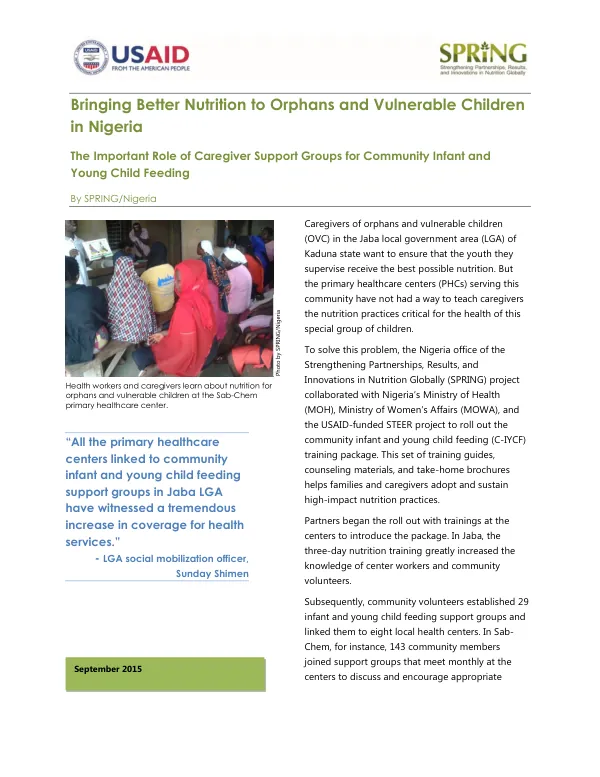 2015
2015USAID DEC
Bringing Better Nutrition to Orphans and Vulnerable Children in Nigeria: The Important Role of Caregiver Support Groups for Community Infant and Young Child Feeding
Open record