USAID DEC
Bringing Better Nutrition to Orphans and Vulnerable Children in Nigeria: The Important Role of Caregiver Support Groups for Community Infant and Young Child Feeding
Sign inHELLEN KELLER INTERNATIONAL
Bringing Better Nutrition to Orphans and Vulnerable Children in Nigeria: The Important Role of Caregiver Support Groups for Community Infant and Young Child Feeding
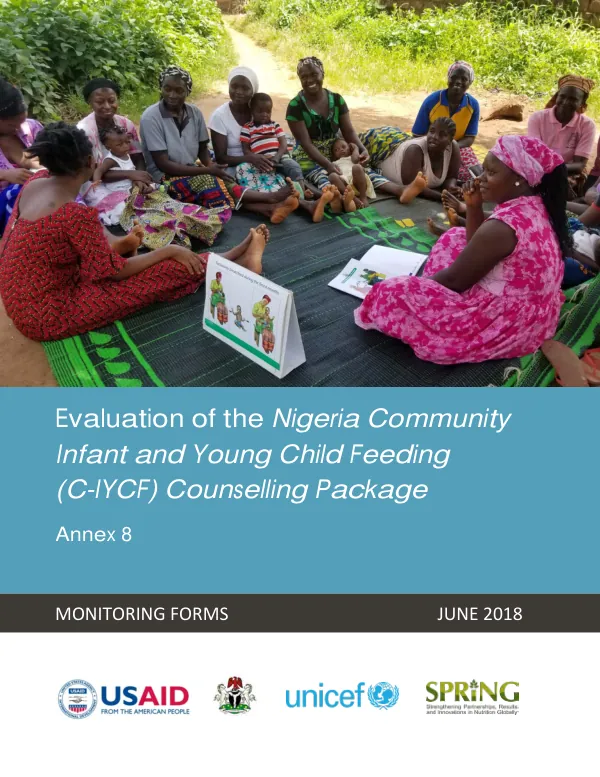
The Nigeria office of the Strengthening Partnerships, Results, and Innovations in Nutrition Globally (SPRING) project collaborated with Nigeria's Ministry of Health (MOH), Ministry of Women's Affairs (MOWA), and the USAID-funded STEER project to address the need for nutrition education among caregivers of orphans and vulnerable children (OVC) in the Jaba local government area (LGA) of Kaduna state.
2015 · 2 pages
Sign in to readA free account is required to download.
Abstract
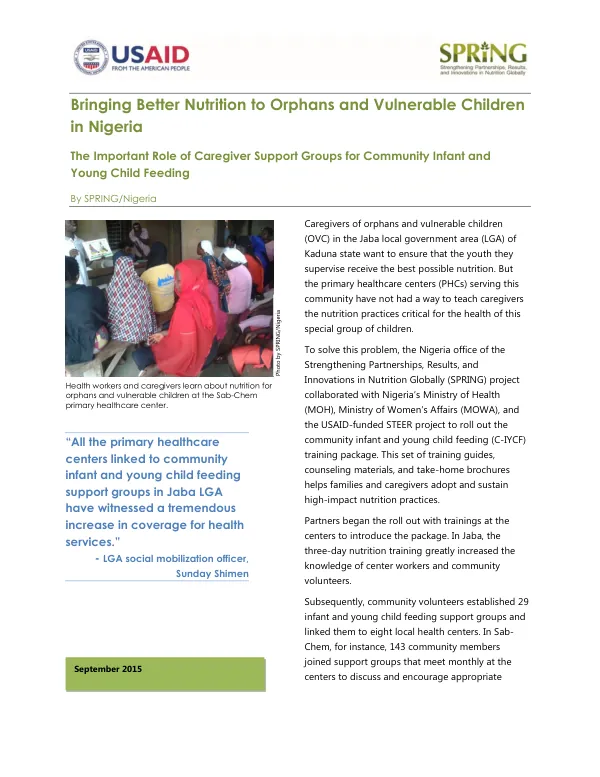
Caregivers in this community faced challenges in accessing accurate nutrition information, hindering their ability to provide optimal care for the children under their supervision. To address this issue, the SPRING project, in partnership with the MOH, MOWA, and the STEER project, rolled out the community infant and young child feeding (C-IYCF) training package. This package included training guides, counseling materials, and take-home brochures designed to help families and caregivers adopt and sustain high-impact nutrition practices. The training package was introduced to center workers and community volunteers through a series of trainings at primary healthcare centers in Jaba. Following the trainings, community volunteers established 29 infant and young child feeding support groups and linked them to eight local health centers. These support groups, which met monthly at the centers, provided a platform for caregivers to discuss and encourage the adoption of appropriate nutrition practices. Health workers and caregivers learned about nutrition for orphans and vulnerable children at the Sab-Chem primary healthcare center, where community volunteers established a support group that attracted 143 community members. The introduction of the C-IYCF training package and the establishment of support groups led to a significant increase in the knowledge of center workers and community volunteers. The improved ability of centers to provide accurate nutrition information generated greater demand for nutrition services and increased caregiver turnout. The Sab-Chem center, for instance, witnessed an 80 percent upturn in client flow. Caregivers' attitudes about and understanding of nutrition also improved, with many adopting best practices such as early initiation of breastfeeding, exclusive breastfeeding for six months, and appropriate and timely complementary feeding. The success of the C-IYCF training package and support groups in Jaba LGA has been acknowledged by local authorities. The LGA social mobilization officer, Sunday Shimen, noted that all primary healthcare centers linked to community infant and young child feeding support groups in Jaba LGA have witnessed a tremendous increase in coverage for health services. The SPRING project continues to collaborate with the MOH, MOWA, and other USAID implementing partners on the shared vision of bringing better nutrition and health to orphans and vulnerable children across Nigeria. The SPRING project works in Nigeria to reduce maternal and child undernutrition and increase HIV-free survival of infants and young children by improving nutrition care practices and access to quality services. Current activities focus on the roll-out of nutrition training packages, complementary social and behavior change communication approaches, and a joint evaluation on the C-IYCF package with UNICEF.
Related documents