HELLEN KELLER INTERNATIONAL
Families in Ebom, Nigeria Embrace Homestead Gardens
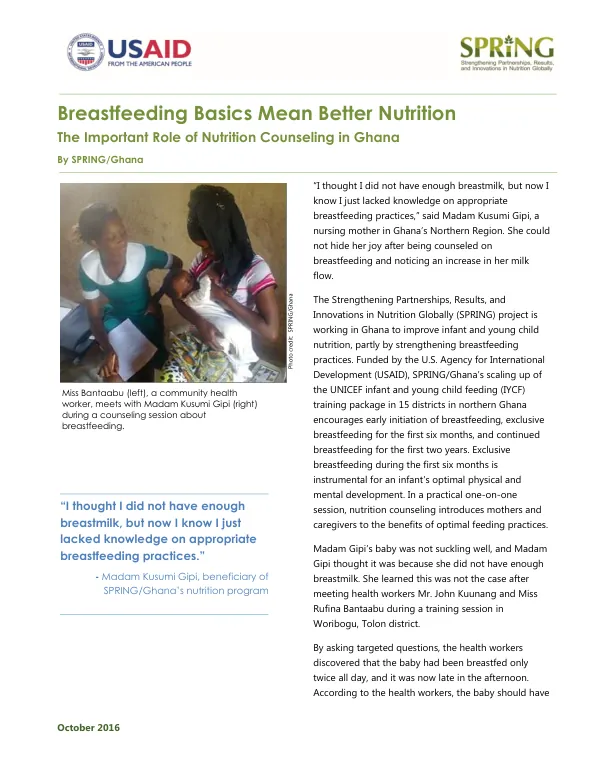
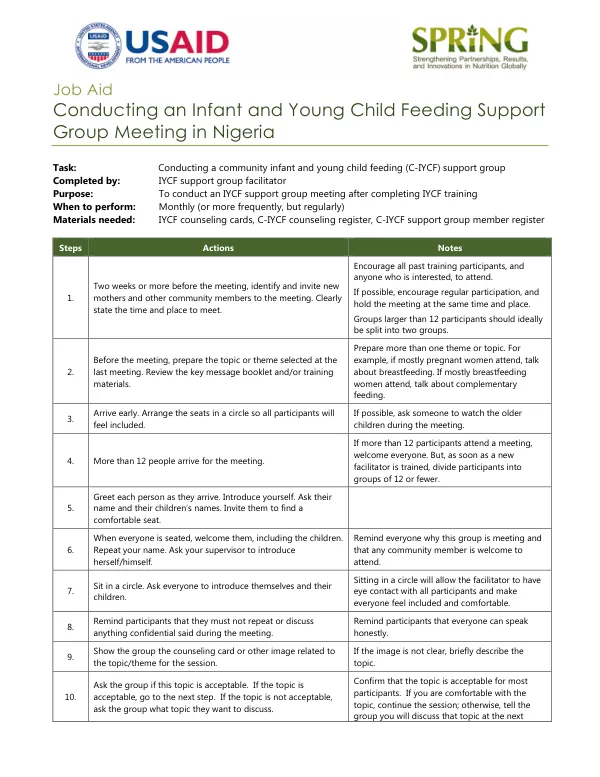
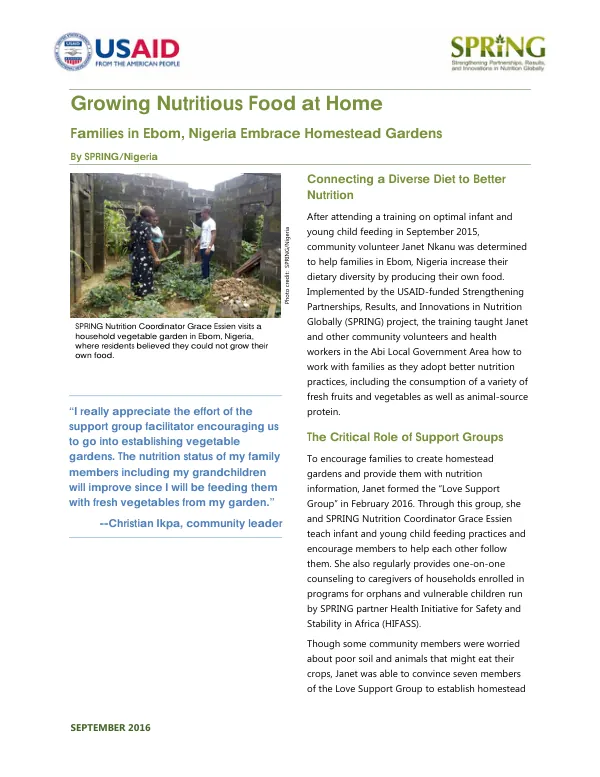
The agricultural development initiative in Ebom, Nigeria, began in 2015 with training on optimal infant and young child feeding.
2016 · 2 pages
Sign in to readA free account is required to download.
Abstract
Community volunteer Janet Nkanu, who attended the training, was determined to help families in the Abi Local Government Area increase their dietary diversity by producing their own food. Implemented by the USAID-funded Strengthening Partnerships, Results, and Innovations in Nutrition Globally (SPRING) project, the training taught Janet and other community volunteers and health workers how to work with families as they adopt better nutrition practices, including the consumption of a variety of fresh fruits and vegetables as well as animal-source protein. The critical role of support groups was identified as essential in encouraging families to create homestead gardens and provide them with nutrition information. Janet formed the "Love Support Group" in February 2016, which was led by SPRING Nutrition Coordinator Grace Essien. Through this group, Janet and Grace taught infant and young child feeding practices and encouraged members to help each other follow them. Janet also provided one-on-one counseling to caregivers of households enrolled in programs for orphans and vulnerable children run by SPRING partner Health Initiative for Safety and Stability in Africa (HIFASS). Seven members of the Love Support Group were convinced by Janet to establish homestead vegetable gardens to increase access to a quality, diverse diet and reduce household food costs. To start their gardens, support group members planted fluted pumpkin, waterleaf, okra, pepper, tomatoes, garden egg, and mint leaves. These vegetables were chosen for their nutritional value and because they are easily grown at the household level. The success of the Love Support Group and Janet's work educating families about the nutritional value of vegetables and other vitamin A-rich foods have led other community members and neighbors to begin cultivating home gardens. The homestead gardens in Ebom have the potential to provide a source of additional income for the families. Members of the support group anticipate a good yield when the vegetables are harvested, and they plan to sell any excess produce. Funded by the U.S. Agency for International Development, SPRING has provided technical support focusing on the first 1,000 days of life to prevent stunting and anemia in Nigeria since 2012. SPRING works in 104 local government areas across 16 states to strengthen community support systems by training community volunteers, establishing support groups, building the capacity of primary health care facilities in IYCF, and fostering linkages between support groups and facilities. The SPRING project is managed by the JSI Research & Training Institute, Inc. (JSI), with partners Helen Keller International, the Manoff Group, Save the Children, and the International Food Policy Research Institute. The project aims to strengthen community support systems and improve nutrition outcomes in Nigeria. By providing training and technical support to community volunteers and health workers, SPRING seeks to empower families to adopt better nutrition practices and improve their overall health and well-being.
Related documents
Documents in this collection
 2018
2018USAID DEC
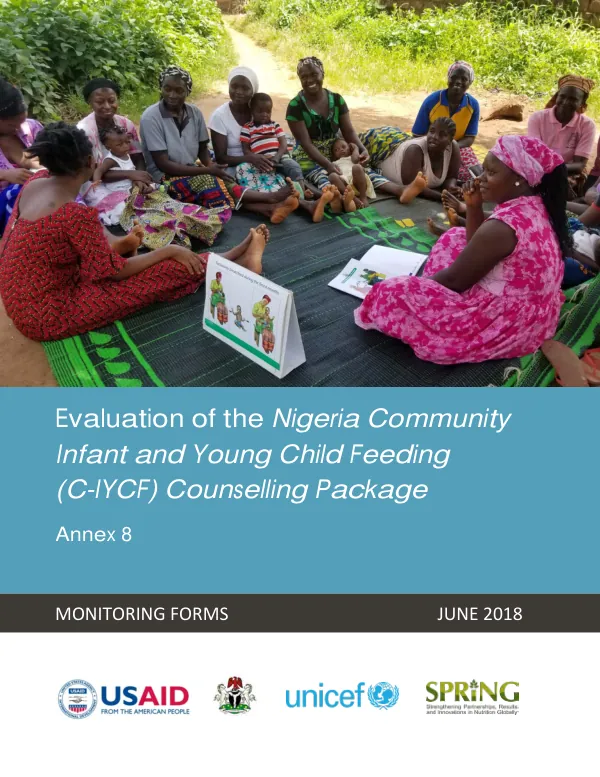
Evaluation of the Nigeria Community Infant and Young Child Feeding (C-IYCF) Counselling Package
Open record 2015
2015USAID DEC