USAID DEC
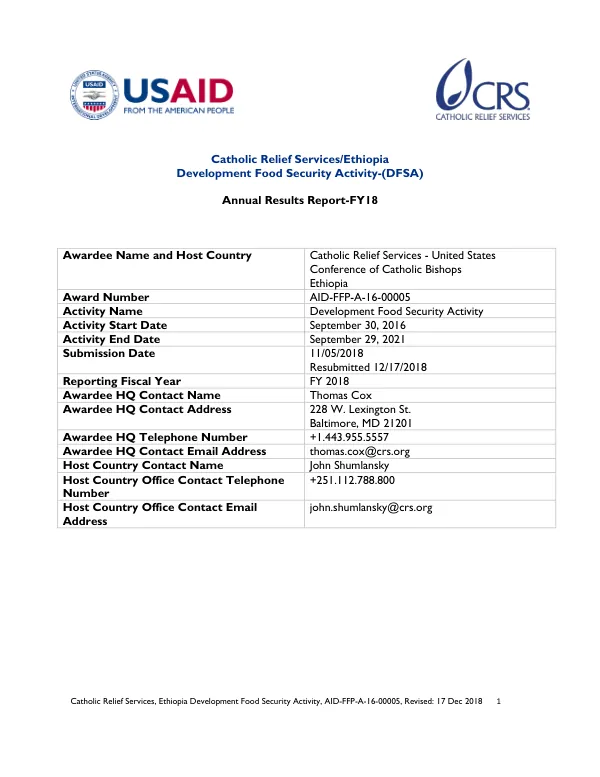
Annual Results Report-FY18: Catholic Relief Services/Ethiopia Development Food Security Activity-(DFSA)
Sign inCATHOLIC RELIEF SERVICES ORGANIZATION
Annual Results Report-FY18: Catholic Relief Services/Ethiopia Development Food Security Activity-(DFSA)
The Development Food Security Activity in Ethiopia, implemented by Catholic Relief Services, focuses on building resilience to shocks, enhancing livelihoods, and improving food security and nutrition for rural households vulnerable to food insecurity.
2018 · 36 pages
Sign in to readA free account is required to download.
Abstract
The geographic locations of the activity are East Hararghe, Arsi, and West Arsi Zones in the Oromia Region, and in Dire Dawa Administrative Unit with nine woredas in total. The activity targets 240,625 Productive Safety Net Program (PSNP) IV beneficiaries, with an additional 80,000 beneficiaries through capacity development of additional woredas, and aims to graduate 60,000 PSNP beneficiaries. The activity's Theory of Change (ToC) remains unchanged in FY18, with efforts directed towards nuanced edits. The CLA workshop helped flesh out implicit assumptions for Intermediate Outcomes (IOs) under Purpose 2, which were related to access, technical linkages, and customized services to vulnerable PSNP households. These assumptions were converted into learning questions within the CLA plan, and efforts will be made to address these questions and modify the ToC if necessary in FY 2019. A key assumption that came to fruition was the impact of security challenges in most of the activity's woredas, which impeded many activities, particularly the timeliness of commodity transfers. The activity's Purpose 1 focuses on GoE and community systems responding to reduce communities' and households' vulnerability to shocks. Sub-purpose 1.1 aims for GoE to successfully adopt the systems approach in PSNP 4, with Intermediate Outcome 1.1.1 being GoE woreda and kebele level institutions having improved coordinated service delivery. Output 1.1.1.1, Woreda level institutions having capacity to coordinate PSNP services, was achieved through training Woreda Food Security Task Force (WFSTF) and Technical Committee (TC) members on planning. CRS' DFSA trained 45 WFSTF/TC members and Implementing Partners (IPs), including one female, on the PSNP planning process, improving the quality of woreda PSNP plans by clarifying the criteria and quality of infrastructure targets. Additionally, CRS' DFSA provided technical support in the preparation of the annual PSNP plan. The activity also produced manuals and teaching aids for WFSTF, distributing 304 PSNP 4 Program Implementation Manuals, 231 Public Works Operation & Maintenance Guidelines, 608 Community Based Participatory Watershed Development Guidelines, Training Guides on Gender and Social Development, and 304 Environmental and Social Management Framework (ESMF) to all DFSA woreda government and partners' offices. These guidelines and manuals have enhanced the implementation capacity of the woreda government's institutions and partners. The activity served 65,211 households, including 128,365 men and 124,247 women, despite the complexities and recurring security obstacles. The activity's interventions and results demonstrate its commitment to building resilience to shocks, enhancing livelihoods, and improving food security and nutrition for rural households vulnerable to food insecurity.