USAID
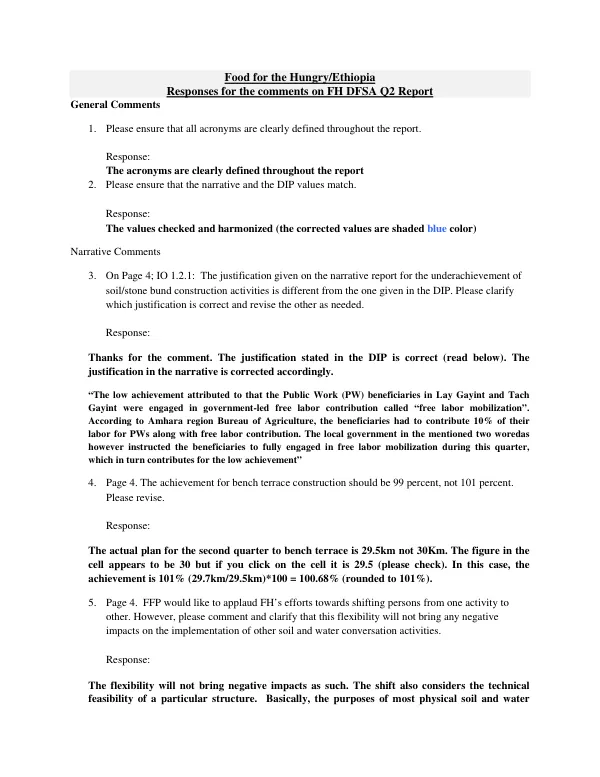
FH DFSA Q2 Report
The Food for the Hungry/Ethiopia DFSA Q2 Report responses address various comments and concerns raised by FFP regarding the report's content and accuracy.
2018 · 5 pages
Sign in to readA free account is required to download.
Abstract
The responses clarify discrepancies and provide additional information to ensure the report's integrity. The report's acronyms are clearly defined throughout, and the narrative and DIP values have been harmonized. The justification for the underachievement of soil/stone bund construction activities has been corrected to reflect the accurate reason, which is attributed to the Public Work beneficiaries' engagement in government-led free labor contribution. The achievement for bench terrace construction has been revised to 99 percent, and the flexibility in shifting persons from one activity to another will not bring negative impacts on the implementation of other soil and water conservation activities. The shift is based on technical feasibility, considering factors such as slope range, soil type, and labor availability. The low achievement of water collection trenches/percolation pits is attributed to Person Day shifts, but the shift will not have unintended negative impacts on other soil and water activities. The remaining water collection trench construction will be conducted in the upcoming quarter before the rainy season starts in June. The construction of social infrastructure is a process that takes over three months, and the narrative section illustrates the current status of a particular construction. The progress will be reported in the DIP when the construction is fully completed. Similarly, the plans for human health post construction will be reported in the DIP when the construction is fully complete. FH plans to address the issue of lack of interest from individuals/farmers to be trained and organized as local input suppliers by closely working with FH field staff, government counterparts, and the community. The introduction of improved storage facilities is an important intervention to help reduce post-harvest losses, and the costs of these facilities are not unaffordable for farmers. The adoption rate of improved storage facilities will be increased, and the TRAIN project efforts will contribute to reinforcing the purchasing power of beneficiaries. In the livelihood transfer component, FH achieved 80 percent of the plan, and the beneficiaries have contributed to starting dairy production and petty trading activities. The figure on FH DFSA IY2 prepositioning has been corrected, and the comparative advantages of implementing cash transfers using ACSI over the conventional method will be documented and reported in the upcoming quarter. The reasons for the low achievement of cash transfers have been resolved, and a full-time E-payment coordinator has been hired to improve the efficiency and effectiveness of e-cash transfers. The justifications for the underachievement of conducting nutrition days for dietary diversification vary across zones, and the reasons have been clarified. The remaining cooking demonstrations will be organized to address the low achievement.