USAID DEC
Approche « Centre de Santé Propre »
The "Centre Santé Propre" initiative aims to improve water, sanitation, and hygiene (WASH) services in healthcare facilities.
2016 · 7 pages
Sign in to readA free account is required to download.
Abstract
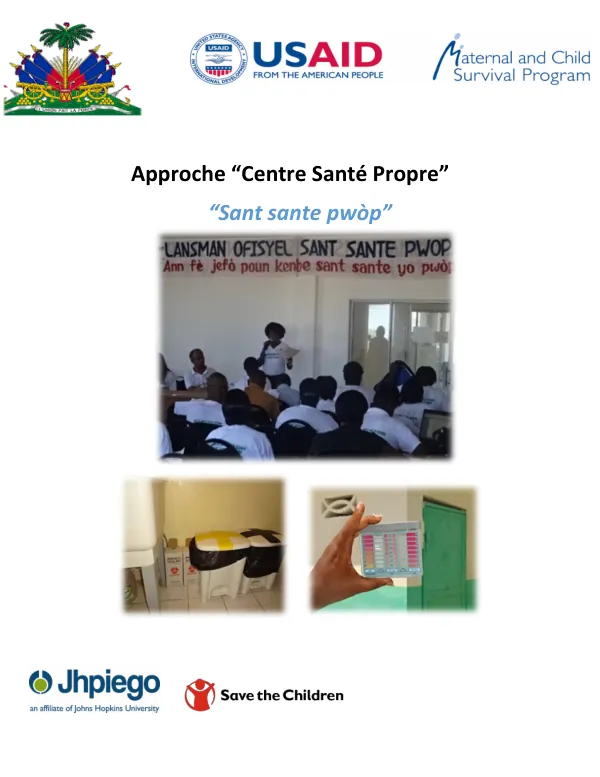
Infections associated with inadequate WASH services in healthcare facilities affect hundreds of millions of patients annually. Approximately 15% of patients develop one or more infections during a hospital stay, resulting in an estimated 430,000 neonatal deaths each year. The risk of infection in low-income facilities is 34 times higher than in high-income facilities. The "Centre Santé Propre" (CCA) approach was adopted by the Maternal and Child Survival Program (MCSP) in Haiti. This approach provides a programmatic tool that encourages healthcare facilities to establish WASH objectives and make progressive improvements towards achieving the ultimate goal of becoming a "Centre Santé Propre," as defined by the Ministry of Public Health (MSPP). The CCA recognizes that the greatest obstacle to improving the WASH component in sites is related to behavior and management, although ideal WASH conditions in a healthcare facility may require increased funding, personnel, training, and hygiene regulations. Small improvements can make a difference, such as improving waste management processes, ensuring handwashing stations are identified and designated, and assigning roles for maintenance. The objectives of the "Centre Santé Propre" initiative include integrating WASH into the quality improvement program of healthcare facilities, developing autonomous facilities that are clean, attractive, and well-visited, and strengthening the capacity of healthcare facility personnel, teams, and communities to improve WASH services without external assistance. The implementation of the CCA approach involves several steps, including evaluating targeted healthcare facilities, establishing consensus and/or improving minimum standards for healthcare facilities, developing program parameters and documentation with the government, introducing the CCA program in targeted healthcare facilities, and implementing action plans to achieve the "Centre Santé Propre" status. The CCA approach also involves monitoring progress towards achieving the "Centre Santé Propre" status, following up on facilities that have achieved this status, and delivering rewards to facilities and personnel. A "Centre Santé Propre" is a healthcare facility that has maintained minimum and higher standards in water, sanitation, and hygiene as defined by the MSPP and WHO for 12 consecutive months. To achieve the "Centre Santé Propre" status, a healthcare facility must meet certain conditions, including having progressive scores during formal inspections by the Departmental Health Directorate, achieving an average of 80% on the total score of the three final inspection scores in the current trimester, and achieving 100% on the excreta management aspect at the third inspection visit. The CCA approach recognizes four levels of "Centre Santé Propre" status, including Centre de santé propre – GARANTI, Centre santé propre- ARGENT, Centre santé- OR, and Centre santé- DIAMANT. The certification process involves monthly inspections by the Departmental Health Directorate, with results displayed at the DDS level and distributed to participating facilities one week after inspections. The classification is made at the third month to certify facilities that have achieved one of the four statuses. After scaling up, the DDS may adjust the frequency of inspection visits as needed.