FOOD AND AGRICULTURE ORGANIZATION OF THE UNITED NATIONS IN GEORGIA
April Collaboration Meeting Report_DEC Version
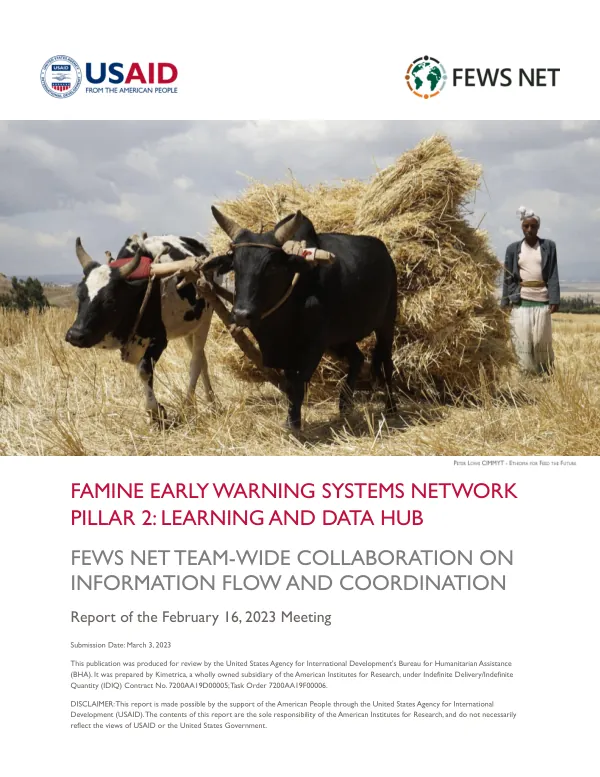
The Famine Early Warning Systems Network (FEWS NET) Collaboration meeting on Information Flow and Coordination was held virtually on April 15, 2021.
2021 · 27 pages
Sign in to readA free account is required to download.
Abstract
The meeting brought together 23 participants representing the US Agency for International Development (USAID), the FEWS NET Early Warning (EW) team, the Learning and Data Hub (Hub) team, and the Science team: United States Geological Survey (USGS), University of California, Santa Barbara (UCSB), and the National Oceanic and Atmospheric Administration (NOAA). Each team provided brief updates on bilateral collaboration activities. The EW-Science team collaborations included reviewing assumptions that underlie weather hazards and flood risks, producing several alerts for the Horn of Africa, finalizing activities for the virtual Southern Africa Crop Tour, and adding country-level administrative units relevant to the EW team's analysis in the USGS Early Warning eXplorer. The EW-Hub team collaborations involved convening the Communications Working Group and FEWS NET Brand Identity activity, finalizing integration of the FAO API into the FEWS NET Data Warehouse (FDW), coordinating on training sessions and demonstrations of the FDW and FDE, and adding new data domains and functionalities into the FEWS NET Data Explorer (FDE). The Science-Hub team collaborations included supporting the Science team's virtual Southern Africa Crop Tour by creating an ODK Server for field data collection and collaborating with USGS on data workflow activities by updating the country and region pages on the fews.net website with revised dataset names for remote sensing content. The Hub and EW teams jointly presented an update on the Country Case Study (CCS), which covered the four phases of the work: inception, discovery, identify ideas for improvement, and iterative design and testing. The CCS update highlighted progress in implementing improvements, including standardizing indicator names and adapting the system's filtering processes to store multiple exchange rates per country. The teams also discussed the integration of new visualizations with the FEWS NET Brand Identity activity and the use of reusable visualizations. The CCS page on the FEWS NET Exchange stores relevant documentation, including meeting minutes and discovery. The Hub presented an analysis of viewership of the COVID-19 landing page (CLP) on the FEWS NET website, covering five months from May 22 to approximately six weeks after the addition and publicizing of the interactive, dynamic map linking COVID-19 data with FEWS NET's IPC rankings. The analysis found that the CLP accounted for two to three percent of fews.net's pageviews, with viewership growing substantially following the Hub's publicity campaign and complementary amplification by FEWS NET implementing partners. However, viewership declined from an average of 32 pageviews per day from May 22 to November 30 to 16 pageviews per day from December 2020 through March 2021. The teams discussed whether the significant investment made by the implementing partners was "worth it" and concluded that conducting and promoting the Project's COVID-19 food security analysis was not only necessary but productive because it served as an important learning experience for FEWS NET partners. The activity further reinforced existing collaborations between the EW team and the Hub, provided a use case for the Hub to create and polish its first dynamic map, and motivated the Project to define dissemination goals and identify which tools and platforms could monitor its impact. The activity also provided support for USAID's need to explore and share information on the links between COVID-19 and food insecurity.
Related documents