FOOD AND AGRICULTURE ORGANIZATION OF THE UNITED NATIONS IN GEORGIA
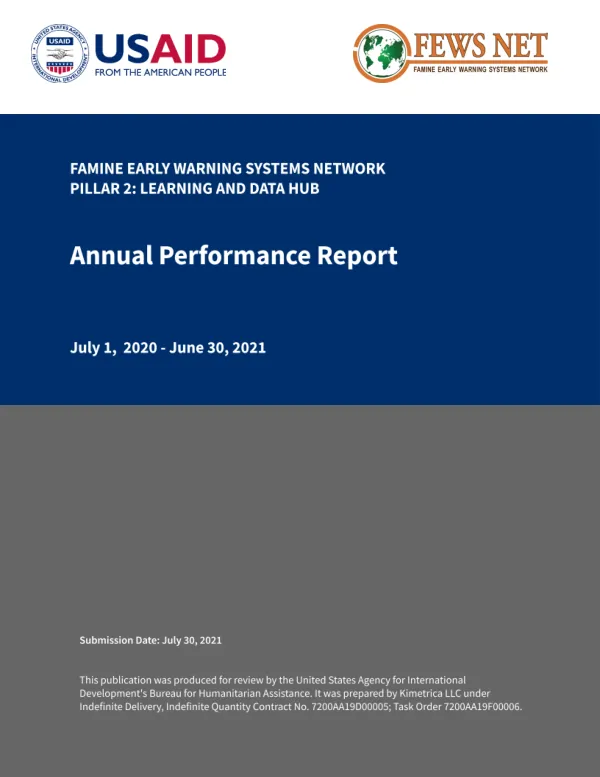
FEWS NET Hub Annual Performance Report: July 1, 2020 - June 30, 2021
The Famine Early Warning System Network (FEWS NET) Learning and Data Hub (the Hub) completed its second year of implementation at the end of June 2021.
2021 · 26 pages
Sign in to readA free account is required to download.
Abstract
The Hub's work is organized into four workstreams: the Data Management Platform (DMP); the Web Platform; Knowledge and Learning (K&L); and Management. The Hub made significant improvements to the FEWS NET DMP during the second year, introducing interactive visualizations, developing new labor-saving features, and further documenting the system functionality and compliance parameters. The DMP team accomplished several major achievements, including the introduction of interactive visualizations and the documentation of compliance parameters. The system is now faster, with more robust datasets and documentation, and is better equipped to handle more drastic feature changes. During the second year, there were eleven major FDW/FDE releases that added 339 new features, changes, and improvements to the system, such as improvements to data ingestion, user interfaces, analytical tools, and visualizations, and the REST/API. The FDW had an average uptime of 99.96 percent, above the target annual threshold of 99.7 percent. The Hub also managed and maintained the fews.net website, responding to and resolving Helpdesk inquiries, and making 28 public-facing releases to maintain the secure and disruption-free functioning of the platform. The website achieved an uptime of 99.99 percent during the year, exceeding the TO 1 contract requirement of 99.70 percent. In the Knowledge and Learning workstream, the Hub developed the FEWS NET-wide Outreach Strategy, a deliverable for the second year, with a draft for comment submitted to USAID. The strategy includes results from desk research and stakeholder interviews, illustrative tasks, and recommendations for follow-up. Work on a brand identity refresh for FEWS NET proceeded as planned, using working group sessions to create options for USAID review on voice and visual design elements for documents, the fews.net website, and data visualizations. The Hub recruited a Documentation Specialist and integrated data documentation into the monthly Data Sprints, providing structure and resources for this work in future years. The Hub's management focused on improving communications and collaboration between the Hub and the rest of the FEWS NET implementing team, as well as working with USAID to build links to the greater food security community. The Hub Director worked closely with the Hub's Contracting Officer's Representatives (COR and USAID FEWS NET Management and Program Analyst) to ensure the Hub's work plan activities were designed to serve the needs of the other FEWS NET team Implementing Partners (IPs), as well as the greater FEWS NET community. On the administrative side, the Hub worked with USAID to shift time allocation between staffing categories to increase productivity. The Hub's DMP workstream consists of a set of activities designed to manage, maintain, and improve the FEWS NET DMP, including the FEWS NET Data Warehouse (FDW) and the FEWS NET Data Explorer (FDE), as well as other digital applications needed to store, manipulate, and disseminate the core FEWS NET databases. The DMP team accomplished several major achievements, including the introduction of interactive visualizations and the documentation of compliance parameters. The system is now faster, with more robust datasets and documentation, and is better equipped to handle more drastic feature changes. The Hub's DMP team also continued basic maintenance, bug resolution, and system upgrades. During the second year, the FDW had an average uptime of 99.96 percent, above the target annual threshold of 99.7 percent. The Hub's DMP team also ensured that the entire platform is compliant with USAID's applicable regulations and standards. The Hub's DMP team designed and managed new datasets, visualizations, and analytical tools, as requested by USAID. The Hub's Web Platform workstream consists of a set of activities designed to manage and maintain the fews.net website, responding to and resolving Helpdesk inquiries, and making public-facing releases to maintain the secure and disruption-free functioning of the platform. The website achieved an uptime of 99.99 percent during the year, exceeding the TO 1 contract requirement of 99.70 percent. The Hub's Knowledge and Learning workstream consists of a set of activities designed to develop the FEWS NET-wide Outreach Strategy, a deliverable for the second year, with a draft for comment submitted to USAID. The strategy includes results from desk research and stakeholder interviews, illustrative tasks, and recommendations for follow-up. Work on a brand identity refresh for FEWS NET proceeded as planned, using working group sessions to create options for USAID review on voice and visual design elements for documents, the fews.net website, and data visualizations. The Hub's Management workstream consists of a set of activities designed to improve communications and collaboration between the Hub and the rest of the FEWS NET implementing team, as well as working with USAID to build links to the greater food security community. The Hub Director worked closely with the Hub's Contracting Officer