THE JANE GOODALL INSTITUTE
ARC Education and Water – March 2012 Nairobi workshop and follow up
The ARC Education and Water project aimed to mainstream religious values into faith schools to promote Education for Sustainable Development (ESD) in Kenya.
2012 · 3 pages
Sign in to readA free account is required to download.
Abstract
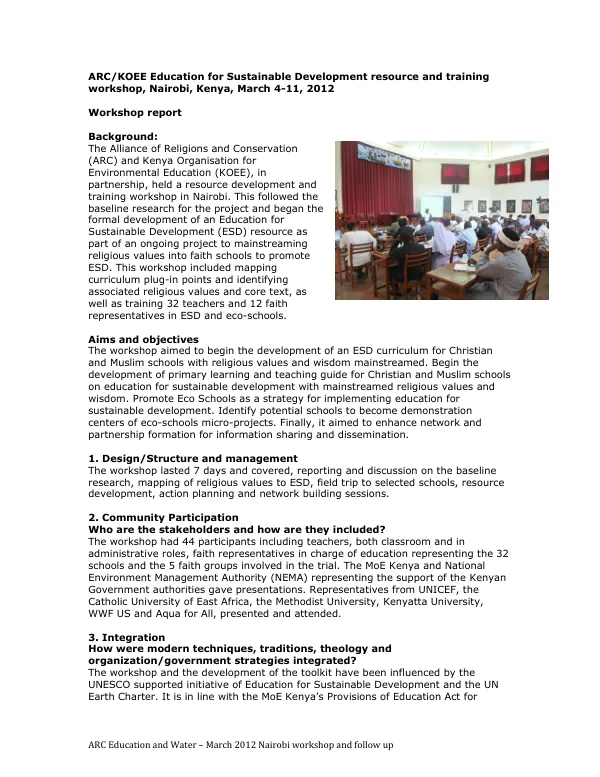
The project was a partnership between the Alliance of Religions and Conservation (ARC) and the Kenya Organisation for Environmental Education (KOEE). The project's primary goal was to develop an ESD curriculum for Christian and Muslim schools, incorporating religious values and wisdom. The project began with a baseline research study, which identified the need for an ESD curriculum that integrated religious values. The research also highlighted the importance of promoting Eco-Schools as a strategy for implementing ESD. The project's workshop, held in Nairobi from March 4-11, 2012, brought together 44 participants, including teachers, faith representatives, and government officials. The workshop aimed to develop an ESD curriculum, identify potential schools to become demonstration centers of eco-schools, and enhance network and partnership formation for information sharing and dissemination. The workshop was structured to include reporting and discussion on the baseline research, mapping of religious values to ESD, field trips to selected schools, resource development, action planning, and network building sessions. The workshop was influenced by the UNESCO-supported initiative of Education for Sustainable Development and the UN Earth Charter. The project also drew on the expertise of various organizations, including the Kenya Institute of Education (KIE), the National Environment Management Authority (NEMA), and the Foundation for Environmental Education (FEE). The project's adaptability was ensured by including faith representatives from non-Kenyan partners in the workshop. The preliminary baseline survey and discussions at the workshop revealed that the faith values and environmental issues were common to all the partners' situations. As a result, the possibility of creating a combined version of the toolkit for Christian and Muslim schools was raised, and the project adapted to this new direction. The workshop was inclusive, with provisions made for the needs of different faith groups. Transportation, accommodation, food, and materials were provided to ensure that all invited participants could financially afford to attend. The accommodation and conference facilities were accessible, and the methods of workshop delivery were designed to allow all participants to contribute to the wider program. The project's sustainability was ensured through its economic, environmental, and social aspects. The venue was financially affordable at a local level, and the inclusion of government bodies and faith groups encouraged the incorporation of long-term support for the project within their strategy and plans. The project also promoted environmental sustainability by providing food from the venue's gardens and reusing water bottles. Socially, the project included all stakeholders in the project through the reach of the workshop, impacting government and civil society policy and structures. Following the workshop, KOEE visited the 9 selected micro-project schools to support them in assessing their environmental issues and possible micro-project focus. The ARC education network list was disseminated, and an education competition was launched. The project manager will visit Kenya in May 2012 to assess the uptake of ESD by teachers trained and meet with faith representatives to assess progress of network development. The trip will also include a visit to ARC's faith partner BAKWATA in Tanzania to discuss the development of the ESD project in Tanzania and field visits to the Jane Goodhall Institute's Roots and Shoots projects in Tanzania to share learning and explore possible partnerships on environmental education projects with faith groups in Tanzania.