THE JANE GOODALL INSTITUTE
ARC Report to the Africa Biodiversity Collaborative Group
The Faith and Conservation project, led by the Alliance of Religions and Conservation (ARC), aimed to integrate faith values into environmental education for sub-Saharan Africa.
2015 · 5 pages
Sign in to readA free account is required to download.
Abstract
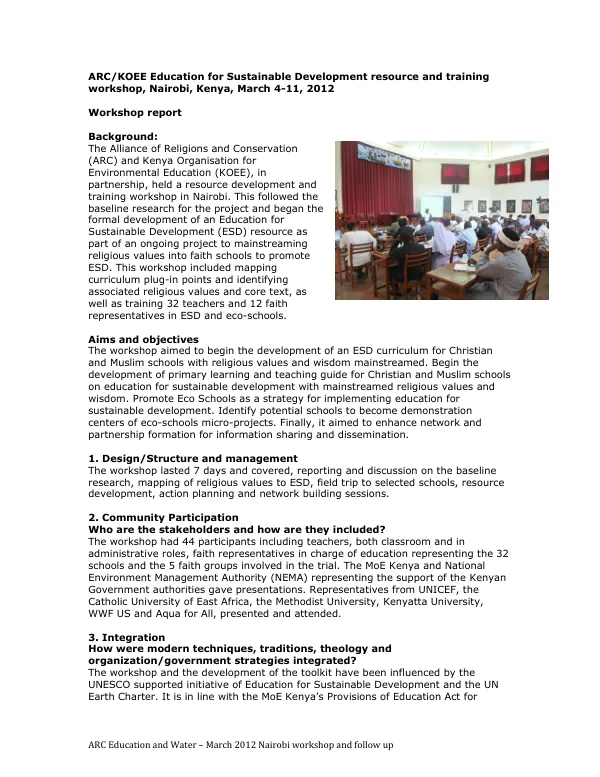
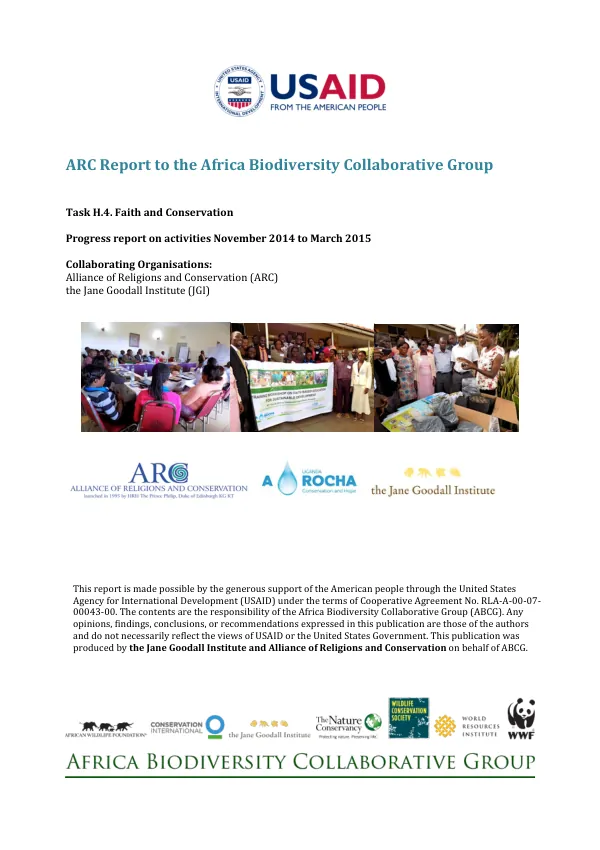
The project began in 2013 with the launch of the Faith-Based Education for Sustainable Development Teacher's Toolkit in Kenya. The toolkit was later taken to Tanzania and Uganda, where workshops were conducted with educationalists, teachers, government representatives, and faith leaders. The toolkit was developed in collaboration with the Jane Goodall Institute (JGI) and was showcased as an example of best practice at UNESCO's World Conference on Education for Sustainable Development (ESD) in Japan in 2014. The toolkit was also accredited as an approved text by the Kenya Institute of Curriculum Development. Following this, the Africa Biodiversity Collaborative Group (ABCG) agreed to support ARC, JGI, and ARC's partner A Rocha Uganda in undertaking further curriculum work and piloting the ESD Toolkit in Uganda. Eight faith-based schools in Kampala, Uganda, were identified to participate in the pilot program. A training workshop was held on March 30, 2015, at Namirembe Guesthouse, where 32 participants, including 14 teachers and five faith leaders, received training on Education for Sustainable Development (ESD) and the Faith-Based ESD Teacher's Toolkit. The workshop included presentations, group work, and exhibitions to fulfill workshop objectives. The eight school representatives were given time to report to their school authorities about the workshop and were asked to choose one eco-project under the guidance of A Rocha Uganda. The project aimed to start and work on the eco-projects throughout term 1. However, challenges were encountered, including limited time for implementation and difficulties in getting schools on board due to religious protocols. The Faith-Based ESD teacher's toolkit was reviewed by a curriculum expert recommended by the National Curriculum Development Centre (NCDC) in 2014. A positive report was received, and recommendations were made by the curriculum expert, which have since been implemented. The revised toolkit was reviewed by the NCDC in April 2015 and received a 78% mark out of 100%. The evaluator praised the toolkit for its alignment to the Ugandan curriculum, content, and level of language. Future steps include obtaining approval from the Quality Assurance Committee of NCDC. The Education Officer, JGI Uganda, has already met with the NCDC Environmental Education Coordinator to discuss approval of the Faith-Based ESD toolkit for its use by teachers in Uganda. Meanwhile, ongoing work in Kenya to develop a trainer-of-trainers guide will strengthen the use of the resource by faith groups. The project has successfully adapted the toolkit for use in Uganda and has strengthened relationships between faith-based organizations and conservation organizations. However, time constraints present some challenges, and work is still needed to consolidate the gains made thus far.