MINISTRY OF HEALTH
WWF Kiunga Marine National Reserve Conservation and Development Project
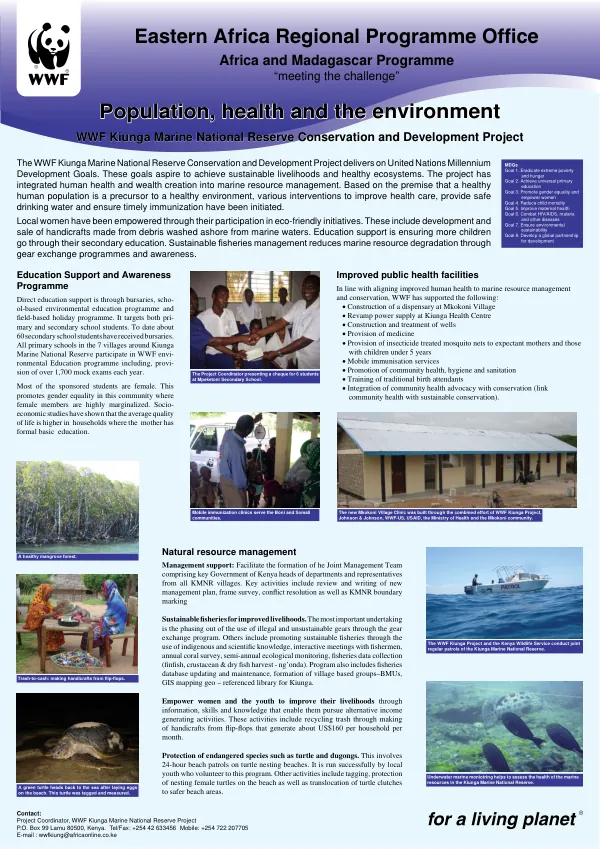
The WWF Kiunga Marine National Reserve Conservation and Development Project is a comprehensive initiative aimed at achieving sustainable livelihoods and healthy ecosystems in the Kiunga Marine National Reserve, Kenya.
1 pages
Sign in to readA free account is required to download.
Abstract
The project integrates human health and wealth creation into marine resource management, recognizing that a healthy human population is a precursor to a healthy environment. Various interventions have been initiated to improve healthcare, provide safe drinking water, and ensure timely immunization. Education support and awareness programs are a key component of the project, targeting both primary and secondary school students. Direct education support is provided through bursaries, school-based environmental education programs, and field-based holiday programs. To date, approximately 60 secondary school students have received bursaries, with most of the sponsored students being female. This promotes gender equality in the community, where female members are highly marginalized. Socioeconomic studies have shown that the average quality of life is higher in households where the mother has formal basic education. The project has also focused on improving public health facilities in the area. WWF has supported the construction of a dispensary at Mkokoni Village, revamp of power supply at Kiunga Health Centre, construction and treatment of wells, provision of medicine, and provision of insecticide-treated mosquito nets to expectant mothers and those with children under 5 years. Mobile immunization services have also been promoted, along with community health, hygiene, and sanitation. Training of traditional birth attendants and integration of community health advocacy with conservation have also been implemented. Natural resource management is another critical aspect of the project. Management support has been provided to facilitate the formation of the Joint Management Team, comprising key Government of Kenya heads of departments and representatives from all KMNR villages. Key activities include review and writing of a new management plan, frame survey, conflict resolution, and KMNR boundary marking. Sustainable fisheries management has also been promoted through the use of indigenous and scientific knowledge, interactive meetings with fishermen, annual coral survey, semi-annual ecological monitoring, and fisheries data collection. Empowerment of women and the youth is also a key objective of the project. Information, skills, and knowledge have been provided to enable them pursue alternative income-generating activities, such as recycling trash through making handicrafts from flip-flops, which generate approximately US$160 per household per month. Protection of endangered species, such as turtles and dugongs, has also been implemented through 24-hour beach patrols, tagging, protection of nesting female turtles, and translocation of turtle clutches to safer beach areas.
Related documents