DELOITTE CONSULTING, LLP
Armenia Improved Water Management for Sustainable Economic Growth Program
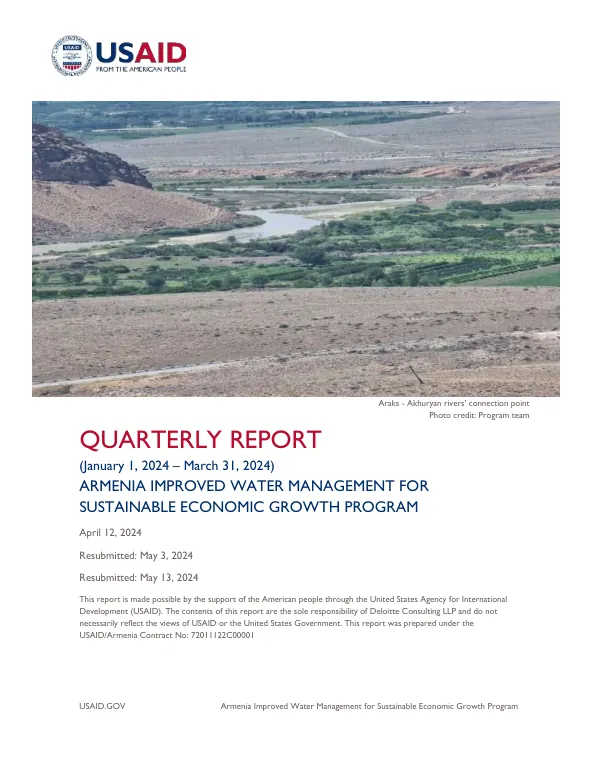
The Armenia Improved Water Management for Sustainable Economic Growth Program aims to strengthen Armenia's water management to improve the equity of access to water while maintaining water quality for the protection of freshwater resources.
2024 · 32 pages
Sign in to readA free account is required to download.
Abstract
The program is implemented by Deloitte Consulting LLP and is funded by the United States Agency for International Development (USAID). The program has five interlinked objectives: Objective 1, Application of Advanced Technologies and Tools to Support Sustainable and Secure Water Management; Objective 2, Improved Water Governance; Objective 3, Promote and Scale Best Practices and Innovative Approaches in Water Conservation and Use to Increase Equitable Access to Water Resources; Objective 4, Preparing for Regional Cooperation with Neighboring Countries; and Objective 5, Improved Access to Water. During the reporting period from January 1 through March 31, 2024, the program achieved several key milestones. Under Objective 1, the program signed a procurement contract to deliver monitoring equipment and training to upgrade Geghamavan monitoring post on Sevan-Hrazdan Canal and Tsovinar monitoring post on Arpa-Sevan Canal. The program also finalized the "Methodology for Determining the Degree of Load on Water Resources" and submitted it to USAID and presented it to the Ministry of Environment. Under Objective 2, the program prepared a public version of the Political Economy Analysis (PEA) report in English and Armenian and shared it with stakeholders. The program also developed a communication and dissemination package for the presentation of PEA for different groups of stakeholders to inform their activities and decisions. The program presented PEA findings to the Government of Armenia and the National Assembly. Under Objective 3, the program identified potential projects in line with Coca Cola Hellenic Bottling Company (CCHBC) requirements to be jointly implemented by both parties by introducing innovative technologies for water saving and conservation. The program conducted a review of international best practices and drafted a road map to guide the municipality to conduct an inventory of the needs for rehabilitation of Gyumri River. Under Objective 4, the program identified HMC transboundary water monitoring priorities in consultation with national partners, along with desk research conducted aimed at informing and preparing ROA for informed regional dialogue on transboundary water management. The program prepared a draft high-level analysis regarding the problems of water resources along the border with Azerbaijan, Turkey, and Georgia. Under Objective 5, the program selected a qualified bidder as a result of competitive procurement for construction works of a pumping station to modernize the irrigation system in Vazashen. The program finalized procurement of water metering units delivered for Khashtarak drinking water system. The program drafted Concept Level Designs (CLDs) for Tegh village irrigation and Lehvaz village drinking water supply projects. The program also conducted 3 orientations in Yerevan, Vayk, and Gyumri to inform and engage interested youth and women in respective Program activities, including in infrastructure development programs activities. The program worked with Goris community, supported predesign efforts for installation of a small hydro power plant (SHPP) as a technological extension of the Khndzoresk irrigation system. Notes on the pre-design were developed and shared with Austrian Development Agency (ADA) to support mobilization of funding. The program has made significant progress in achieving its objectives and has contributed to the improvement of water management in Armenia. The program's activities have focused on applying advanced technologies and tools, improving water governance, promoting best practices and innovative approaches, preparing for regional cooperation, and improving access to water. The program's achievements have been recognized by the Government of Armenia and the National Assembly, and the program continues to work towards its objectives.