USAID DEC
Artificial Intelligence and Machine Learning: An Alternative to Surveys to Determine Sanitation Service Levels
Sign inMICROSOFT CORPORATION
Artificial Intelligence and Machine Learning: An Alternative to Surveys to Determine Sanitation Service Levels
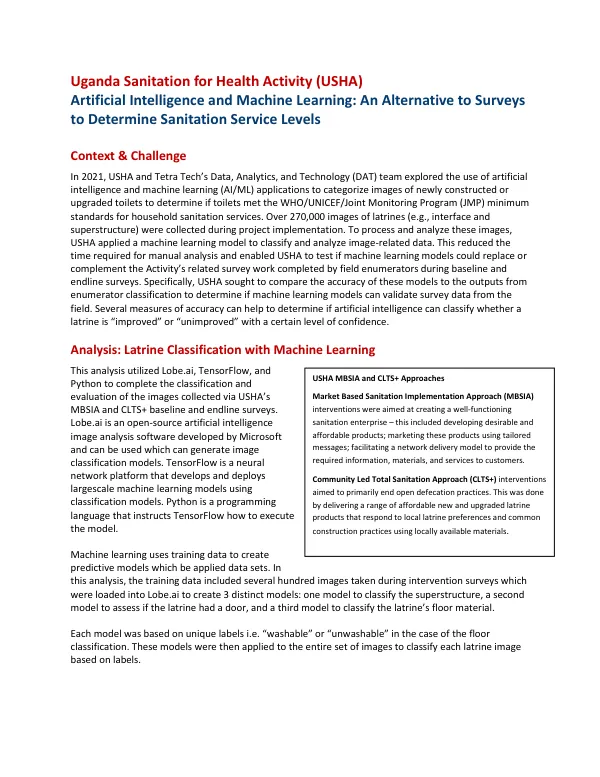
The use of artificial intelligence and machine learning (AI/ML) applications to determine sanitation service levels has been explored by the USAID Uganda Sanitation for Health Activity (USHA) in collaboration with Tetra Tech's Data, Analytics, and Technology (DAT) team.
2023 · 4 pages
Sign in to readA free account is required to download.
Abstract
In 2021, the team collected over 270,000 images of newly constructed or upgraded toilets to categorize them according to the WHO/UNICEF/Joint Monitoring Program (JMP) minimum standards for household sanitation services. The AI/ML model was applied to classify and analyze image-related data, reducing the time required for manual analysis and enabling USHA to test if machine learning models could replace or complement the Activity's related survey work completed by field enumerators during baseline and endline surveys. The model was trained using Lobe.ai, TensorFlow, and Python, and was used to classify images into three distinct categories: superstructure, door, and floor material. The analysis focused on the endline survey model results for the floor material, which is one of two key defining features used globally to assess the level of household sanitation services. Toilets with washable interface materials are considered improved facilities. The results showed that 36% of the total images were categorized as washable in the Northern Cluster, with 81% of the images having a high level of accuracy. In the Central East and Central West regions, 60% and 66% of the total images were categorized as washable, respectively, with 91% and 84% of the images having a high level of accuracy. The analysis also compared enumerator's classifications from the toilet image selection and their field data to see how closely they matched the model's classifications. The results showed that 70% of the classifications were a match for Central East, 76% for Central West, and only 46% for Northern Cluster. The Central East and West region's results demonstrated that a model like the one developed for this analysis could be used in place of enumerators or to complement their efforts. The lessons learned from this analysis include the importance of using clearer high-resolution images of toilet floor types, ensuring that the drop hole area of the latrine is not covered to avoid any obstructions of the ML models, and the use of ML & Image classification models to classify latrine types can save time and resources required to administer long surveys. Additionally, sanitation service surveys should further classify "unwashable floor" materials by durable smooth mud/mortar to ensure compliance with the JMP/WHO/UNICEF standards, especially in low-income communities such as Northern Uganda. The TensorFlow models for the Floor, Superstructure, and Door are publicly available on the USHA Google Drive, and the Python code and methodology used in this analysis are also available. This analysis demonstrates the potential of AI/ML to help classify sanitation service ladders for large-scale sanitation and hygiene projects with accuracy and high levels of confidence, and highlights the importance of further refining the model and clarifying the method of classification by enumerators to ensure consistency for classification purposes.