ENVIRONMENTAL INCENTIVES, LLC
Sustainable WASH Systems Learning Partnership Fact Sheet
Sustainable services remain a daunting challenge in the water, sanitation, and hygiene (WASH) sector.
2019 · 2 pages
Sign in to readA free account is required to download.
Abstract
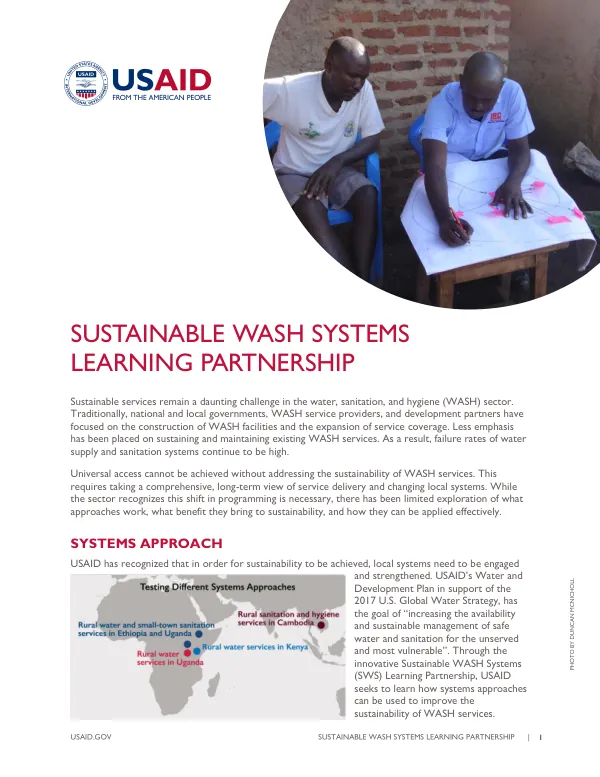
National and local governments, WASH service providers, and development partners have traditionally focused on the construction of WASH facilities and the expansion of service coverage, with less emphasis on sustaining and maintaining existing WASH services. As a result, failure rates of water supply and sanitation systems continue to be high. Universal access cannot be achieved without addressing the sustainability of WASH services, which requires taking a comprehensive, long-term view of service delivery and changing local systems. USAID has recognized that local systems need to be engaged and strengthened to achieve sustainability. The Water and Development Plan in support of the 2017 U.S. Global Water Strategy aims to increase the availability and sustainable management of safe water and sanitation for the unserved and most vulnerable. Through the Sustainable WASH Systems (SWS) Learning Partnership, USAID seeks to learn how systems approaches can be used to improve the sustainability of WASH services. A systems approach is defined as one that seeks to understand the complexity, interactions, and interdependencies between actors and factors through a deliberate, rigorous manner, acts based on this understanding, and regularly adapts to feedback and changing conditions. The SWS theory of change posits that if a WASH system is understood by the actors in that system, those actors will then use that understanding to work together to identify needs and priorities and implement activities to strengthen the system. A strengthened system for the delivery of WASH services will lead to an increased likelihood that these services will be sustained. In applying this theory of change, SWS teams use a deliberate, rigorous approach that includes engagements with key actors, systems mapping, and analysis tools. Tools such as social network analysis and iterative factor mapping and learning are used to examine relationships between actors in a bounded system and reveal the factors that influence sustainable WASH services and how those factors influence each other. SWS teams help identify needs and opportunities within the network of actors, design actions to address key factors and leverage points in the system, and foster local government ownership over their implementation. Specific areas of intervention include establishing common monitoring platforms to share information on services, models for preventative maintenance of water points and systems, and evaluations and analysis of physical and financial assets to inform improved management and regulation, financing, and institutional arrangements that support service provision. SWS's monitoring, evaluation, and learning process allows partners to generate evidence on the effectiveness and potential future applications of their approaches, with the dual purpose of fostering learning among local governments and actors to improve services and informing USAID, donors, and development partners of the effectiveness of systems approaches.