IRC
Kabarole District Pay-As-You-Fetch Research Report
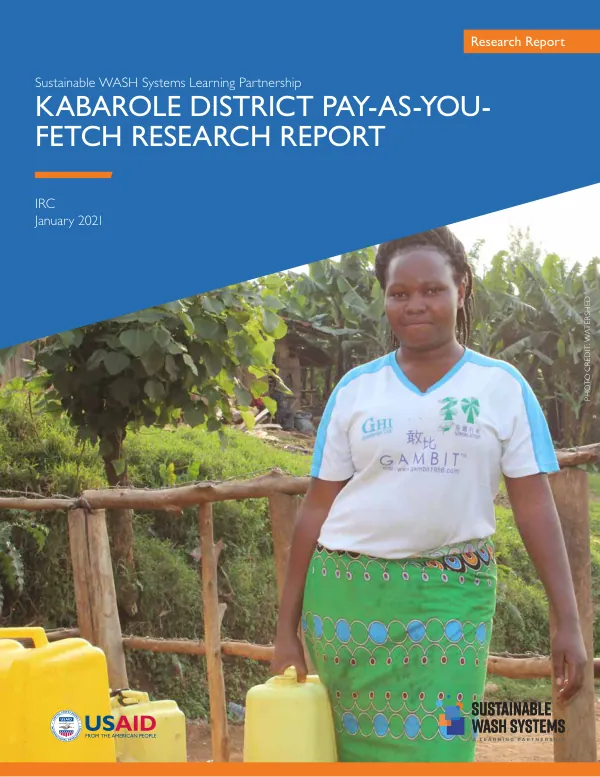
The Pay-As-You-Fetch (PAYF) model is a method for pre-payment of water where a caretaker or an operator of a hand pump collects money from users per unit of water they collect.
2021 · 61 pages
Sign in to readA free account is required to download.
Abstract
The revenue collected is used to maintain water systems and ensure water supply is reliable. The tariff set in the target communities ranged from 50 to 100 Ugandan shillings (UGX) per 20-liter container. Implementation of the PAYF model was piloted in 16 communities in Kabarole and Bunyangabu Districts in Uganda in 2016 by IRC Uganda and Kabarole district local government. The study investigated the factors leading to success or failure of the PAYF tariff collection model in these communities. The study also assessed if the PAYF model leads to any exclusion from water services in communities where the PAYF model is implemented. The study consisted of both quantitative and qualitative data collection techniques. The qualitative techniques included document review, focus group discussions with Water and Sanitation Committees (WSCs), and key informant interviews with local government staff at the district and sub-county level and caretakers at 16 PAYF pilot hand pumps. The quantitative techniques included a survey of 486 households in both PAYF and non-PAYF communities. A comparative analysis was then conducted on the following parameters: water supply, payment for water, affordability, exclusion, and preventive maintenance. Key findings from the study indicate that only 5 out of the 16 communities where the PAYF model was introduced have subsequently implemented the approach. In these communities, users have continued to pay for water and receive support from WSCs and the Hand Pump Mechanic Association (HPMA) to ensure that their water point remains functional. However, the implementation of the PAYF model did not incentivize preventive maintenance as had been envisaged during design of the pilot. WSCs and HPMA had not adopted a system for ensuring that preventive maintenance is consistently performed. The implementation of the PAYF model was negatively affected by challenges with the community-based management approach, including political influence discouraging users from paying, lack of transparency of WSCs, and dissatisfaction of water users with the performance of WSCs. Further, a lack of accountability in handling water user fees affected users' willingness to pay. WSCs identified several incidents where water user funds could not be accounted for after the transition of caretakers. Safe custody of funds was also a major concern that demotivated users whose committees had no bank accounts. The study also found that the willingness of water users to pay continues to be easily influenced by politicians at the local and national level. The community mobilization and set up of the relevant structures when introducing the PAYF model followed a consultative and participatory process that involved all relevant actors. The process focused on ensuring that target communities were sensitized on management of their hand pumps using PAYF. Local leaders, including area councilors and sub-county political and technical leaders, embraced the model from the start. The study's findings have implications for the implementation of the PAYF model in other communities. The results suggest that the model's success depends on the ability of WSCs and HPMA to adopt a system for ensuring consistent preventive maintenance. Additionally, the study highlights the need for improved accountability in handling water user fees and the importance of community mobilization and sensitization in the implementation of the PAYF model.