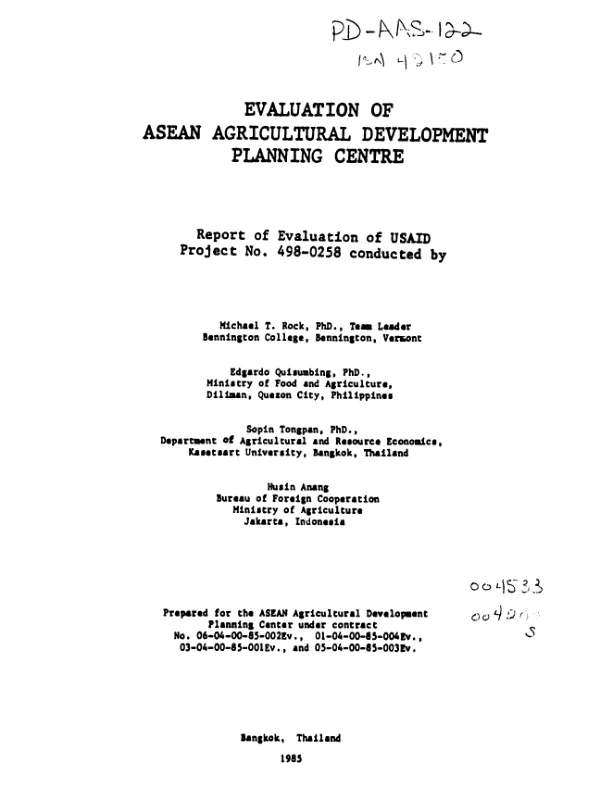
USAID. BUR. FOR PRIVATE ENTERPRISE. USAID/ASEAN REGIONAL DEVELOPMENT OFC.
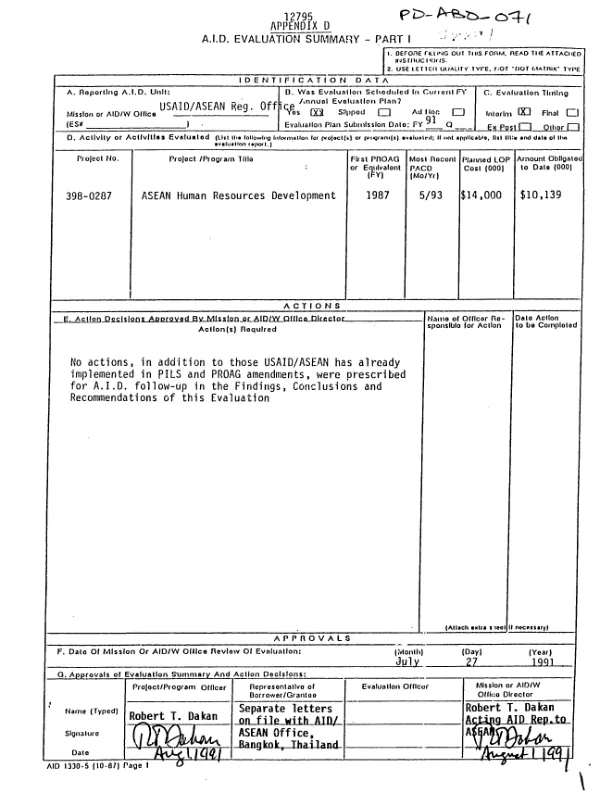
ASEAN human resources development
Summarizes interim evaluation (unattached) of a project to provide training and research support to four regional centers in member states of the Association of Southeast Asian Nations (ASEAN).
1991
Sign in to readA free account is required to download.
Abstract
The evaluation covered the period FY87-7/91. The project has made significant accomplishments in strengthening the following institutions: the Asian Institute of Technology (A.I.T.); the SEAMEO Tropical Medicine and Public Health Project (TROPMED); the ASEAN Agricultural Development Planning Center (ADPC); and the Plant Quarantine Center and Training Institute (PLANTI). ASEAN has acted as a coordinating agency. The A.I.T. subproject (SP) has performed well, and a 21-month extension has been granted to complete private sector training programs. No additional funding is contemplated. As A.I.T."s capacities for postgraduate engineering education and applied research have grown, so has its capacity to solicit contributions from public and private sources throughout Asia, Europe, and North America. As a result, A.I.D. financing, the principal external source at A.I.T."s inauguration in 1967, now makes up only 4.49% of external support. The TROPMED SP has conducted short- and long-term courses addressing the region"s changing public health priorities resulting from rapid urbanization and industrialization. The SP is also moving into environmental health concerns and plans to increase private sector participation in the preventive, rather than the curative side of occupational and urban health issues. TA and improved facilities will be required to implement this plan. The ASEAN ADPC has fulfilled training goals in short-term courses, as well as its M.S. programs. However, M.S. training is almost totally dependent on the faculty of Kasetsart University, since ASEAN support has been inadequate to develop ADPC"s own staff. PLANTI has begun expanding its research and training programs, which have enhanced its role and reputation in the ASEAN region as the focal point for plant quarantine. PLANTI has built a coordinated network of national plant quarantine services within the region and is extending its communications with those in other areas. Facilities and staff capabilities are impressive. Continued viability of PLANTI is assured, especially given its close connections with the University of Malaysia and the Malaysian Agricultural Research Center. ASEAN has not provided strong direction, guidance, or coordination to the regional centers, and, as a result, the centers are still viewed by the member states as national, rather than regional institutions. Moreover, because ASEAN national committees are responsible for the financial viabilities of the projects, there has been a reluctance to share recurrent and operational costs collectively. Among the lessons of this project are: (1) ASEAN provides a structure through which regional assistance can be channeled to supplement or supplant bilateral aid programs in Southeast Asia; (2) The ASEAN centers can serve as effective conduits of assistance to Cambodia, Vietnam, and Laos, as well as other nations outside ASEAN such as Bhutan, Myanmar, Outer Mongolia, and Papua New Guinea. (3) ASEAN should help the centers to play a larger role in supporting private sector activities.
Related documents