USAID DEC
Assessing Customary Land Tenure Institutions for Land Administration in Sandwe Chiefdom: Good Governance Perspective
Sign inTETRA TECH
Assessing Customary Land Tenure Institutions for Land Administration in Sandwe Chiefdom: Good Governance Perspective
The institutional framework in Zambia recognizes customary tenure, but presents a particular challenge to customary tenure institutions.
2017 · 27 pages
Sign in to readA free account is required to download.
Abstract
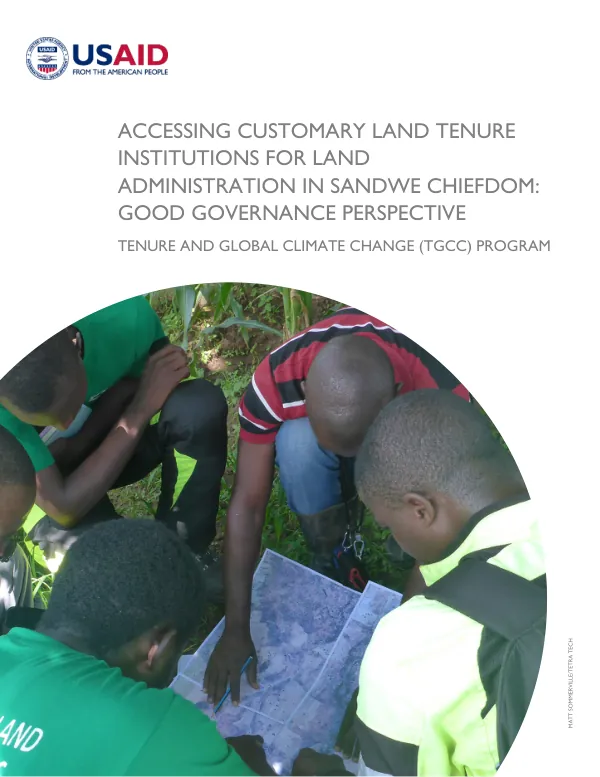
Customary institutions maintain their traditional power and social responsibility to allocate the rights to use land, resolve conflicts, and carry out overall management of customary land. In Sandwe Chiefdom of Eastern Province, Zambia, the majority of people in rural areas continue to rely on customary tenure arrangements for land delivery. The study assesses governance issues within customary land delivery and presents a framework for assessing customary tenure institutions for rural land governance. The assessment is based on four governance dimensions: efficiency and effectiveness in land delivery processes, equity in distribution and allocation of land resources, accountability of stewardship, participation of community members in land management activities, and decision-making, and transparency and access to information. In Sandwe Chiefdom, customary land tenure institutions face challenges in operating within the rapidly changing political and economic environment in Zambia. The state land administration institutions sometimes continue to operate side by side with indigenous community-based customary land tenure institutions, resulting in a major concern. The customary institutions maintain their traditional power and social responsibility to allocate the rights to use land, resolve conflicts, and carry out overall management of customary land. The study identifies that measures of efficiency and effectiveness in land delivery processes, equity in distribution and allocation of land resources, accountability of stewardship, participation of community members in land management activities, and decision-making, and transparency and access to information are essential to any complete assessment of good governance in customary land delivery processes. The assessment of customary tenure institutions in Sandwe Chiefdom highlights the need for a framework that addresses the challenges faced by customary institutions in operating within the existing formal legal system. The study area, Sandwe Chiefdom, is located in Eastern Province of Zambia, where the majority of people in rural areas continue to rely on customary tenure arrangements for land delivery. The customary institutions in the chiefdom maintain their traditional power and social responsibility to allocate the rights to use land, resolve conflicts, and carry out overall management of customary land. The study assesses governance issues within customary land delivery and presents a framework for assessing customary tenure institutions for rural land governance. The assessment is based on a literature review of customary tenure, land administration in Zambia, and good governance in customary land administration. The study also employs a research methodology that involves data collection through interviews with customary land tenure institutions and community members in Sandwe Chiefdom. The results of the study highlight the importance of transparency and access to information, participation of community members in land management activities, and decision-making, and accountability of stewardship in ensuring good governance in customary land delivery processes.
Related documents