USAID DEC
TARGETING COMMUNITY-LED TOTAL SANITATION (CLTS) TO FAVORABLE CONTEXTS: FACTORS CONTRIBUTING TO THE SUCCESS OF CLTS IN ZAMBIA
Sign inUSAID
TARGETING COMMUNITY-LED TOTAL SANITATION (CLTS) TO FAVORABLE CONTEXTS: FACTORS CONTRIBUTING TO THE SUCCESS OF CLTS IN ZAMBIA
The Zambia Sanitation and Hygiene Program (ZSHP) implemented Community-Led Total Sanitation (CLTS) in 9,017 villages from 2013 to 2018.
2021 · 5 pages
Sign in to readA free account is required to download.
Abstract
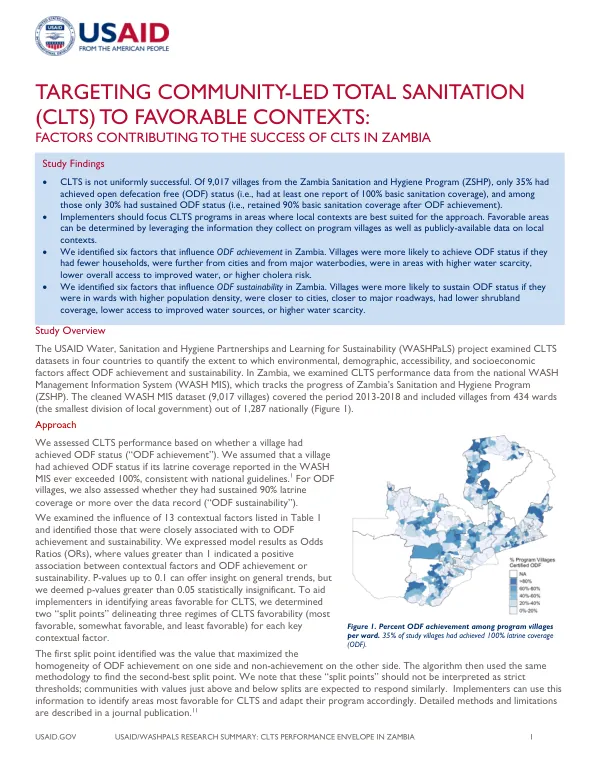
The program aimed to achieve open defecation free (ODF) status, where at least 100% of households have access to a latrine with a superstructure, a smooth/cleanable floor, a lid, and a handwashing device with soap/ash. CLTS performance metrics were used to assess ODF achievement and sustainability. ODF achievement was defined as a village ever achieving 100% toilet coverage, while ODF sustainability was defined as a village remaining above 90% toilet coverage following ODF achievement. The national ODF guidelines require no sign of open defecation and every household to have a latrine with a superstructure, a smooth/cleanable floor, a lid, and a handwashing device with soap/ash. The study identified six statistically significant contextual determinants of ODF achievement and six of ODF sustainability in Zambia. Villages were more likely to achieve ODF status if they had fewer households, had lower access to improved water sources, were further from cities and major waterbodies, had higher cholera risk or higher water scarcity. Villages were more likely to sustain ODF status if they had lower access to improved water, were located in wards with higher population density, had lower shrubland coverage in the immediate vicinity, were closer to major roadways and cities, and had higher water scarcity. The study found that smaller villages were more likely to achieve ODF status, with villages having fewer than approximately 32 households being the most favorable. In contrast, villages with more than approximately 75 households were least favorable, achieving ODF status in 19% of cases. Village size was not associated with ODF sustainability, indicating that the benefits of small villages may not translate to sustained behavior change. Both ODF achievement and sustainability were more likely in water-stressed villages with lower access to drinking water. Villages with no improved water source may be more motivated to build latrines and keep them functional, translating into higher ODF achievement and higher ODF sustainability. The study also found that CLTS was more successful in villages with higher water scarcity and located further from major waterbodies. ODF achievement was more likely in villages further from cities, but ODF sustainability was higher in more accessible areas. Villages further than 34 minutes from a city experienced 38% ODF achievement, while villages closer to cities only achieved ODF in 23% of cases. In contrast, ODF sustainability was higher in accessible areas characterized by a short distance to roads, short travel time to cities, and high population density. The study's findings suggest that CLTS programs should focus on areas where local contexts are best suited for the approach. Implementers can use the information collected on program villages and publicly available data on local contexts to identify areas most favorable for CLTS and adapt their program accordingly.
Related documents